C-17 Airdrop Operations — How Cargo and Troops Exit at 25,000 Feet
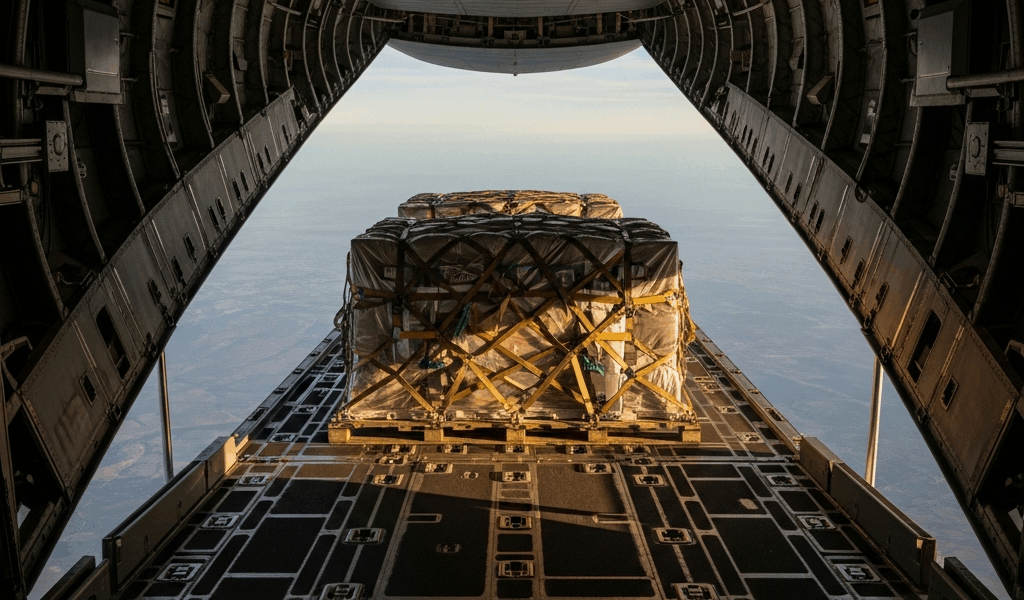
C-17 airdrop operations have gotten complicated with all the misconceptions flying around. As someone who spent enough time around the flight line at Joint Base Charleston to pick up a working obsession with cargo aircraft, I learned everything there is to know about what actually happens when a Globemaster III opens its ramp at altitude. Today, I will share it all with you.
The C-17 Globemaster III handles roughly 85% of U.S. military strategic airlift missions. Airdrop is central to that role — whether you’re putting paratroopers over a combat zone or yanking a Humvee out the back at 150 knots. The aircraft and crew have to get it exactly right. Every single time.
Types of C-17 Airdrop — From Paratroopers to Heavy Equipment
But what is a C-17 airdrop, really? In essence, it’s a controlled delivery of personnel or cargo from a moving aircraft at altitude. But it’s much more than that — it’s a category of operations spanning half a dozen distinct methods, each with its own physics, its own equipment stack, and its own ways to go catastrophically wrong.
Static-line jumps are the traditional method. Paratroopers hook a static line to the anchor cable running the length of the cargo compartment, step off the rear ramp, and their parachutes deploy automatically as the line goes taut. The aircraft typically flies at 1,000 to 1,500 feet and 130 knots. Low and slow, by aviation standards.
HALO and HAHO jumps are different animals entirely. Free-fall jumpers exit at altitudes between 25,000 and 35,000 feet carrying oxygen systems and altitude-rated gear. HALO — High Altitude Low Opening — means deploying below 5,000 feet after a long free fall. HAHO — High Altitude High Opening — means pulling the chute almost immediately and gliding, sometimes 20 or 30 miles, to a target the enemy never saw coming.
Container Delivery System drops handle cargo. Pallets rigged to parachutes rated for their weight slide off the ramp and float down. A standard CDS pallet tops out around 2,200 pounds and deploys a 35-foot diameter parachute. Straightforward in concept. Anything but in practice.
Heavy equipment extraction is where things get visually dramatic — probably should have opened with this section, honestly, since it’s the operation everyone pictures first. A Humvee, strapped to a steel platform, gets yanked out the back of a moving aircraft by a parachute. We’ll get into exactly how that works.
How Heavy Equipment Extraction Works
The platform itself is a steel frame, roughly 22 feet long and 8 feet wide, that sits flush with the cargo floor on roller systems. Empty, a standard Humvee extraction platform weighs around 4,000 pounds. Vehicles are secured using tie-down chains rated for the extraction forces — forces that will exceed 4 Gs when that chute pops.
The extraction parachute system starts small. A 7-foot pilot chute deploys first, catching air and pulling the main extraction chute from its container. That main chute — typically a 100-foot diameter flat circular parachute — inflates and jerks the entire platform and vehicle out the rear of the aircraft. The loadmaster triggers the sequence. The window to get it right is measured in seconds.
The physics here is brutal. The aircraft is carrying airspeed; the cargo experiences sudden deceleration the moment that extraction chute catches air. Steel suspension cables and shock struts in the platform cradle the vehicle frame and absorb the impact. Once clear of the aircraft, the extraction parachute is jettisoned and the cargo chute — usually a 64-foot diameter main — deploys for the actual descent.
The vehicle hits the ground at roughly 20 feet per second. That’s a hard landing. Survivable for equipment, and historically survivable for trained personnel who’ve ridden rigged vehicles down during testing. I wouldn’t volunteer for it. Don’t make my mistake of romanticizing what that landing actually feels like — talk to anyone who’s been on a drop zone when a platform comes in and you’ll recalibrate fast.
High Altitude Airdrop — HALO and HAHO from a C-17
High altitude operations require a different level of preparation. The aircraft climbs to 25,000 or 35,000 feet — temperatures at those altitudes run minus 50 degrees Fahrenheit or colder — and holds that altitude while jumpers rig up. The air has roughly one-third the oxygen content of what you’re breathing right now. Oxygen masks aren’t optional.
HALO jumpers wear insulated clothing, sometimes pressure suits, and carry altimeters because visual ground reference disappears completely up there. They don’t use the door. They exit from the rear cargo ramp at controlled intervals — usually 5 to 10 seconds apart — to prevent mid-air collisions during the free-fall phase.
The loadmaster confirms every jumper is properly equipped before anyone goes near that ramp. Oxygen systems functioning. Main and reserve parachutes positioned correctly. Static lines or ripcords accessible. Mistakes at 30,000 feet don’t get corrected mid-jump. That’s the reality of this work — the loadmaster’s pre-jump inspection is the last line of defense before physics takes over.
HAHO jumps involve deploying canopies almost immediately after exit — within a few seconds of leaving the ramp at 24,000 or 25,000 feet. Modern HAHO parachutes are rectangular, steerable systems. They glide. Jumpers navigate under canopy for 30 to 45 minutes sometimes, drifting miles from the actual drop zone, descending to a target that radar never flagged because the aircraft was never overhead. That’s what makes HAHO endearing to special operations planners — the aircraft and the objective can be 20 miles apart.
Oxygen requirements for HAHO are intense. Jumpers need supplemental oxygen from exit until they descend below 10,000 feet. The loadmaster tracks oxygen consumption, checks regulators before exit, and confirms backup systems are available. I’m apparently someone who notices these logistics details obsessively, and watching a loadmaster run that pre-jump oxygen check — systematic, unhurried, thorough — never stops being impressive.
The Loadmaster Role in Airdrop
The loadmaster is the mission specialist. Trained through a pipeline that runs through Lackland Air Force Base and a handful of equivalent facilities, a qualified loadmaster understands weight distribution, rigging procedures, extraction sequences, and emergency protocols in a way that takes years to build.
Hours before takeoff, the loadmaster is inspecting straps. Every parachute. Every rigging point. They’re calculating weight and balance — the aircraft’s center of gravity has to stay within published limits the entire flight, including during extraction when a 4,000-pound platform slides aft and the balance equation changes in real time. For a 2,400-pound pallet drop, the loadmaster has already done that math and confirmed it twice.
During flight, the loadmaster monitors cargo movement, communicates with pilots via intercom, watches for equipment failures, and runs the jumper equipment checks for static-line operations. Helmet secure. Reserve chute visible and accessible. Static line attached correctly to the anchor cable. They physically inspect every jumper’s rig — not a visual scan, a hands-on inspection.
I learned the hard way that loadmasters catch mistakes everyone else misses. One extraction operation I was observing got flagged before the aircraft ever taxied — a loadmaster spotted a visibly cracked extraction chute connector during platform assembly inspection. The loading crew had missed it. That crack, under extraction forces, would have meant a failed deployment and a 4,000-pound platform dropping free from a moving aircraft. That loadmaster prevented a catastrophic failure with a visual inspection that took maybe 45 seconds.
The loadmaster also holds safety authority. They’ll halt an operation if winds exceed limits, if the drop zone is occupied, if aircraft systems malfunction. Pilots appreciate loadmasters who prioritize the mission over schedule pressure — and the good ones always do.
Joint Precision Airdrop System (JPADS)
JPADS has gotten complicated with all the hype flying around it, so let’s be precise about what it actually does. Traditional parachute drops scatter cargo — a circular error probable of 300 to 500 meters was historically considered acceptable. JPADS lands cargo within 50 meters of a GPS-targeted coordinate. That’s not incremental improvement. That’s a different category of capability.
The system uses a steerable parachute canopy fitted with a guidance unit — GPS receiver, onboard computer, steering actuators. The computer compares current position to target coordinates throughout the descent and commands canopy adjustments to steer toward the target. From the loadmaster’s perspective, the drop sequence looks nearly identical to a standard CDS operation. The pallet is rigged, the parachute pack includes the guidance unit, and the drop proceeds normally. The difference lands on the ground.
Supplies can be delivered to forward operating bases, isolated outposts, humanitarian operations — locations where a 400-meter scatter pattern would mean cargo landing in contested terrain or in someone’s living room. JPADS changed the calculus for those scenarios significantly.
The system isn’t foolproof, though. GPS degradation near mountainous terrain or urban structures degrades accuracy. Wind shear at lower altitudes can push the guidance system past its compensation limits. First, you should understand those constraints — at least if you’re planning operations in environments where terrain masking is a factor. But for the majority of operational scenarios, JPADS has transformed what airdrop logistics can actually deliver.
So, without further ado, here’s the bottom line: C-17 airdrop operations blend mechanical engineering, procedural discipline, and human judgment in ways that don’t reduce to a simple checklist. The loadmaster orchestrates it all — the person who ensures a Humvee lands intact five miles forward of a convoy, or that paratroopers exit in tight formation over a contested drop zone. That expertise, built over years of flight-line work and hard-earned inspections, remains the center of gravity for strategic airlift capability.

Subscribe for Updates
Get the latest c-17 pilot updates delivered to your inbox.
We respect your privacy. Unsubscribe anytime.