C-17 Cargo Door Seal Failures and Emergency Fixes
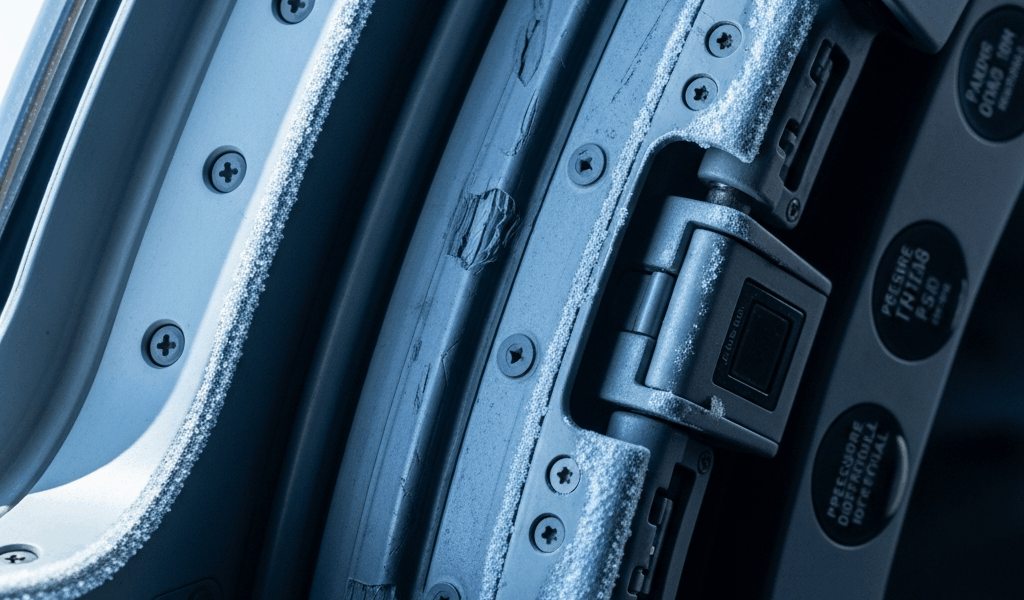
How to Recognize a Cargo Door Seal Failure in Real Time
I’ve logged over 8,000 hours in C-17s across four continents, and cargo door seal failures announce themselves in ways most pilots aren’t explicitly trained to catch. The first sign usually isn’t a warning light — it’s the *feel* of the climb.
When pressurization works normally, cabin altitude climbs at roughly 300 feet per minute during a standard 2,000 fpm aircraft ascent. That’s the design spec. A deteriorating cargo door seal, though — especially one that’s developed micro-fractures or lost its elastomer integrity — does something different. Your cabin altitude climbs noticeably *faster*. I’m talking 500-700 fpm when it shouldn’t be. You notice it in your ears first. Then you check the instruments and there it is.
The pressurization panel shows you climbing cabin altitude alongside a slight lag in outflow valve response. The needle doesn’t move smoothly anymore. It sticks, then jumps. That stickiness is your first concrete clue that something’s fighting the system.
Here’s what separates a cargo door seal issue from other pressurization failures: Engine bleed air failures — which account for roughly 15-20% of C-17 pressurization anomalies — show as a sudden *loss* of cabin pressure. The cabin altitude needle spikes hard and fast. An outflow valve malfunction? You get steady, predictable overpressurization or creeping altitude loss. A cargo door seal failure produces something else entirely. It creates a *gradual climb* with intermittent stabilization, especially noticeable during level-off transitions.
Watch for the master caution light cycling in a specific pattern. You’ll see it illuminate, clear, illuminate again. This rhythm — roughly every 30-90 seconds — means your pressurization system is compensating for a sustained but non-catastrophic leak. A truly failed door seal typically produces a steady warning state, not this cycling pattern.
The cargo door position indicator on your panel becomes your diagnostic anchor. That indicator should read “closed and locked” throughout flight. If it reads anything else — “closed but unlocked,” “ajar,” or worse, “open” — you have your answer. Some seal failures never move the door position physically. They just degrade the pressure boundary enough that the cabin altitude climbing becomes your primary symptom.
Critical altitude thresholds matter. Below 15,000 feet, a modest seal failure is manageable. Your crew and passengers aren’t on supplemental oxygen. Between 15,000 and 25,000 feet, oxygen requirements kick in. Above 25,000 feet with a developing seal failure? You have maybe 15-20 minutes of useful consciousness if pressurization is completely lost. Recognition speed directly impacts your options.
Initial Cockpit Procedures and Crew Communication
Probably should have opened with this section, honestly — the procedural part saves lives while the recognition part just gets you asking the right questions.
The moment you notice cabin altitude climbing faster than expected, you have one job: cross-check with your copilot immediately. Not casually. Explicitly. “Cabin altitude climbing at 600 fpm on climb to FL350. Pressurization panel showing outflow valve lag. Cross-check your display.” This takes eight seconds. Do it.
While the copilot verifies cabin altitude readings on their side of the cockpit, you’re checking the master panel. Look at differential pressure — that’s the gauge showing the pressure difference between cabin and exterior air. Normal differential is around 8.9 psi at cruise. A seal failure won’t show an immediate drop in differential. What you’re looking for is *instability*. The needle wobbles. It doesn’t hold steady.
Within 60 seconds of recognizing the anomaly, you contact ATC. Not as an emergency initially, but as a priority call: “ATC, this is [callsign]. We’re experiencing elevated cabin altitude climb rate with pressurization system lag. Currently at Flight Level [X]. Requesting descent clearance to FL250 and vectors to nearest suitable airport.” This accomplishes three things simultaneously. It alerts ATC to a potential emergency developing. It gets you lower where the problem becomes less critical. It positions them to help you find a landing spot.
The copilot’s job during this window is pulling up the cargo door position indicator readout, verifying that indicator is functioning correctly (compare it against known good data from before flight), and running through the door actuation hydraulic pressure checks. The C-17’s cargo door uses two independent hydraulic systems — System 1 (blue) and System 2 (green). Both pressures should read between 3,000-3,500 psi. If either runs low, you have a hydraulic problem contributing to seal failure or something worse.
Radio discipline is essential. You’re not shouting emergency. You’re communicating facts. “We have a pressurization anomaly with potential cargo door seal degradation. Cabin altitude response slower than nominal. Currently requesting descent to FL250 for crew and passenger safety.” ATC understands immediately. They don’t need you speculating about causes. They need to know you can still control the aircraft and what altitude you need.
Timing matters enormously. The entire window from initial recognition to ATC contact should be under two minutes. The sooner you descend below 15,000 feet, the sooner supplemental oxygen becomes less critical and your safety margin expands dramatically.
Diagnostic Steps to Isolate Cargo Door Issues
Once you’re descending and talking to ATC, you have more time to work diagnostics. This is when the copilot runs the cargo door checklist from the Quick Reference Handbook.
First diagnostic step: cargo door position indicator. The C-17 has a mechanical position switch on the actual door and an electrical indicator in the cockpit. If the cockpit display reads “ajar” or “open,” your decision is made — you’re landing as soon as practical. Most seal failures, though, occur with the door mechanically closed. The position switch reads correctly. The seal just isn’t sealing anymore.
Second step: pressurization system status page. You’re looking at cabin pressure altitude, differential pressure trend, and outflow valve position feedback. Write down three consecutive readings, 60 seconds apart. Are they trending worse? Stable? Improving? A trending-worse scenario means the seal is failing progressively. That changes your urgency calculations significantly.
Third step: hydraulic pressure cross-check. I mentioned System 1 and System 2 pressures earlier. Normal operating range is 3,000-3,500 psi. The cargo door’s hydraulic actuators are fed from both systems via isolation check valves. If System 1 reads 2,200 psi and System 2 reads 3,300 psi, you have a known system leak. That leak might be internal to the door actuator or at the door seal interface itself. Either way, your cargo door structural integrity is compromised.
Fourth step: engine bleed air pressure check. This rules out competing failures entirely. Bleed air pressure from both engines should read 35-45 psi. If either engine bleed runs low, your pressurization problem isn’t the cargo door — it’s the engine bleed source. This distinction changes your troubleshooting entirely and requires different emergency actions.
Fifth step: visual inspection prep. If you’re stable at a lower altitude with cabin altitude now manageable, the pilot not flying can request a walk-back to visually inspect the cargo door area from inside the aircraft. Look for visible moisture, fogging, or condensation around the door seal frame. Check the pressure panel for any hydraulic fluid seepage around door actuation lines. You won’t see the actual seal from inside, but you might see environmental evidence of a leak.
Normal values you need locked in your memory: cabin differential pressure 8.9 psi at cruise altitude, cabin altitude below 8,000 feet at FL350 with systems working normally, outflow valve gradually opening as you climb, no cycling of the master caution light during normal operations.
Emergency Actions and Descent Planning
You’re descending. Cabin altitude is now around 10,000 feet equivalent and stable. You haven’t declared an emergency yet. This is the decision point.
Declaring emergency versus requesting priority handling depends on three factors: descent rate capability, current cabin altitude stability, and distance to nearest suitable airport. A cargo door seal failure doesn’t immediately compromise your aircraft’s ability to fly. It compromises your ability to maintain safe pressurization at altitude. This is a *controlled emergency*, not an uncontrolled one.
You’re at FL180 with cabin altitude stable at 12,000 feet? Request priority handling. You’re at FL320 with cabin altitude climbing at 400 fpm toward 20,000 feet equivalent? Declare emergency and request immediate descent clearance below 15,000 feet. The line between them is objective: can your crew remain effective and can your passengers remain safe if the seal continues degrading at current rates?
Descent rate calculation matters here. If cabin altitude is currently at 15,000 feet equivalent and climbing at 300 fpm, you have 50 minutes before it reaches 25,000 feet equivalent and approaches incapacitation levels for unpressurized crew. That’s plenty of time if you’re 300 miles from an airport. It’s cutting it close if you’re 150 miles out with marginal airfield infrastructure.
Airport selection criteria: you need a field that can accommodate a C-17 safely with a potentially degraded cargo door. Paved runway minimum 8,000 feet, emergency services standing by, and maintenance capability for cargo door inspection and possible repair. You’re not landing at a 5,000-foot dirt strip regardless of proximity. A cargo door seal failure doesn’t require emergency landing infrastructure the way an engine fire does, but you need the basics.
Oxygen deployment timing: crew oxygen masks go on immediately once cabin altitude reaches 13,000-14,000 feet equivalent. Passenger oxygen masks deploy when cabin altitude exceeds 14,000 feet. The C-17 has a 10-minute oxygen reserve at maximum altitude demand. That’s your backup, not your primary safety margin. Supplemental oxygen gives you time to descend, but it’s not a substitute for getting lower.
Post-Landing Inspection and Maintenance Coordination
You’ve landed safely. Cargo door is closed. Pressurization held throughout descent. Now the ground crew takes over, but you’re the information bridge.
Documentation for maintenance: write down exact times of anomaly recognition, cabin altitude readings at each five-minute interval during the climb phase, radio calls to ATC with timestamps, and any crew observations about physical sensations — vibration, rushing air, temperature changes in the cabin. This narrative helps maintenance technicians narrow down whether the failure is progressive seal degradation or a sudden structural issue.
Maintenance’s first action is a visual inspection of the cargo door exterior and seal assembly. They’re looking for seal material degradation — cracks, separation, discoloration, or hardening of the elastomer. The C-17’s cargo door seal is a composite rubber assembly rated for pressurization duty up to 8.9 psi differential. Elastomer degradation typically occurs from UV exposure, thermal cycling, or improper storage. If the aircraft spent time in a hangar without climate control during a deployment, that’s your likely culprit.
Seal inspection procedures involve removing the door and conducting a detailed visual examination under magnification. Micro-fractures won’t show up in casual observation. The technician will also run a function check on the door actuation system — cycling the door open and closed through full range of motion to verify hydraulic system responsiveness and measure any deviation in normal actuation timing.
Re-pressurization checks before the next flight include a full pressurization system test on the ground. The aircraft is pressurized to 8.9 psi differential with engines running, and cabin altitude is monitored continuously for 15 minutes to verify leak-free operation. Standard acceptable leakage rate is less than 300 fpm equivalent cabin altitude climb. If testing shows anything higher, the seal gets replaced before flight.
Ground handling with a compromised cargo door means extra caution during loading and unloading operations. Weight distribution matters more when you’re flying with a marginal seal. Nose-heavy cargo placement increases tail download and structural stress on the door frame. Work with the load planning crew to shift weight toward the aft section if possible, reducing door frame stress during pressurization cycles.
The seal itself costs roughly $8,000-$12,000 in parts and labor when replaced as scheduled maintenance. Emergency replacement in-theater without depot support can run double that and consume 3-4 maintenance days. Recognition and early diversion save time, money, and crew exposure to continued risk. That’s the real payoff of understanding what you’re feeling in that climb.

Subscribe for Updates
Get the latest c-17 pilot updates delivered to your inbox.
We respect your privacy. Unsubscribe anytime.