C-17 Hydraulic System Failures and Emergency Procedures
“`html
The Three Hydraulic Systems and Failure Signatures
The C-17 carries three independent hydraulic systems—A, B, and C—because the Air Force learned decades ago that redundancy saves lives. I’ve spent 8,000 hours in the left seat of this aircraft, and honestly, understanding what each system actually powers is the difference between a controlled descent and a catastrophic loss of control authority.
System A pressurizes to 4,000 PSI and feeds the flight control surfaces—ailerons, elevators, and rudder. It’s the backbone of pitch, roll, and yaw. System B runs the nose gear steering, main gear extension and retraction, and the wheel brakes. System C backs up the landing gear and provides auxiliary power to flight controls if both A and B fail simultaneously. Each system has its own pump, reservoir, and electrical motor — they’re physically separated. This matters because a catastrophic leak in System A doesn’t automatically drain System B.
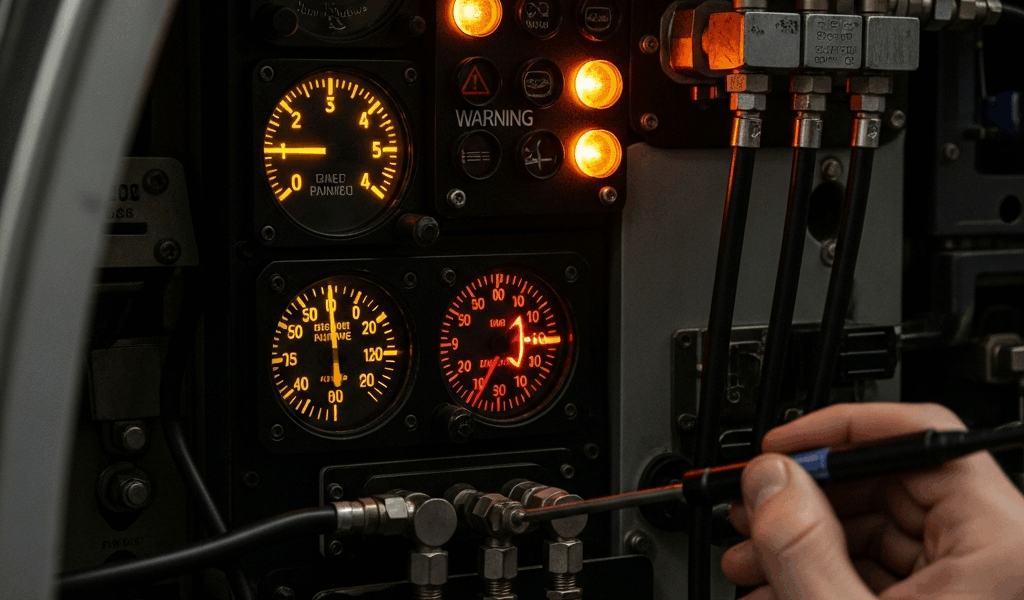
Here’s where pilots get complacent: the warning lights. The overhead panel has four primary gauges. System A pressure reads on one with a green arc between 3,000 and 4,500 PSI. System B has its own. System C sits below them. You’ll also see accumulator pressure indicators—these are pressurized nitrogen spheres that store hydraulic energy for emergency procedures. When one of these gauges dips below 2,500 PSI, you’re in degraded status. Below 2,000 PSI, you need to land.
The warning lights are color-coded amber for caution (degradation occurring) and red for failure (you’ve lost system redundancy). I learned this the hard way during a training sortie in 2019 when I ignored an amber light for thirty seconds, convinced it was a sensor malfunction. It wasn’t.
Early Warning Signs Pilots Often Miss
Soft hydraulic failures announce themselves quietly. You won’t get a bang or a shudder — you get whispers.
The first whisper is sluggish control response. The stick takes half a second longer to bite than normal. Your pitch rate decreases by 5 degrees per second. The autopilot compensates automatically, so you might not notice immediately. Situational awareness fails here. I’ve watched copilots fly the entire approach phase without realizing System A pressure was dropping from 4,000 to 3,200 PSI.
The second whisper? Unusual pump noise. The hydraulic pump in the engine bay produces a distinct whine—about 65 decibels in the cockpit under normal conditions. When internal seals begin to degrade, the pump works harder to maintain pressure. That whine becomes a screech. It’s audible over the intercom. Most copilots don’t know what they’re listening for, so they report “weird engine sound” to maintenance, and three days later the system fails completely during a mission.
Slow gear extension is the third indicator — normal main gear deployment takes eight seconds from the moment you lower the handle. Degraded System B? Twelve seconds. Fourteen seconds. The green gear-down light still illuminates eventually, but the delay tells you something is wrong. I’ve seen pilots ignore this because the gear technically locked down. Probably should have opened with this section, honestly—it’s the most common missed signal.
Here’s the troubleshooting fork: Is it electrical or hydraulic? Toggle the system A/B/C selector switch on the overhead panel. If pressure jumps back to green, you have an electrical distribution issue, not a pump failure. If pressure stays low, the pump itself is degrading or there’s an internal leak. These require different emergency responses.
Fluid color and smell provide additional clues. Healthy hydraulic fluid is translucent amber—like weak tea. Degraded fluid turns dark brown or nearly black. Smell it during preflight if you’re suspicious. Scorched fluid smells like burnt rubber. Contaminated fluid smells like rust and moisture.
Emergency Procedures by Failure Type
Single System Loss
You lose System A mid-flight. Immediately, the amber light illuminates. Your first action is verify the failure on the gauge—not the light. Lights lie. Gauges tell you numbers.
If System A pressure reads zero and remains zero for ten seconds, it’s a real failure. Switch to manual flight control. Disengage the autopilot. The aircraft will fly with Systems B and C backing up flight control authority, but you lose redundancy. You now have one failure between control and a ditch.
Declare the failure to ATC immediately: “Tower, [callsign], we’re declaring a Level One hydraulic emergency. System A failure confirmed. Request vectors to nearest suitable airfield.” Don’t phrase it as a question. Phrase it as a statement. Controllers respect decisiveness.
Continue flight. Maintain altitude and speed. Flight control response will be sluggish but present. Land at the nearest airfield with a runway of at least 10,000 feet. Approach normally. On short final, be aware that System B brakes may not have full modulation—you might experience grab-and-release behavior during wheel braking. Pump the brakes gently. Use the reversers for additional stopping distance.
Dual System Loss
This is where decisions become genuinely critical. You’ve lost both Systems A and B. Only System C remains, and it cannot power flight controls and landing gear simultaneously. You must choose: control authority or the ability to extend gear.
Extend the landing gear immediately using System C. Use every ounce of hydraulic pressure in that system to get three green lights. Once gear is down and locked, System C is depleted. You now have manual flight control only—and it’s extremely heavy. Elevator response takes serious physical force. The aircraft will fly, but barely.
Get on the radio. “Mayday, mayday, mayday. [Callsign]. Dual hydraulic system failure. Landing gear down. Flying on manual control only. Request emergency services standing by.” That “mayday” is not optional. You’ve lost all redundancy and entered a time-critical descent.
Locate an airfield with emergency equipment—a barrier system, arresting gear, or simply long runway space. The C-17 can land safely with manual control alone, but you need margin. Approach at reduced speed. Reduce power early. Begin descent at 300 feet per minute or less. Touchdown will be firm, but the aircraft is designed for it.
Total System Loss
Three red lights. All systems gone. This is beyond rare—I’ve never experienced it in actual flight, and only seen it once in a full-motion simulator. But the procedure exists.
You have emergency accumulator pressure. This is a nitrogen-pressurized sphere that stores about 3,000 PSI of hydraulic energy. It provides one single use of either flight control authority or gear extension. Choose wisely. You cannot do both.
If you’re at altitude with runway distance ahead, use the accumulator to extend gear. Then glide to landing on manual control—no hydraulics available. If you’re already configured for approach and landing gear is already down, use the accumulator to maintain control authority for the final minutes of descent. Land with whatever gear position you have.
Declare emergency. Request fire trucks, medical standby, and crash equipment. This landing may not be survivable. Modern C-17s are built tough, but total hydraulic failure is a cascading catastrophe.
When to Declare Emergency and Divert
The decision tree is simple, not because hydraulics are simple, but because the Air Force has already thought through every scenario.
Single system loss with runway distance remaining and an alternate airfield available? No emergency declaration required. Land within thirty minutes at your current destination or nearest alternate. No diversion necessary unless your destination has fewer than 10,000 feet of runway.
Single system loss with current runway below 8,000 feet means declare Level Two emergency. Request diversion to airfield with 12,000+ feet. Weather minimums remain standard—you can still land in 500-foot ceilings and 1-mile visibility because flight control authority is present, just reduced.
Dual system loss requires Level One emergency declaration immediately. Request nearest suitable airfield. Disregard your original mission. Weather minimums tighten—you need at least 1,000-foot ceiling and 2-mile visibility because manual control requires visual reference for flare and touchdown.
Total system loss means declare mayday. Request emergency airfield with crash equipment. Weather minimums are lowest ceiling and visibility you can legally attempt—often 200 feet and half-mile—because you have no control options remaining. Only attempt landing if terrain allows stable descent angle.
Runway length is non-negotiable. The C-17 needs 10,000 feet for normal landing. With single system loss, 12,000 feet minimum. With dual system loss, 14,000 feet. With manual control only, you lose about 30 percent of normal braking effectiveness. Barrier systems, if available, add 2,000 feet of stopping capability.
Maintenance Red Flags Between Flights
Post-flight troubleshooting catches failures before they compound. I’ve prevented three genuine emergencies through conscientious logbook notation and maintenance coordination.
After each flight, record all hydraulic system pressures at the end of flight. If System A showed 3,800 PSI on today’s flight and 3,400 PSI on yesterday’s flight, that’s a 400-PSI drop in 24 hours. Ground the aircraft. Order a system inspection. Don’t wait for the next flight.
Fluid color checks are quick and critical. Open each system’s reservoir cap—they’re located on the upper fuselage. Dip a white cloth into the fluid. Healthy fluid transfers as translucent amber. Dark brown fluid means oxidation has begun. Black fluid means contamination or internal component failure is advanced. Replace the fluid immediately.
Fluid smell during these checks is equally important. Fresh hydraulic fluid smells like oil. Degraded fluid smells like scorched rubber or burnt electrical components. This smell indicates high internal heat—usually from mechanical friction from failing seals or contaminated fluid particles grinding against pump internals.
Pressure bleed tests, performed by maintenance technicians using hydraulic test carts, should be logged quarterly. Each system should hold 4,000 PSI for at least 30 minutes without loss. If pressure bleeds below 3,800 PSI during a 30-minute hold, an internal seal has degraded. Schedule overhaul.
Finally, accumulator pressure checks are essential before any cross-country flight. Accumulators pressurize to 1,600 PSI of nitrogen gas. This is measured with a dry gauge—moisture will contaminate the sphere. If accumulator pressure drops below 1,400 PSI, emergency procedures are compromised. Request maintenance action before flight release.
These checks take 20 minutes and prevent catastrophes. I’ve never regretted being thorough with hydraulics.
“`

Subscribe for Updates
Get the latest c-17 pilot updates delivered to your inbox.
We respect your privacy. Unsubscribe anytime.