C-17 Nose Gear Steering System Malfunctions
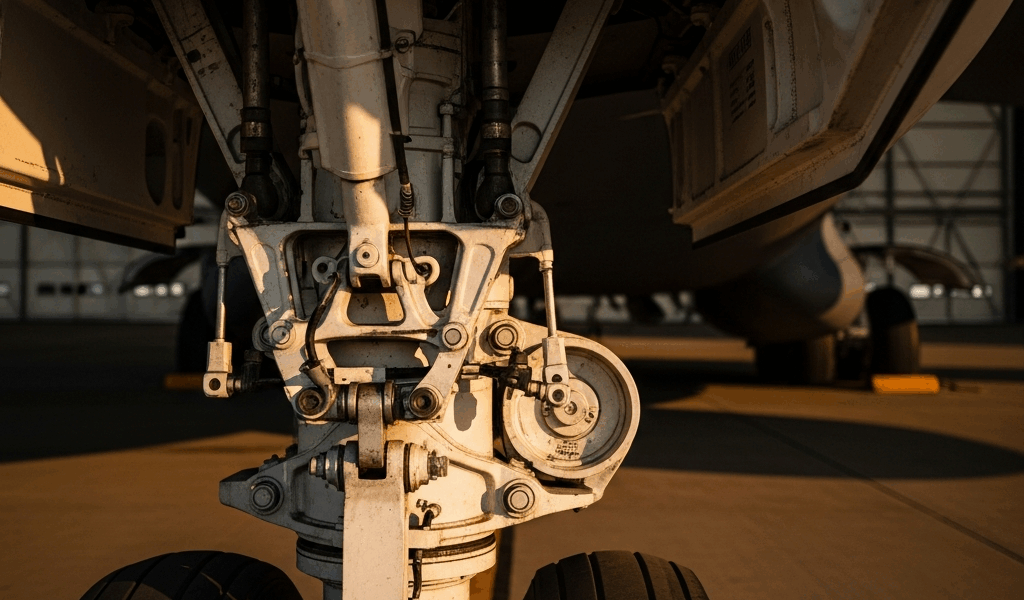
Signs of Nose Gear Steering Degradation
Sit in the left seat of a C-17 with your nose gear steering acting up, and you’ll know something’s wrong immediately. I’ve logged over 2,000 hours flying heavy transport, and the feel of nose gear response becomes almost instinctive — when it changes, every pilot in the cockpit feels it.
The earliest warnings are subtle, honestly. Your nose wheel might lag half a second behind tiller input. Sometimes it’s asymmetric — the nose gear wants to drift left consistently, forcing constant right pedal compensation. You’re fighting to keep the centerline during taxi, and after two hours of ground ops, that exhaustion sets in hard.
Then there’s shimmy. The nose gear oscillates back and forth around 2-4 Hz. You feel it through the controls, hear it in the strut. Not dangerous at low speeds, but it tells you hydraulic damping is already compromised.
Hard failures are obvious. Complete loss of steering response to tiller input — the nose wheel locks straight and won’t turn. Period. Some pilots report that pedal input works but tiller doesn’t, or vice versa. That asymmetry tells you whether you’re looking at a dual-channel hydraulic problem or something mechanical in the linkage itself.
I encountered the worst case on a delivery to Ramstein — probably should have opened with this section, honestly. The steering degraded gradually over forty minutes of taxi. It wasn’t a sudden failure, which made diagnosing it in real time harder. Halfway to the ramp, we were barely coaxing the nose gear into position.
Initial Diagnosis During Taxi
First thing: test tiller response at low speed. Gentle inputs only. Move the tiller left, count to one, watch the nose wheel. Do this at both 5 knots and 10 knots. A healthy C-17 nose gear responds within half a second and centers itself smoothly when you release the tiller.
Check your steering system pressure indicators. The C-17 runs dual hydraulic steering channels — System A and System B. Both should show green on the pressure gauge. Yellow or amber on either channel? That’s your problem right there. Hydraulic pressure nominally sits at 3,000 psi for steering. Drop below 2,700 psi and you’ve lost pressure somewhere in the system.
Test pedal input separately from tiller. Hard right rudder — observe nose gear response. Hard left. This confirms whether the mechanical linkage from the pedals to the nose gear strut is functional. Most steering failures we’ve seen hit either the tiller circuit or the pedal circuit, but rarely both at once.
Check your hydraulic fluid level indication on the flight deck — not all C-17s display this clearly, but if yours does and it’s low, that’s a red flag for internal leakage in the actuator or lines.
Request a visual inspection from ground ops while you’re parked. Have them look at the nose gear steering actuator on the aft side of the nose gear strut — it’s visible from the ground. Any hydraulic fluid seeping around the actuator barrel means the seals are compromised and you’ve already lost steering authority.
Operating With Reduced or Failed Steering
You’ve diagnosed partial steering degradation and the parking spot is three miles away. Can’t declare an emergency every time you lose 30 percent steering authority. Here’s what actually works in the real world.
Use differential braking on the main gear — this is your primary workaround. If the nose gear pulls left, apply steady pressure to the left main brake while turning right with the tiller. This counteracts the steering deficiency and lets you track a wider radius. You’re using main gear braking as yaw control augment. It works. I’ve taxied a C-17 with 50 percent steering authority using just this technique.
Reduce taxi speed immediately. Drop to 3-5 knots. Steering authority issues multiply exponentially at higher speeds because momentum and aerodynamic forces work against you. Walking speed gives you time to correct and anticipate. At 15 knots with degraded steering, you’re fighting the aircraft instead of flying it.
Request longer taxiways and wider turns from ground operations. Tell them you’re experiencing steering degradation and need wider routing. Most tower controllers will happily vector you around the airfield if it prevents an accident — they’ve handled this before.
Complete loss of steering — nose gear won’t turn at all, tiller or pedal — changes everything. Declare a minor emergency. You can taxi straight using main gear differential braking, but you cannot safely navigate intersections or aprons. Request a tug or tow vehicle immediately. This is non-negotiable. Continuing to taxi a completely unsteered C-17 to avoid paperwork gets people hurt.
Coordinate with your aircraft commander and flight engineer. Make a crew decision, not a solo one. The flight engineer might see something on the hydraulic panel you missed from the flight deck. Your co-pilot might have spotted fluid on the nose gear during preflight. Get all three heads working the problem.
Ground Support and Recovery Options
When steering is completely gone or so degraded that taxi becomes unsafe, call for a tug. The C-17 uses either an AT-340 or AT-345 depending on location — standard towing vehicles at major transport bases. Request tow-on, tow-off service, and they’ll connect to the nose gear tow fitting and move your aircraft.
Towing takes time — 20-30 minutes from request to arrival in most situations. Plan accordingly. Inbound and discovering steering failure late in descent? Declare it early to air traffic control so ground ops can pre-position a tug. Don’t wait until landing — that creates coordination chaos.
Parking constraints matter here. Some ramps have tight spot sizes that don’t allow tug assistance. Talk to the parking coordinator before committing to a spot with degraded steering. Some spots are tug-accessible; others aren’t. Choose the right one.
Maintenance will need to replace or repair the steering actuator in most cases. This is a double-acting hydraulic cylinder that converts fluid pressure into nose wheel authority. Failed seals mean leaks. Binding rods mean sticking. Either way, it’s shop work — 4-6 hours for replacement depending on hangar availability.
Before the next flight, ensure maintenance inspects both steering system hydraulic lines for leaks, checks the actuator rod for scoring or corrosion, and runs a full pressure test on both channels. Don’t take off until steering shows solid green across every check.
Prevention and Preflight Checks
Steering system failures are preventable if you catch them early. During your preflight briefing, ask the flight engineer directly about steering anomalies from the last flight. “Any issues with nose gear steering?” — direct question. Previous crew noted asymmetric response or slow reaction? That’s documented. You inherit that problem.
Walk around the nose gear yourself if possible. Look at the steering actuator. It should be dry — no fluid seepage, no visible corrosion around the rod. The nose gear strut itself should be clean and free of hydraulic residue. Any visible fluid means internal seal leakage is already underway.
Check the nose gear tire pressure if you have access. A soft nose gear tire feels like steering degradation because the wheel flat-spots under load and resists turning. Proper pressure runs 185-200 psi. A tire 30 psi low will absolutely affect your steering feel.
During taxi-out, perform your steering system test before committing to the active runway. Low-speed tiller inputs in a holding area or on a taxiway bypass. Both channels should respond immediately and crisply. Anything other than direct response? Stop and test again.
When you land and taxi back in, test steering one more time before parking. Any degradation at all? Report it in your postflight briefing. Write it in the maintenance log. Don’t downgrade it or minimize it hoping the next crew won’t notice — they will, and they’ll be working degraded systems because you didn’t document it.
The steering system is straightforward enough that proper maintenance prevents 90 percent of failures. The other 10 percent happen because someone skipped an inspection or didn’t report a subtle symptom. Don’t be that crew.

Subscribe for Updates
Get the latest c-17 pilot updates delivered to your inbox.
We respect your privacy. Unsubscribe anytime.