C-17 Airdrop Operations: Cargo, Paratroopers and Crew Roles
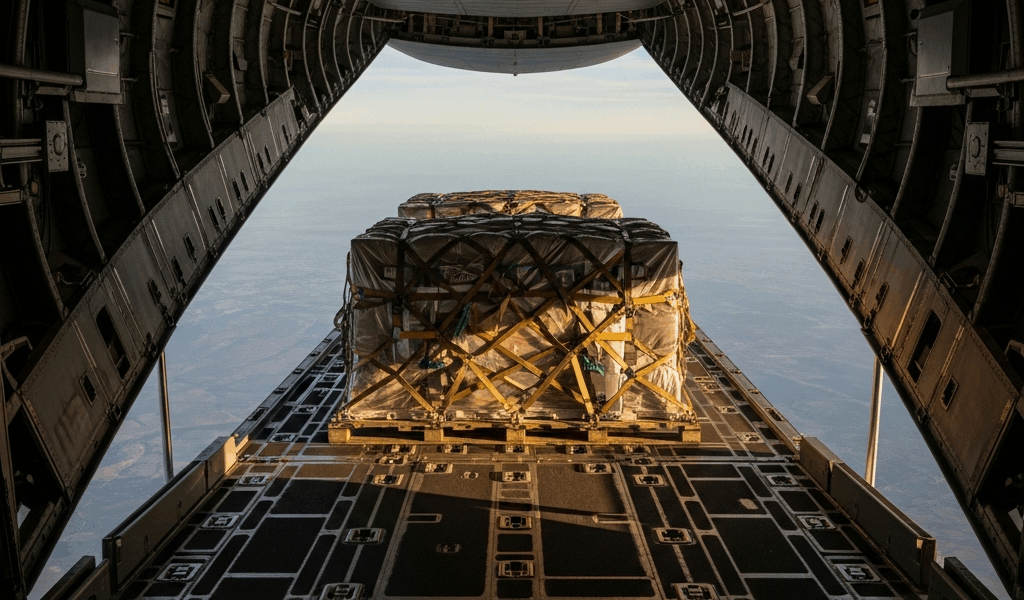
The C-17 Globemaster III can deliver paratroopers, supplies and heavy equipment by airdrop when an airfield is unavailable or airlanding is not the right option. The mission combines pilots, loadmasters, aerial-delivery specialists, jumpmasters, drop-zone teams and supported ground forces.
This public guide explains the major airdrop types, what each crew member contributes and how Air Force training supports the mission. It intentionally omits release calculations, run-in parameters, airspeeds, altitudes, crew callouts and malfunction procedures. Those details belong in current technical guidance and qualified aircrew training.
What is a C-17 airdrop?
An airdrop delivers people or materiel from an aircraft in flight. It can place supplies near a supported unit, insert qualified airborne forces or deliver equipment that would otherwise require an aircraft to land.
The C-17 is also an airland aircraft, and many missions use a runway because landing can be more efficient and allows cargo to be unloaded directly. Mission planners choose between airland and airdrop based on access, urgency, threat, cargo, weather, support and the condition of the destination.
How much can a C-17 carry?
The Air Force fact sheet lists a maximum payload of 170,900 pounds and says the aircraft is designed to airdrop 102 paratroopers with their accompanying equipment. Those are aircraft capabilities, not a promise that every mission can use the maximum. Fuel, route, weather, configuration, cargo, drop method and operational restrictions all affect the actual load.
For airland cargo configurations and aircraft dimensions, see the C-17 cargo-capacity guide.
The main types of C-17 airdrop
Personnel airdrop
Personnel airdrop carries qualified paratroopers who exit the aircraft over an approved drop zone. The supported airborne unit supplies jumpmasters and follows its own qualification and safety requirements, while the aircraft crew manages the C-17 and coordinates the aerial-delivery portion of the mission.
The C-17’s side doors and cargo ramp support different approved personnel configurations. The exact configuration depends on the mission and current guidance.
Container Delivery System
The Container Delivery System, commonly called CDS, packages supplies into parachute-equipped bundles or containers. Public Air Force reporting shows CDS pallets used during C-17 training at Altus Air Force Base.
CDS is useful for supplies that can be divided into delivery loads, such as food, water or other sustainment materiel. Aerial-delivery specialists prepare the loads, and the aircraft crew verifies that the accepted cargo and aircraft configuration match the mission documentation.
Heavy-equipment airdrop
Heavy-equipment airdrop delivers larger vehicles, equipment or supplies secured to specially prepared platforms. It requires coordination among the unit providing the cargo, aerial-delivery riggers, inspectors, loadmasters and pilots.
The term “heavy equipment” describes a delivery category, not a license to load any object up to the aircraft’s maximum payload. Platform limits, parachute systems, rigging instructions, aircraft balance and approved combinations govern what can be delivered.
Precision-guided airdrop
Precision-guided systems add navigation and guidance to compatible cargo delivery systems. They can improve delivery accuracy and provide planners with options when conventional delivery is less suitable.
JPADS—the Joint Precision Airdrop System—is often discussed as if it were a feature built into every C-17 load. It is better understood as a compatible delivery system used for specifically prepared cargo under an approved mission plan.
What pilots do during an airdrop mission
The pilots integrate the airdrop into the larger flight. Their work includes mission planning, aircraft performance, navigation, weather assessment, airspace coordination, aircraft control and coordination with the rest of the crew.
Airdrop is not simply flying over a point and opening the ramp. The aircraft must arrive in the required condition while the loadmasters and supported teams complete their own responsibilities. Timing and shared situational awareness matter because actions in the cockpit and cargo compartment are interdependent.
Public articles should stop at that conceptual level. The construction of release points, detailed run-in techniques and real-time correction methods are operational procedures that qualified crews learn from current guidance and instructors.
What loadmasters do
The C-17’s standard crew includes one loadmaster, although mission requirements can change crew composition. Loadmasters manage the cargo compartment and connect the aircraft’s operation with the people or materiel being delivered.
At a public level, their airdrop responsibilities include:
- coordinating aircraft configuration;
- checking accepted cargo and restraint or delivery equipment;
- working with aerial-delivery specialists and supported-unit personnel;
- monitoring the cargo compartment and participating in crew coordination;
- supporting the safe completion of the approved delivery sequence.
For the broader career and training pipeline, see how to become a C-17 loadmaster.
Who prepares the cargo?
Airdrop preparation is a team effort. Air Force aerial-delivery and logistics personnel pack parachutes, assemble platforms, prepare loads and support inspection and training. The unit that owns the cargo provides accurate information and ensures its equipment is prepared for the applicable process.
Air Education and Training Command reporting from Altus describes logistics personnel producing hundreds of training platforms for C-17 loadmaster training. That work happens before the aircraft reaches the drop zone and is essential to a safe, repeatable training system.
How a drop zone fits into the mission
A drop zone is a surveyed and controlled area approved for aerial delivery. Ground personnel establish the zone, assess conditions, manage access and communicate required information through the mission’s approved channels.
The aircraft crew does not independently invent a drop zone from a map pin. Suitability depends on the delivery type, terrain, obstacles, dimensions, weather, supported force and governing criteria.
How C-17 crews train for airdrop
Air Education and Training Command performs C-17 aircrew training at Altus Air Force Base. Students use computer-based instruction, simulators, cargo-compartment trainers and aircraft events as part of initial, upgrade and instructor training.
Loadmaster students practice cargo-compartment configuration and leadership in a controlled environment before applying those skills in flight. Pilots use simulators to integrate aircraft systems, navigation, crew coordination and mission demands.
Airdrop qualification is not permanent after one event. Aircrews and supported units maintain qualifications and currency through recurring training under their applicable programs. Air Force reporting also shows Altus instructors supporting allied C-17 crews in personnel-airdrop qualification and standardization.
Why crew coordination matters
The cockpit cannot see everything happening in the cargo compartment, and the cargo compartment does not independently control the flight path. Pilots and loadmasters therefore depend on standardized communication, clear responsibilities and the ability to stop when conditions do not match the plan.
Coordination also extends beyond the aircraft. Aerial-delivery specialists, jumpmasters, airspace agencies, weather personnel, maintainers and drop-zone teams contribute information or capability that the crew needs.
Airdrop versus airland delivery
Airdrop can deliver cargo or personnel without landing, but it also requires specialized preparation, parachute systems, a suitable drop zone and recovery by the receiving force. Airland delivery can move larger or more varied loads through an available runway and may simplify cargo recovery.
The C-17 is valuable because it supports both methods. Its strategic range, large cargo compartment and ability to use relatively short, austere airfields let planners combine long-range movement with tactical delivery options.
Common misconceptions
Does every C-17 airdrop happen at 25,000 feet?
No. There is no single altitude for every personnel, container, heavy-equipment or precision-guided mission. The old title of this page implied otherwise. Actual parameters depend on the delivery system, mission and current approved guidance.
Can the C-17 always airdrop its full maximum payload?
No. Maximum aircraft payload and an approved airdrop load are different concepts. Configuration, delivery-system and mission limits determine the actual load.
Does the pilot release the cargo alone?
No. Airdrop is a coordinated crew and joint-team event. Pilots, loadmasters and ground specialists have separate responsibilities within the approved process.
Is JPADS the same as every CDS load?
No. JPADS is a precision-guided delivery capability used with compatible, specially prepared loads. CDS is a broader containerized-delivery category.
Can an online guide teach an operational airdrop?
No. Real operations require qualified personnel, current technical guidance, approved loads, surveyed drop zones and unit supervision. This page is a public capability overview.
Official sources
- U.S. Air Force: C-17 Globemaster III fact sheet
- Air Education and Training Command: Training C-17 masters of the globe
- Air Education and Training Command: C-17 airdrop training support
- Air Education and Training Command: assembling airdrop training platforms
- Air Education and Training Command: personnel-airdrop qualification
Low-level navigation can support the tactical delivery phase; see the C-17 low-level flight overview.

Subscribe for Updates
Get the latest c-17 pilot updates delivered to your inbox.
We respect your privacy. Unsubscribe anytime.