C-17 vs A400M — What Crews and Planners Actually Think
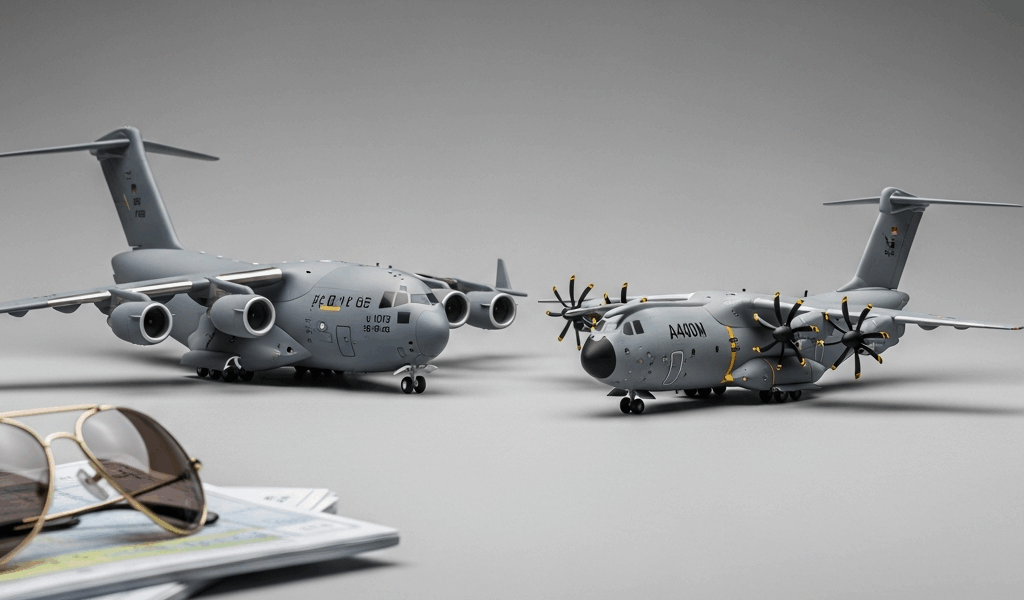
C-17 vs A400M — What Crews and Planners Actually Think
The C-17 vs A400M debate has gotten complicated with all the spec-table noise flying around. Max payload here, range there, cruising speed in the middle column — dressed up as analysis, passed off as insight. As someone who spent years around military airlift operations, talking to loadmasters, mission planners, and aircrew on both platforms, I learned everything there is to know about what those numbers actually mean at 0300 on a ramp somewhere cold and dark, trying to figure out if your aircraft can do what the mission requires. Spoiler: the spec table misses almost all of it. So let’s do this properly.
C-17 vs A400M — The Basic Numbers
But what are we actually comparing here? In essence, it’s two military airlifters built for different customers with different problems to solve. But it’s much more than that — and the numbers, while worth knowing, are where most people stop when they should be starting.
The C-17 Globemaster III carries a maximum payload of 170,000 lbs (77,000 kg). The A400M Atlas tops out at 81,570 lbs (37,000 kg). That’s not a rounding error. Roughly twice the weight — full stop.
Range with max payload: the C-17 gets approximately 2,400 nautical miles. The A400M gets approximately 2,000. Cruising speed: C-17 at 450 knots true airspeed, A400M at 340. Those 110 knots don’t sound catastrophic until you’re planning a transatlantic mission and doing the math on crew duty day limits. Then they start mattering quite a bit.
Here’s the framing most people miss — the A400M is not really a C-17 competitor. It slots in between the C-130J and the C-17. European air forces needed something larger than the C-130 but couldn’t justify, politically or financially, buying into a US military procurement program. Comparing the A400M directly to the C-17 is a little like comparing a Freightliner M2 to a Peterbilt 389. Same category. Not the same truck.
Turbofan vs Turboprop — Why It Matters for Operations
Probably should have opened with this section, honestly. Engine type is the most consequential technical difference between these two aircraft — and spec tables bury it in a footnote.
The C-17 runs four CFM F117-PW-100 high-bypass turbofan engines — same engine family as the Boeing 757. Jet engine. High-altitude cruise. Air refueling compatible. The A400M runs four Europrop TP400-D6 turboprops — the most powerful turboprops ever built for military aviation, producing around 11,000 shaft horsepower each. That’s a meaningful distinction, not a trivia answer.
Turbofans are built for speed and altitude. Turboprops are built for efficiency and low-speed performance. That’s what makes the engine debate endearing to us airlift nerds — the answer changes completely depending on which mission you’re flying.
At hot-and-high airfields — Kabul in August, mountain strips in Afghanistan where density altitude pushes 10,000 feet while you’re still on the ground — turboprop engines handle thin air differently. The A400M’s TP400s maintain more useful power in those conditions than many turbofan installations. Crews who flew into austere Afghan airstrips told me the A400M’s performance envelope at high-altitude, high-temperature fields surprised them. Better than expected, apparently.
The C-17’s advantage shows up on long legs. Cruising at 450 knots versus 340 is a real difference across 4,000 nautical miles. Add aerial refueling and the C-17 sustains those speeds over ocean crossings the A400M simply can’t match on time. Don’t make my mistake of treating engine type as a footnote — it’s the whole argument.
Short Field Performance — Both Can Land on Austere Strips, With Differences
Both aircraft were designed for assault landings on unpaved, short, or damaged runways. Neither one lands on a dirt strip by accident — both require specific crew training and careful procedures. That’s table stakes for this category.
C-17 minimum landing distance in assault configuration: approximately 3,000 feet. A400M: approximately 2,800 feet. The A400M edges it slightly on raw numbers. In practice, the difference between those two figures is smaller than the difference in what each aircraft can actually deliver once it gets there.
Frustrated by the limitations of conventional jet-blast on unprepared surfaces, aircraft designers made some interesting choices here. The A400M’s turboprop engines produce prop wash — airflow pushed forward and down — that clears debris in a different pattern than jet blast. Whether it matters depends on the specific strip. Jet blast from the C-17’s F117s moves backward with significant force, which can create FOD problems on unprepared surfaces. On some strips it’s a real consideration. On others, totally irrelevant.
What the C-17 does that the A400M doesn’t: it can use thrust reversers while taxiing — including to back up. On a narrow tactical airstrip where turning around is impossible, the C-17 taxis forward, unloads, and reverses back down the strip to the runway threshold without ever turning the aircraft around. Loadmasters described this to me as the capability they rely on most in austere environments and think about least until they suddenly need it. The A400M doesn’t have it. You need turning room — and on some strips, turning room doesn’t exist.
Why the US Chose the C-17 and Europe Chose the A400M
The customer split is not accidental, and it’s not purely about aircraft performance. This new idea of European strategic airlift took off several years into the post-Cold War era and eventually evolved into the A400M program enthusiasts know and argue about today.
Eight nations — Belgium, France, Germany, Luxembourg, Malaysia, Spain, Turkey, and the United Kingdom — chose the A400M. The US, Australia, Canada, India, the UAE, and several others chose the C-17. Understanding why tells you almost everything about what each aircraft was actually built to do.
European nations chose the A400M for three reasons that have nothing to do with maximum payload. Airbus built substantial European industrial workshare into the program — components manufactured across Germany, Spain, France, and the UK, in factories employing people with mortgages and voting cards. Choosing the A400M kept aerospace manufacturing inside European borders. The per-unit cost was also more politically viable than entering a US military acquisition program. And European defense doctrine in the 1990s and early 2000s didn’t require the same outsized cargo capacity and intercontinental range that US power projection doctrine demands.
The US and its partners chose the C-17 for different reasons. USAF interoperability was a major factor — the C-17 uses the same aerial refueling receptacle as virtually every other USAF receiver aircraft. No special nozzles, no connector adapters, no coordination problems at 3 a.m. over the Atlantic. The C-17’s outsized cargo capability — M1 Abrams tanks, Apache helicopters, 40-foot shipping containers — aligned directly with US force projection doctrine.
Here’s where it gets operationally complicated. A coalition that includes both C-17 and A400M operators faces real interoperability friction — different fuel system connectors, different cargo loading systems and tie-down patterns, different maintenance manuals written in different languages by different prime contractors. On a joint mission, that friction is manageable. In a sustained combat logistics operation, it adds up to real cost in time and coordination effort. Probably more than anyone budgeted for.
The Verdict — C-17 vs A400M — Which Is Better
Asking which aircraft is better is asking the wrong question. Both are the right answer — to two completely different questions.
For US military doctrine — power projection, outsized cargo, transatlantic speed, aerial refueling for extended range — the C-17 is the clearly superior platform. Twice the payload, 110 knots faster over long distances, full integration with USAF tanker infrastructure, capable of delivering an Abrams tank to a 3,000-foot dirt strip. Nothing else does all of that. Not even close.
For European defense needs — regional heavy airlift, hot-and-high performance, shorter supply chains, European industrial content — the A400M is the right aircraft. It filled a capability gap the C-130 couldn’t fill and that the C-17 was too expensive, and too politically American, to fill in a European context. That’s what makes the A400M endearing to us airlift analysts — it solved a genuinely hard problem that nobody else was going to solve.
I made the mistake early on of treating this as a straight capability comparison — cost me a lot of time arguing points that weren’t really in dispute. Don’t make my mistake. The C-17 is bigger, faster over long distances, and more compatible with US logistics infrastructure. The A400M fills a gap between the C-130 and the C-17 that needed filling for European operators. Both of those things are true simultaneously — and the comparison only looks like a competition if you assume both aircraft were trying to solve the same problem. They weren’t.

Subscribe for Updates
Get the latest c-17 pilot updates delivered to your inbox.
We respect your privacy. Unsubscribe anytime.