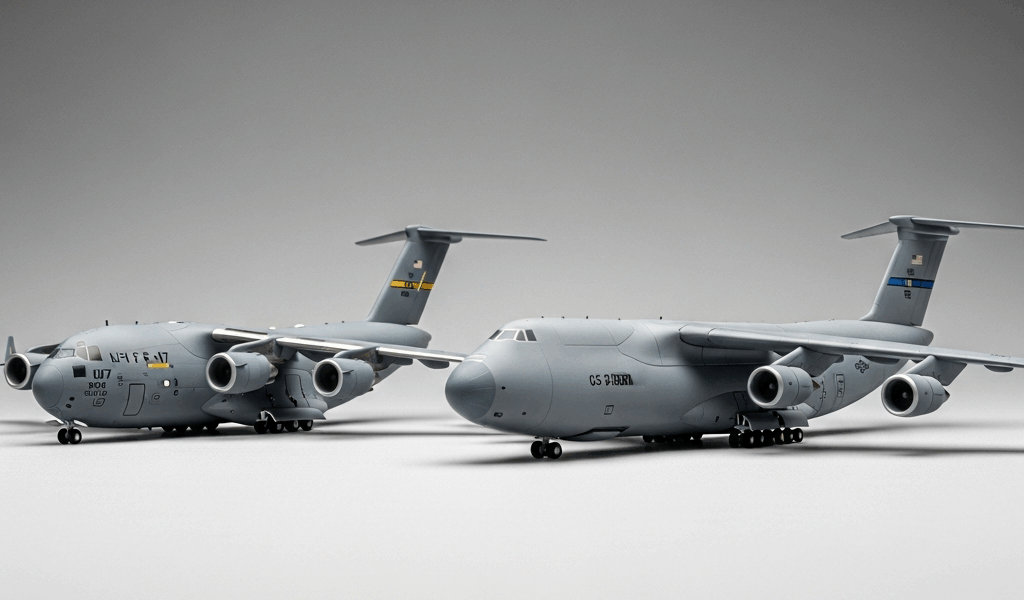
C-17 vs C-5 Galaxy — Why the Air Force Needs Both

C-17 vs C-5 Galaxy — Why the Air Force Needs Both

The C-17 vs C-5 Galaxy debate comes up constantly in airlift circles, and honestly, it’s the wrong frame. These aren’t competing aircraft. They’re complementary ones. Fly the C-17 long enough and you stop thinking about the C-5 as a bigger, slower version of what you’re doing — you start thinking about it as an entirely different tool built for an entirely different job. I flew the C-17 Globemaster III for years out of McChord Field, and the C-5 crews we’d cross paths with at places like Dover or Travis weren’t doing the same mission. They were doing something adjacent to it. Understanding that distinction is the whole ballgame when it comes to understanding American strategic airlift.

Different Airplanes for Different Missions

Here’s the single most important thing to understand before you look at one spec sheet: the C-5 Galaxy is a strategic heavy hauler. Full stop. The C-17 Globemaster III is a strategic-tactical hybrid. That hyphen carries enormous weight. It is the entire reason both aircraft exist simultaneously in the fleet, and it’s the reason the Air Force hasn’t — and shouldn’t — simply replaced one with the other.

Strategic airlift means moving massive amounts of cargo over intercontinental distances. Both aircraft do that. The C-5M Super Galaxy does it with a payload capacity that nothing else in the Western world can match. The C-17 does it while also being able to turn around and land on a dirt strip in the middle of nowhere. Those are not the same mission dressed up in different airframes. They are fundamentally different operational requirements that happen to share an altitude and a general direction of travel.

Think about the actual logistics chain of a major combat operation. Heavy equipment — M1 Abrams tanks, Apache helicopter airframes, oversized engineering machinery — has to move from the continental United States to a theater staging base. That’s a C-5 job. Getting smaller loads of that same equipment from the theater staging base down to a forward operating location with a rough, short runway? That’s a C-17 job. The C-5 delivers to the big base. The C-17 pushes further forward.

Probably should have opened with this section, honestly — because once you internalize the strategic versus strategic-tactical distinction, every spec comparison that follows makes immediate sense. You stop asking “why is the C-5 so much bigger” and start asking “what problem was it designed to solve.”

The Strategic-Tactical Hybrid Concept

When the Air Force developed requirements for what would become the C-17 in the late 1970s and early 1980s, they were trying to solve a real operational gap. The C-5 was extraordinary but required major airfields. The C-130 Hercules could get into tight spots but couldn’t carry strategic-sized loads over long distances efficiently. The C-17 was supposed to bridge that gap — carry loads approaching C-5 territory and deliver them directly to austere fields that the C-5 could never touch.

McDonnell Douglas won that contract, and the result was an aircraft that uses externally blown flaps, thrust reversers that can actually back the aircraft up under its own power, and a high-thrust-to-weight ratio that gives it performance characteristics wildly different from anything else in its weight class. The Boeing acquisition absorbed the program, the aircraft entered service in 1993, and it has done exactly what it was designed to do ever since.

Payload — What Each Aircraft Actually Carries

Numbers first, then context. The C-5M Super Galaxy has a maximum payload of approximately 281,000 pounds. The C-17 Globemaster III maxes out at 170,900 pounds. That’s not a rounding error — the C-5 carries roughly 65 percent more cargo by weight.

In practical terms, the C-5 can carry two M1A2 Abrams main battle tanks simultaneously. Two. The M1A2 SEPv3 variant weighs approximately 73.6 tons — around 147,200 pounds — and you can load two of them into a C-5 with room for additional cargo. The C-17 can carry one M1 Abrams, period. Load one tank and you’re essentially at your payload limit for a fully fueled long-range mission.

The C-17 trades some of that raw carrying capacity for flexibility. Three Stryker armored vehicles fit inside a C-17. A Stryker in its various configurations runs roughly 38,000 to 44,000 pounds depending on variant — the M1126 Infantry Carrier Vehicle being one of the lighter ones at around 38,000 lbs. Three of those fit comfortably. The C-17 also routinely carries helicopters, artillery pieces, HMMWVs stacked three across, and 102 paratroopers in a single pass.

Cargo Dimensions and Loadability

The C-5 cargo compartment measures 143 feet long, 13.5 feet wide, and 13.5 feet tall. It also has a nose visor that opens upward, meaning you can drive vehicles straight through from the front ramp to the rear ramp — a feature that is genuinely useful for outsized vehicles that need nose-first loading. The usable cargo floor on a C-5 is 121 feet.

The C-17 cargo compartment is 88 feet long, 18 feet wide, and 12.4 feet tall inside. Wait — 18 feet wide? Yes. The C-17 is actually wider on the cargo floor than the C-5, which matters enormously for side-by-side vehicle loading. You can load two Humvees side by side across the floor of a C-17. That width combined with the rear loading ramp configuration makes the C-17 significantly faster to load and unload at austere locations where you don’t have the luxury of a powered ground loader or a 60K Halvorsen aircraft cargo loader.

The C-5 also has an upper deck that seats 73 passengers — troops, maintenance personnel, security forces — which makes it genuinely useful as a combination cargo-and-passenger aircraft on some missions. The C-17 can seat 54 troops along the sidewalls when configured for personnel transport, but that’s not typically how it’s used in heavy cargo configuration.

Range and Fuel

The C-5M has a range of approximately 5,524 nautical miles with a full 281,000-pound payload. With reduced cargo, it can reach further. The C-17 has a range of about 2,785 nautical miles with a 160,000-pound payload, but extends to around 4,200 nautical miles with a lighter load and air refueling capability. Both aircraft are AR-capable. In practice, for global operations, neither one of these planes is going anywhere without tanker support on the long legs.

The Short Field Advantage That Defines the C-17

This is where the conversation changes completely. The C-17 can land on a 3,500-foot unpaved runway. Then, using its thrust reversers, it can back itself up to reposition for takeoff. Under its own power. In reverse. On a dirt strip.

Loaded by that capability alone, C-17 crews can operate in environments where no other strategic airlifter on Earth can go. That 3,500-foot austere field requirement was baked into the original design spec, and the aircraft meets it with margin. I have personally landed at airfields that I would have described to a civilian as “a field with a strip of packed dirt and a windsock,” and the C-17 handled it without drama. The key enablers are the externally blown flap system — which channels engine exhaust over and under the flaps to dramatically increase lift at low speeds — and the high-bypass F117-PW-100 engines, four of them rated at 40,440 pounds of thrust each.

The C-5 needs a minimum of roughly 6,000 feet of paved, prepared runway. In practice, C-5 operations are almost exclusively from main operating bases with full infrastructure — concrete or asphalt runways, sufficient load-bearing capacity to support an aircraft with a maximum gross weight of 840,000 pounds, aircraft parking capable of accommodating a 247-foot wingspan, and ground equipment scaled for a very large aircraft. You cannot land a C-5 at a forward operating base in Afghanistan, a remote strip in Africa, or a flood-damaged airfield with structural damage to portions of the runway. You can land a C-17 at all three.

Combat Airdrop — A C-17 Specialty

The short field advantage extends into airdrop capability, which is another area where the two aircraft diverge sharply. The C-17 was designed from the start for combat airdrop operations — both CDS (Container Delivery System) bundle drops and heavy equipment airdrop using the LAPES (Low Altitude Parachute Extraction System) technique or standard ACES (Airdrop Container Extraction System) rigging.

The C-17 can drop 60 paratroopers out each door simultaneously with a single pass. It can airdrop a single load of up to 110,000 pounds using a heavy equipment platform. It can do all of this while flying low-level, terrain-following routes at 250 feet above ground level to avoid radar detection. The aircraft’s avionics suite — the mission computers, the terrain-following radar, the systems integration — was designed to support these tactics.

The C-5 has some airdrop capability, but it is not an airdrop platform in any operationally meaningful sense. The fleet is not trained to the same proficiency level, the aircraft is not designed for low-level terrain-following flight in the same way, and C-5 units don’t maintain the airdrop currency that C-17 units do. When the 82nd Airborne needs an airborne assault, they call the C-17.

The Khe Sanh Problem, Scaled to Modern Ops

There’s a useful historical lens here. During the Vietnam War, Khe Sanh was a Marine combat base under siege. C-130s were landing there under fire on a short, beat-up runway, delivering supplies that the garrison could not receive any other way. The C-5 could not have operated there. The lesson — that large-scale logistics chains have to terminate somewhere, and that somewhere is often a degraded, short, or austere field — has only become more relevant in modern distributed operations.

Modern conflict planning assumes contested, degraded, and operationally limited environments. CDOL, in Air Force parlance. In a CDOL environment, the large, fixed, well-paved main operating bases that the C-5 requires are exactly the targets that adversaries focus on first with ballistic missiles, cruise missiles, and special operations forces. The C-17’s ability to disperse operations to smaller, less predictable airfields is a genuine strategic asset.

Reliability and Mission Capable Rates

The C-5 has a complicated maintenance history. The original C-5A entered service in 1968 with wing cracks and structural issues that required expensive remediation. The C-5B improved on this, and the current C-5M Super Galaxy — upgraded with new engines, avionics, and systems under the Reliability Enhancement and Re-engining Program, or RERP — is meaningfully better than what came before it. The CF6-80C2 engines on the C-5M replaced the TF39s that had powered the original variants and substantially improved both fuel efficiency and reliability.

Even so, the C-5’s mission capable rate has historically lagged behind the C-17. GAO reports from the 2000s and early 2010s documented C-5 mission capable rates in the low-to-mid 50 percent range for the legacy variants. The C-5M has improved that significantly — Air Mobility Command data from recent years suggests the C-5M mission capable rate has climbed toward the mid-60s and occasionally higher. That’s still below the C-17.

The C-17’s mission capable rate has consistently run in the high 70s to low 80s as a fleet average. Air Mobility Command has reported C-17 mission capable rates around 82 to 85 percent in various reporting periods. For a fleet-wide average across several hundred aircraft operating in high-tempo conditions globally, that’s a strong number.

I learned this the hard way early in my flying career — not from reading reports but from watching crew schedulers scramble when a C-5 went down at a forward location with no parts, no specialized maintenance personnel, and a load that needed to move. The C-17’s logistics footprint is smaller, its maintenance is more standardized, and when something breaks on a deployed C-17, the probability that a field team can fix it without waiting for a specialized support team to fly in is meaningfully higher.

Maintenance Footprint Matters Downrange

The C-5 is a complex aircraft requiring a significant maintenance footprint. It has more systems, more landing gear components — 28 wheels on the main gear alone — and a larger physical envelope that requires specialized ground equipment at every location it visits. The C-17 is complex too, but it was designed with a forward maintenance philosophy. Boeing built the aircraft to support line replaceable units, meaning components that a relatively small deployed maintenance team can swap at a forward location without depot-level support.

The Integrated Diagnostics System on the C-17 gives maintenance crews real-time fault data that speeds troubleshooting considerably. Combine that with a well-established logistics pipeline and you get an aircraft that, despite operating globally in harsh conditions, maintains a mission capable rate that supports the operational tempo that Combatant Commanders actually need.

The Future — Next-Gen Airlifter Replaces Both by 2038

Here’s where things get genuinely interesting, and genuinely uncertain. The Air Force has been studying what it calls the Next Generation Airlift, or NGAL, capability for several years. The stated goal is an aircraft with Initial Operational Capability around 2038 that can eventually replace both the C-17 and the C-5M — combining the heavy payload capacity of the Galaxy with the short-field, austere-landing capability of the Globemaster III.

Whether that is achievable in a single airframe at any reasonable cost is an open question. The engineering trades that make the C-5 capable of carrying 281,000 pounds work against the trades that make the C-17 capable of landing on 3,500-foot dirt strips. You want more payload, you need a bigger aircraft with more wing area and more landing gear load distribution. You want short field performance, you need high lift at low speeds, a high thrust-to-weight ratio, and landing gear that can handle unprepared surfaces. These requirements push in opposite directions.

The current fleet retirement schedule has the C-5M flying until approximately 2045. The C-17, a younger and more structurally sound fleet, is projected to fly well into the 2060s and potentially to 2075 depending on utilization rates and fatigue life management. The Air Force currently operates 275 C-17s and 52 C-5M/Bs. The C-17 fleet is the backbone of strategic airlift and will remain so for the foreseeable future regardless of what NGAL does.

What NGAL Requirements Tell Us

The NGAL analysis of alternatives, portions of which have been discussed publicly in Congressional testimony and Air Mobility Command briefings, suggests the Air Force is looking at payload requirements in the 150,000 to 200,000-pound range with austere field capability of roughly 3,000 to 4,000 feet. That is, notably, roughly C-17 territory, not C-5 territory. The “replace both” framing may be aspirational — in practice, NGAL may end up being a C-17 successor with incremental improvements rather than a true C-5 replacement in payload terms.

New propulsion is central to NGAL planning. Advanced turbofan technology, potentially hybrid-electric systems for certain phases of flight, and open fan architectures are all being studied. Reduced fuel consumption would directly increase range and payload-range tradeoffs. Whether any of this produces a fielded aircraft by 2038 given the current state of defense acquisition is — let’s be direct — far from guaranteed. The B-21 program has shown that the Air Force can still execute a major acquisition on schedule when prioritized. Whether NGAL receives that prioritization in a contested budget environment is another matter.

The 30-Year Window

For the next 20 to 25 years at minimum, the Air Force needs both aircraft. The C-5M provides irreplaceable heavy lift capacity for outsized cargo that no other aircraft can carry. The C-17 provides the forward reach

Jason Michael

Jason Michael

Author

Jason covers aviation technology and flight systems for FlightTechTrends. With a background in aerospace engineering and over 15 years following the aviation industry, he breaks down complex avionics, fly-by-wire systems, and emerging aircraft technology for pilots and enthusiasts. Private pilot certificate holder (ASEL) based in the Pacific Northwest.

✈️ Get the latest C-17 news & insider content

Shop C-17 Gear

Subscribe for Updates

Get the latest c-17 pilot updates delivered to your inbox.