How C-17 Pilots Train for Assault Landings
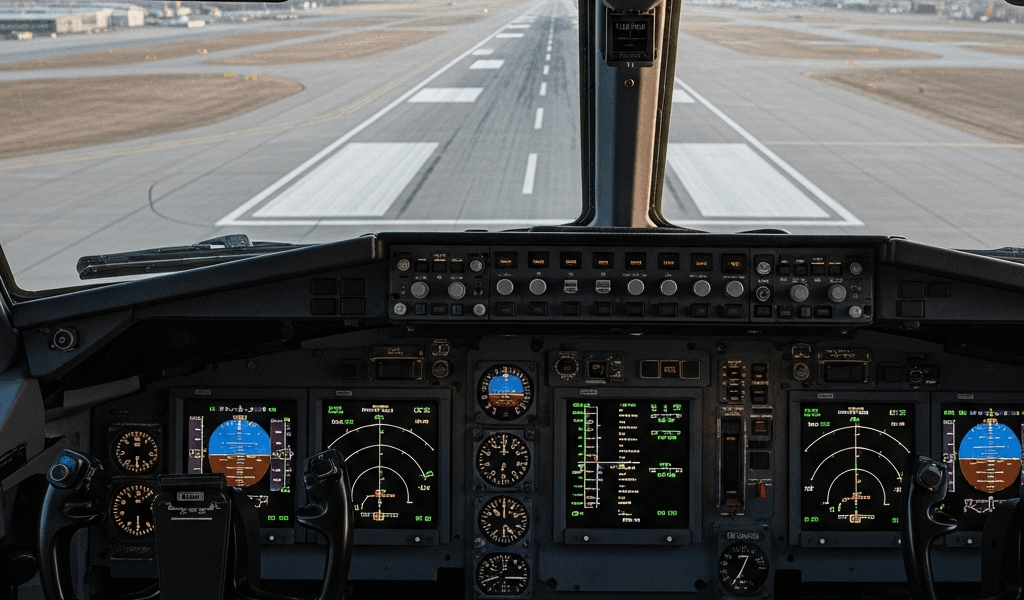
What an Assault Landing Actually Is
Assault landing terminology has gotten complicated with all the misconceptions flying around. The first time I watched a C-17 work an assault approach, I genuinely thought the pilot had misconfigured something. Nose pitched high. Sink rate that looked borderline catastrophic. Gear down way earlier than anything I’d seen before. Then the mains slammed the pavement — and I mean slammed — and the deceleration nearly launched me out of my seat at the observation window.
That’s the thing. That wasn’t a malfunction. That was the point.
But what is an assault landing? In essence, it’s a steep-angle approach — typically 5 to 7 degrees versus the standard 3-degree glide slope — executed to a short or unimproved strip at high sink rates with maximum-effort braking on contact. But it’s much more than that. The aircraft is configured specifically to stop in the shortest distance physically possible, sometimes on dirt, sometimes on combat-damaged pavement, sometimes on perforated steel matting laid over mud. No go-around. No second pass. You committed the moment you turned final.
Operationally, this matters anywhere paved infrastructure stopped existing years ago — or never existed at all. Forward operating bases carved into mountainous terrain. Airfields in contested zones that took damage before you arrived. Expeditionary dirt strips where a Globemaster III has no business operating by normal standards. Except it can. Not because Boeing designed it for this — they didn’t — but because crews train relentlessly to push the aircraft to its actual limits.
Standard approaches forgive a lot. Drifting high? Extend the glide path. Getting unstable? Push the throttles, go around, try again. Assault landings eliminate that margin entirely. The steep angle changes how ground effect behaves. The high sink rate demands throttle and pitch precision happening simultaneously, not sequentially. A long touchdown isn’t just inefficient — it’s a failure. Everything accelerates, and nothing is optional.
How Pilots Get Qualified in the C-17 First
Before assault landings enter the picture at all, there’s the standard C-17 qualification pipeline — roughly 18 months from day one of training to initial operating experience. That’s the baseline. Probably should have mentioned that upfront, honestly.
Most new Globemaster pilots run through Altus Air Force Base in Oklahoma, home of the 97th Air Mobility Operations Squadron and the formal training unit. Approximately 150 simulator hours, 100 actual flight hours, spanning the T-6 Texan II, some KC-135 tanker exposure, and eventually the C-17 itself. Systems knowledge, normal procedures, engine-out performance, instrument flying, cargo ops. Essential stuff. Not glamorous by the standards of what follows.
After initial qualification, pilots report to their operational squadron and log another 200-plus hours across 12 months of initial operating experience. They figure out how their specific unit loads cargo, which routes the squadron actually flies, what the real mission set looks like versus what the syllabus described. By the time a C-17 pilot becomes eligible for assault landing training, they already know this aircraft inside out. They’re not learning to fly the C-17 anymore — they’re learning to fly it against its operational limits.
That distinction matters more than it sounds.
The Assault Landing Certification Process
Probably should have opened with this section, honestly. This is what most people actually want when they search for this topic.
The certification progression runs three phases: ground academics, simulator training, and live flying. Each phase gets completed and validated before the next one opens. No exceptions, no shortcuts — at least not at any unit I’ve ever seen operate with integrity.
Ground Academics and Systems Knowledge
It starts in a classroom. Steep-approach aerodynamics. Takeoff and landing distance cards — TOLD cards — specific to assault operations rather than standard profiles. Weight-and-balance limitations that get tighter as the runway shortens. Runway surface assessment criteria that most transport pilots never think about.
An instructor walks through the C-17’s automatic landing system — yes, the aircraft can technically land itself — and then explains why manual flying is both safer and more tactically flexible when you’re operating somewhere austere. The automation assumes a lot. Manual flying assumes nothing except what you can see and feel.
The specific parameters get drilled until they’re reflexive: approach angle 3-plus degrees, threshold crossing height 35 feet, target touchdown zone starting 1,000 feet down the runway, maximum landing distance 4,500 feet. Those numbers aren’t guidelines. Exceed them and you wash out of the phase. That was true in 2006, still true now.
Ground academics also cover emergency procedures unique to assault ops. Engine failure on short final. Hydraulic degradation mid-approach. Landing on a surface with soft spots or embedded debris. Once you’re committed to an assault approach, the go-around option is gone — so the question becomes: what do you do when something breaks and you’re still going to land?
Simulator Progression
The C-17 full-flight simulator at Altus is remarkably accurate — not perfect, but close enough that instructors trust it for certification events. It replicates handling characteristics, weight distribution shifts as fuel burns, visual cues from the flight deck, and the ground effect behavior changes that start below 500 feet.
First simulator event: daylight, calm winds, good visibility, prepared runway. Just learn the profile. Feel the control inputs required for a steep approach. Practice the flare. Get comfortable with max-effort braking that makes passengers grab their seats. Every event gets recorded and debriefed by an instructor grading approach stability, descent rate control, touchdown accuracy in feet — not approximate feet, actual feet — and stopping distance.
Later events introduce degradation systematically. Crosswinds building to 20 knots. Visibility dropping. Simulated uneven runway surfaces. Thermal turbulence. An engine failure on short final with 800 feet of runway left. By the fifth or sixth event, this isn’t procedure execution anymore — it’s active problem-solving under pressure in conditions that never offer comfort as an option.
Currency in the simulator gets verified through checkrides. An evaluator rides along for a complete profile: takeoff, climb, descent, the assault approach itself, landing, and max-effort stop. Approach angle must hold within limits. Touchdown zone accuracy is measured. Stopping distance is logged data, not an estimate. Deviate beyond limits on two of three approaches and you recycle back to training sorties. I’ve seen it happen to confident pilots. It’s humbling every time.
Real-World Assault Landing Sorties
Transitioning from simulator to actual aircraft is controlled — but it’s real weight, real runway, real consequences. First assault sorties typically happen at prepared airfields. Kirtland Air Force Base in New Mexico is common for this phase. Runways are paved and long enough to be forgiving, but pilots execute genuine steep approaches and max-effort stops rather than simulated ones.
Evaluators fly every sortie. Wind limits are enforced. Fuel requirements are calculated before engine start. Recovery airfield options are briefed and filed. The pilot flies the approach manually, demonstrating actual control authority rather than system management. The landing is recorded. The aircraft’s stopping performance gets logged and compared against what the TOLD card predicted.
Passing this phase requires consistent performance: three consecutive sorties with approaches inside limits, touchdowns in the target zone, stopping distances that are predictable and safe. Fail one sortie and the cycle repeats. Fail two and you’re out of the pipeline. Not suspended — out.
Dirt Strips and Unimproved Airfields — What Changes
Once a pilot demonstrates proficiency on paved runways, the training shifts to unprepared surfaces. This is where complexity jumps significantly — and where the interesting variables live.
Unimproved runways introduce factors that simply don’t exist at prepared airfields. Surface composition: compacted dirt, crushed stone, PSP matting — that’s perforated steel planking — or combinations of all three across a single strip. Drainage and current water content. Ruts, soft spots, settled areas. Foreign object damage risk to the four Pratt & Whitney F117 engines if the nose gear contacts debris during rollout.
TOLD cards get recalculated for every unique surface combination. The same aircraft weight at the same temperature and pressure altitude might need 3,500 feet on paved concrete and 4,800 feet on a dirt strip with marginal drainage and recent rain. Pilots learn to assess surface condition using standardized photographic guides and radio reports from forward observers on the ground. Is the surface trafficable? Any standing water? Has it been graded recently? When was the last heavy aircraft?
The max-effort stopping procedure changes on dirt, too. Reverse thrust application is identical — all four engines to maximum reverse — but landing gear dynamics behave differently. The nose can slew slightly when the nose gear contacts an uneven surface at speed. Main gear can sink into soft areas under braking loads. Directional control becomes active work, not passive monitoring. That’s an important distinction when you’re decelerating through 80 knots on a strip that hasn’t been inspected since last Thursday.
Pilots training for dirt strip operations also work through SOLL II procedures — Short-Takeoff-and-Landing Level II — the formal framework for assessing whether a specific airfield is safe for C-17 operations at all. Runway length, surface composition, obstacle clearance, recovery airfields within range. If a single factor is marginal, assault operations don’t get approved. That discipline has prevented accidents. Probably more than anyone has formally documented.
Staying Current — How Often Pilots Train for This
Certification isn’t the finish line. Once qualified for assault landings, pilots must maintain currency — and in most C-17 squadrons, that means logging at least one actual assault landing every 120 calendar days. One real landing, not a simulator event.
This is genuinely hard to schedule. Assault sorties require an evaluator present, dedicated training range access, and specific airfield clearance. Squadrons don’t always have multiple assault-qualified pilots available on the same week, let alone the same day. The practical solution is integrated simulator training — once per quarter, pilots fly a full-profile assault scenario in the sim with an instructor evaluator. That maintains administrative currency until the next live sortie opens up.
Being out of currency isn’t a minor paperwork issue. Pilots who exceed 120 days without an assault landing complete a full requalification sortie with an evaluator before leading assault operations again. Some squadrons run 90-day requirements instead — because there’s a real difference between technically current and actually proficient, and they’ve apparently decided that 30 days matters.
Don’t make my mistake of assuming the paperwork gap and the proficiency gap are the same thing.
I’m apparently the type who notices this stuff, and watching the contrast is educational. Some pilots log their one required assault landing every 119 days — showing up with no prep, no recent sim work, nothing between sorties. The approaches are sloppy. Touchdowns land long. They stop safely, technically, but barely and not predictably. Then there are pilots who maintain extra sim practice voluntarily, who take extra assault sorties when nobody requires it, who stay genuinely immersed in the profile. Those approaches are stable from the gate. Those touchdowns land in the zone consistently. Those stops are controlled, predictable, deliberate. The technique is visible from the outside.
The gap isn’t procedural knowledge — both pilots know the steps. The gap is proficiency. The actual capacity to execute precisely when it matters, when you’ve committed to a steep approach on a dirt strip somewhere without a recovery option, flying the most expensive airlifter in the world toward a surface that might have soft spots, where the consequences of a sloppy landing aren’t a debrief point but something considerably worse.
That’s what makes the training culture endearing to those of us who follow this closely. The standards exist because the margin doesn’t.

Subscribe for Updates
Get the latest c-17 pilot updates delivered to your inbox.
We respect your privacy. Unsubscribe anytime.