C-17 Cockpit Layout What Every Control Does
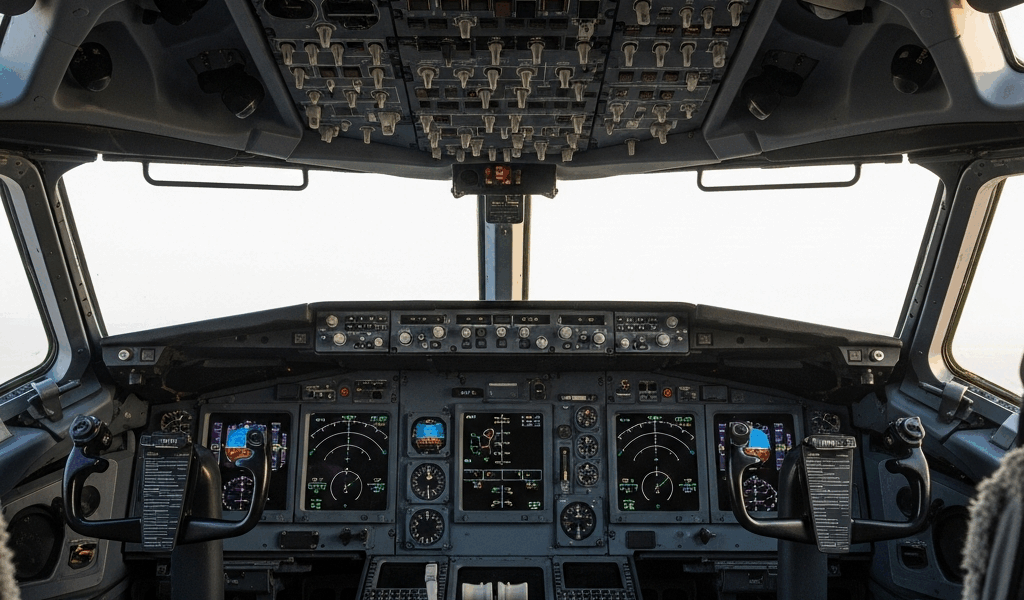
What You See When You First Climb In
C-17 cockpit orientation has gotten complicated with all the simulator footage and YouTube walkthroughs flying around. Most of it misses what actually matters. As someone who spent years logging hours in military airlift, I learned everything there is to know about what that flight deck demands from the people sitting in it. Today, I will share it all with you.
Walking into a C-17 cockpit the first time hits different than you expect. The space feels purposeful — almost sparse compared to the analog chaos of legacy airlifters like the C-141. Two pilot seats dominate the forward section, reclined at a functional angle that lets you see both the instrument panel and the windscreen without contorting your neck. Martin-Baker ejection seats, same technology fighter pilots use. You’ll almost never actually eject from a cargo aircraft. But they’re there.
Behind those seats sits the center console. This is real estate — throttle quadrant, fuel panel selectors, landing gear controls, and the Flight Management System interface, all within arm’s reach of either pilot. The overhead panel stretches above your head like a grid of switches and circuit breakers. Electrical buses. Hydraulic selectors. Pressurization controls, anti-ice systems, lighting panels. Maybe fifteen feet of integrated glass displays running the length of the main instrument panel. No steam gauges. No mechanical backup instruments like you’d find in older cargo birds.
Probably should have opened with this section, honestly — the spatial layout matters more than most people think. Everything on that flight deck was positioned with one philosophy: reduce pilot workload during high-stress phases, especially at low altitude, high speed, or during combat offload operations.
The C-17 Globemaster III entered service in 1995 and represented something genuinely different. One of the first large military transport aircraft built around a fully digital flight deck from the ground up. That single design choice compressed what used to require three flight engineers and a navigator into a cockpit where two pilots manage an 840,000-pound aircraft across intercontinental ranges. That’s what makes the C-17 endearing to us airlifters — it asks more from fewer people and somehow delivers anyway.
The Main Instrument Panel and MFDs
Your eye naturally centers on the multifunction displays. Six of them, arranged in two rows across the main panel — two upper display units and four lower display units. Each can show different information simultaneously. Sounds simple until you’re managing a full systems failure at 1,500 feet on approach to a dirt strip in eastern Afghanistan at 0200 local.
During preflight, you’re cycling through system pages. Engine parameters — N1, N2, fuel flow, exhaust gas temperature, hydraulic pressure across all four engines. Pilots scan these numbers the way a surgeon watches a monitor before the first incision. You want symmetry across all four Pratt & Whitney F117-PW-100s. Any deviation signals trouble. Small deviations signal small trouble. Big ones mean you’re not going anywhere today.
In cruise, one pilot typically manages navigation and route tracking on the upper displays while the lower displays show fuel accounting, center of gravity, and system status pages. The FMS feeds continuous position data and wind corrections into fuel calculations. Over an eight-hour transpacific flight carrying 134,000 pounds of cargo, fuel planning isn’t abstract — it’s the difference between landing with 45 minutes of reserve or diverting to Guam at 3 a.m. I’ve seen both scenarios. One is a non-event. The other involves a lot of phone calls.
The glass cockpit consolidated what used to be separate instruments into unified data streams. Temperature, pressure, electrical load, hydraulic redundancy — all of it flowing into those screens. A legacy C-141 crew burned mental energy cross-referencing individual gauges all flight long. C-17 pilots get integrated system health summaries. Efficient, but only if you genuinely understand what you’re looking at.
Navigation and Approach
For instrument approaches, the primary flight display shows attitude, altitude, airspeed, vertical speed, and course guidance. But underneath that layer, the FMS has already loaded the approach procedure, built the descent plan, calculated wind drift, and briefed the missed approach routing. You’re not flying a needle across a dial anymore. You’re monitoring an autopilot actively managing a three-dimensional flight path down to a single runway in Kandahar at midnight — one with no approach lighting and maybe marginal visibility.
That capability changed mission profiles outright. C-17s land on shorter airfields in worse weather with less ground infrastructure than their predecessors ever managed. The downside? If you don’t understand that system deeply, you become a passenger in your own cockpit. Don’t make my mistake of assuming proficiency in the sim translates cleanly to line operations. It doesn’t, not immediately.
Overhead Panel — Where Systems Management Lives
Spent hours studying the overhead panel during my first C-17 assignment — at least if you count the times I sat in a darkened simulator just staring at switch positions. I’m apparently a tactile learner and physically tracing panel zones works for me while reading diagrams never really clicked. Different people, different methods. Find yours early.
Split the overhead into functional zones. Left side: electrical power distribution. Four engine generators, one external power unit receptacle, backup batteries. Pilots verify generator outputs, set the electrical bus configuration, check backup systems. It matters because losing generators in flight means the FMS, displays, and flight control computers need alternative power sources immediately — not eventually, immediately.
Center section handles the fuel system. Eight tanks total — two in each wing, two in the fuselage, with crossfeed capability between all of them. Fuel quantity indicating systems, crossfeed selectors, engine feed controls. Bad fuel management runs one wing dry while the other holds thousands of pounds in reserve. I watched a young captain nearly make that exact mistake on a ferry flight to Ramstein AB until the flight engineer caught it during cruise checks. That was a quiet thirty seconds on the intercom afterward.
Hydraulic panel. Four independent systems — not redundancy for convenience, but for flight control surfaces, landing gear, and cargo door operation. Each system has isolation switches, pressure gauges, and isolation check procedures. You need all four healthy for normal operations. Lose one and you’re still flying. Lose two and approach planning changes immediately. Lose three and you’re having a very different kind of day.
Right side covers environmental control, pressurization, and anti-ice. The C-17 operates from sea level to 45,000 feet regularly. Pressurization failures demand immediate descent and emergency procedures — no deliberation, no committee meeting. Anti-ice systems on the engines and leading edges require active monitoring during climb through icing altitudes. You’ll see icing conditions between 5,000 and 22,000 feet consistently over water or mountains. Expect it rather than hoping to avoid it.
Lighting panel rounds out the overhead. Position lights, strobes, landing lights, cargo ramp lights, interior illumination. For night operations at austere airfields, lighting discipline prevents errors. You want the ramp lit for cargo handling — but not so bright that night vision goggles become useless for tactical operations. That balance takes practice and a loadmaster who communicates well.
Center Console — Throttles, FMS, and Comms
But what is the center console, really? In essence, it’s the primary interface between pilots and aircraft power, navigation, and communications. But it’s much more than that — it’s where the mission actually gets executed, not just monitored.
The throttle quadrant sits front and center. Four throttles for four engines, arranged in a row you can manage with either hand. The FMS interface lives just inboard — a keyboard interface with a screen roughly six inches across. It looks almost quaint compared to what commercial pilots manage on a 777-300ER. For cargo operations, though, it’s precisely adequate. You load airdrop target coordinates and the system calculates release points based on wind forecasts, aircraft weight, and descent profiles. For humanitarian operations dropping supplies into remote valleys in Pakistan or Nepal, that capability separates precision delivery from supplies scattered across a five-mile radius.
Communications stack beneath the FMS. VHF, UHF, HF radios, satellite communications. Long-range deployments mean managing multiple frequencies simultaneously — orbiting over Iraq at flight level 310, monitoring both air traffic control clearances and tactical direct air support nets at the same time. Switching between networks manually takes seconds. Wrong frequency selection during a critical moment creates genuine risk. Seconds matter at that point.
Intercom system connects pilots, cargo crew, loadmasters, and tactical operations centers. On a full operation with eight or nine people distributed across the aircraft, comm management becomes a workload item by itself. I’ve trained with crews that dedicated entire pre-departure briefs to comm architecture — who talks when, on what net, using which call signs, with explicit radio discipline protocols. That level of structure sounds excessive until you’re coordinating a combat airdrop with four agencies simultaneously.
How the Cockpit Changes the Way Crews Fly
So, without further ado, let’s dive into what this flight deck actually changed about military airlift operations — because the cockpit layout isn’t just ergonomics. It’s doctrine made physical.
Frustrated by the crew-intensive demands of legacy airlifters, Boeing and the Air Force designed the C-17 using a two-pilot crew concept that consolidated systems management into integrated displays and automated monitoring. This new approach took shape through the late 1980s and eventually evolved into the full-authority digital flight deck that C-17 crews know and depend on today.
Legacy airlifters needed three pilots — two flying the aircraft, one managing systems full-time. The C-17 performs those functions with two. That’s efficiency, but it’s purchased through intensive systems training and significantly higher workload concentration during abnormal operations. No free lunch. The math just moved.
Situational awareness improved measurably regardless. Integrated displays deliver system health status instantly rather than requiring cross-checks between a dozen separate gauges. Autopilot and FMS integration means precise navigation and fuel planning that older crews genuinely envied. Load a complex approach procedure, brief it, execute it with precision that earlier generations couldn’t reliably achieve.
There’s a cost, though. Newer pilots transitioning from simulators to line flying sometimes struggle with the depth of systems knowledge required. Hydraulic redundancy, electrical bus architecture, fuel transfer logic — you cannot fake understanding these systems at altitude when something actually breaks. That’s exactly why the C-17 training pipeline includes months of ground school and hundreds of simulator hours before anyone touches actual controls. While you won’t need to memorize every circuit breaker on the overhead panel, you will need a handful of foundational systems frameworks that make everything else click into place.
Walk through that flight deck knowing what the displays show, what the overhead systems control, and how the center console manages power and navigation. The cockpit layout reflects a training reality — everything positioned logically, everything with a purpose, nothing installed to look impressive. Understanding it means understanding not just a cockpit, but how modern military aviation actually works at the operational level.
See the complete C-17 interior layout, including the cargo hold and flight deck. Read the related guide.

Subscribe for Updates
Get the latest c-17 pilot updates delivered to your inbox.
We respect your privacy. Unsubscribe anytime.