How C-17 Pilots Land on Unimproved Dirt Airstrips
How C-17 Pilots Land on Unimproved Dirt Airstrips
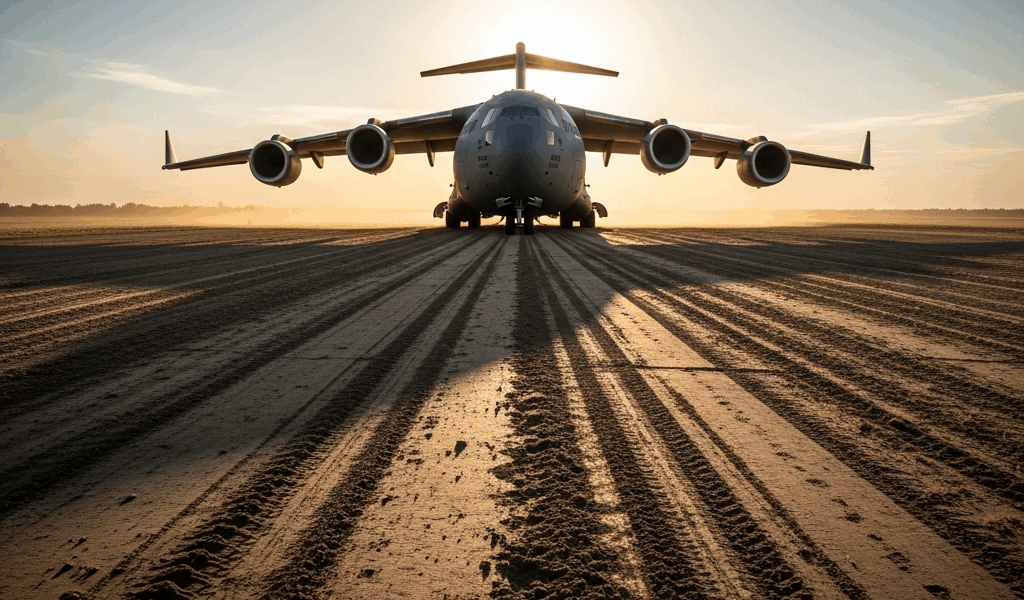
Dirt strip operations have gotten complicated with all the misinformation flying around — half the internet thinks the C-17 Globemaster III is just a big cargo plane that needs a proper airport, and the other half treats it like some kind of magic trick. As someone who spent months talking with retired USAF C-17 pilots who’ve actually done this — in Iraq, Afghanistan, and West Africa humanitarian ops — I learned everything there is to know about how these landings actually work. Today, I will share it all with you.
The actual procedure almost never shows up in detail anywhere. You find doctrinal summaries. You find specs. You don’t find what it actually feels like to descend toward a brown runway with no lights, no ILS, and maybe a crater from last week’s weather. So, without further ado, let’s dive in.
What Makes a C-17 Capable of Dirt Strip Operations
But what is a C-17, really, in terms of capability? In essence, it’s a heavy military airlifter that can operate from 3,000-foot semi-prepared surfaces. But it’s much more than that.
A Boeing 777 freighter needs 10,000 feet of paved runway. The Globemaster doesn’t. The design details are deliberate — every single one of them. Externally blown flaps generate lift at lower speeds than conventional high-lift devices, which drops approach speeds to around 130 knots instead of the 160-plus knots you’d see on a commercial airliner. The nose gear runs smaller tires rated at 600 psi. Main gear tires run at 1,500 psi. All of them operate at lower pressures than you’d expect — this spreads the aircraft’s 585,000-pound max gross weight across soft ground without sinking like a boot in mud.
Thrust reversers work in what crews call reverse taxi mode. The C-17 can back up under its own power on a narrow strip — critical when there’s no turnaround pad at the end of a jungle clearing. The landing gear itself is articulated for rough terrain, overbuilt, and designed to absorb sink rates that would tear apart a civilian transport. That’s what makes the C-17 endearing to us aviation enthusiasts. Capability and smart execution are different things, though. The aircraft can do it. Crews have to decide whether they should.
Pre-Mission Planning for an Unimproved Runway
Every unimproved runway mission starts with the same question: What’s the actual condition right now? Not the weather forecast. Not the report from two days ago. The specific, current load-bearing strength of the surface.
The USAF uses CBR values — California Bearing Ratio — as the standard. A CBR of 3 means the runway can support a C-17. A CBR of 1.5 means you’re gambling. These numbers come from field teams, Army pathfinder squads, or special operations personnel who’ve driven equipment across the strip and pushed soil probes in by hand. I once trusted a report that was seventy-two hours old during monsoon season. Don’t make my mistake. The surface had gone from marginal to boggy. We diverted.
The crew assembles these data points before every single mission:
- Runway length and width — minimum 3,000 feet × 90 feet, though 4,000-plus is preferred
- Surface composition — clay, laterite, PSP (pierced steel planking), or mixed contamination
- Moisture content and drainage condition
- Obstacle clearance on approach and departure — trees, terrain, structures
- Thermal and dust activity patterns for the expected landing window
- Whether repair crews or grading equipment are staged to manage surface degradation between sorties
The navigator plots the approach course with obsessive precision. Unimproved airstrips rarely have instrument approaches — you’re working from GPS coordinates, visual landmarks, and maybe, if you’re lucky, a PAPI unit or some chemical lights laid out by the ground team. Headwind components, density altitude effects on landing distance, abort points — all calculated before wheels leave the ground.
TOLD data — takeoff and landing distance — changes completely on soft surfaces. Standard C-17 landing distance tables don’t apply here. Crews use dedicated software that factors in CBR, moisture content, temperature, and payload weight. I’ve seen landing distance requirements jump from 4,500 feet on concrete to 6,200 feet on soft dirt at identical weight and weather conditions. That difference decides whether a strip is usable or a non-starter — period.
Coordination with forward air elements is non-negotiable. If an Army ALCE — Airlift Liaison Element — is on-site, they own the runway condition report. Remote humanitarian operations mean talking to whoever’s on the ground: NGO staff, medical teams, local coordinators. That communication has to be specific. “Runway is rough” is useless information. “Runway has ruts three feet deep on the south half and pooled water in the center” is actionable intelligence. Those are very different conversations.
Flying the Approach Into a Dirt Strip
The descent profile for an unimproved runway runs shallower than an instrument approach but steeper than a typical visual pattern. Around 3 degrees — maybe 3.5. Visual cues are everything out here.
Without ILS or PAPI, the crew hand-flies the entire approach, using the HUD to maintain descent profile and alignment simultaneously. The pilot cross-checks altitude against groundspeed and estimated descent rate. On a 3,000-foot runway, threshold crossing happens at exactly 50 feet and 130 knots. No lower — you land short. No higher — you land long and run out of stopping room. There’s almost no margin for sloppiness.
Dust is the killer. Brownout conditions develop fast — especially in West Africa during dry season or across the Middle East when the C-17’s exhaust starts kicking up surface material during descent. The crew briefs a go-around altitude of 200 feet and commits to it before the approach even starts. If the runway isn’t clearly visible by that point, you’re going around. Full reverse, full power, climb out, wait five minutes for the dust to settle, try again. I’ve done it. It’s not failure — it’s the only safe choice available.
Both pilots scan constantly for obstacles during the approach: animals, vehicles, people on an uncontrolled strip. Radio calls to ground personnel happen early — “We are five minutes out, confirm runway is clear.” Not everyone on the ground understands airfield operations. You’ll see goats, cattle, even parked trucks near the threshold. The crew briefs a low pass if conditions allow — a 500-foot burn-in to scatter wildlife and confirm surface condition visually before committing to the actual landing.
The approach itself is smooth and committed. No slips or S-turns to lose altitude — those eat runway. Descent rate stays constant. Around 500 feet, the pilot begins the flare, reducing power gradually. Externally blown flaps are already deployed at high settings — usually 25 degrees. The nose pitches up slightly, speed bleeds off, and the aircraft settles toward the dirt.
Touchdown and Rollout on an Unprepared Surface
Landing on dirt is firm. Main gear touches first, nose gear follows — and at 130 knots on a dirt runway, you feel more deceleration, more feedback through the airframe than you’d ever get on concrete. It communicates differently.
The moment mains touch down, both pilots go to maximum reverse thrust. Immediately. This isn’t gradual. Thrust reversers deploy fully — reverse idle isn’t a thing on a dirt strip landing. You want maximum braking effect in the shortest possible distance. The engineer watches engine parameters — temps, vibration signatures, any anomalies. The loadmaster stays alert for cargo shifts or stress sounds from the airframe.
Probably should have opened with this section, honestly: FOD — foreign object damage — is a real and immediate consideration. Reverse thrusting on a loose dirt surface throws rocks, dust, and debris straight into engine intakes. You’re accepting that risk because stopping matters more than engine preservation in that moment. Crews have to be confident the strip surface is clear of large debris before committing to the approach. Any doubt changes the whole calculation.
Braking on soft surfaces is delicate work — nothing like braking on concrete where you press hard and stop. Pushing toe brakes hard locks the wheels on dirt. Locked wheels dig in and can flip the aircraft or cause directional control loss immediately. C-17 pilots use progressive braking — feel the surface, apply pressure gradually, modulate constantly as the aircraft slows. It’s active, continuous adjustment from touchdown to full stop.
Rollout distance on soft CBR surfaces runs 40 to 50 percent longer than on pavement. A 5,000-foot dirt strip with poor CBR might only give you 3,000 feet of usable stopping distance. That’s tight. The navigator calls it out: “Three thousand feet remaining… two thousand… thousand feet remaining…” The pilot focuses on directional control, aiming for runway center, watching for ruts or washouts that could catch a main gear and drag the aircraft sideways at speed.
Common Hazards Crews Watch For on Dirt Strips
Surface degradation happens fast — faster than most people realize. One C-17 landing leaves ruts. Two landings start to pancake the soil. By the fourth or fifth arrival, the runway is visibly worse than when the first crew saw it. Multiple sorties into the same strip mean each subsequent crew inherits fewer good landing options. That’s a planning problem, not just a flying problem.
Hidden washouts catch people. A rainstorm the night before creates drainage channels invisible from the air — a crew spots what looks like a clean runway and doesn’t realize there’s a one-foot drop-off on the south edge that will catch a main gear and tear off an engine pod. That’s exactly why low passes, ground coordination, and current CBR data are non-negotiable before every single approach.
Animals are a persistent problem. Goats, donkeys, cattle — even wild animals in remote African or Central Asian strips. They don’t understand what jet noise means. Ground personnel have to actively clear the strip, and crews brief go-around procedures specifically for wildlife encounters during final approach. It comes up more than people expect.
Abort criteria are simple and firm. At 200 feet with no clear runway — go around. On the landing roll when surface conditions suddenly degrade — directional control and staying on the surface become the only priorities. Options narrow fast once you’re committed and rolling on dirt at speed.
Departure is actually harder than arrival on some strips — and this surprises people. You’re heavier on rotation, which increases sink risk immediately after wheels up. Crosswinds matter more during initial climb. Crews plan reduced-load departures where possible, take the shortest roll achievable, and rotate firmly. Banking too early catches a wingtip on rising terrain. The departure brief runs just as detailed as the arrival brief — sometimes more so. That was true in Afghanistan. It was true in West Africa. It’s true everywhere.
Landing a C-17 on dirt is possible because the aircraft was specifically built for it. But it only stays possible when crews treat every single mission like it could be their last opportunity at that strip. The margin is thinner out there. The variables multiply. The stakes are real — and experienced crews never let themselves forget that.

Subscribe for Updates
Get the latest c-17 pilot updates delivered to your inbox.
We respect your privacy. Unsubscribe anytime.