How C-17 Pilots Train for Aerial Refueling Operations
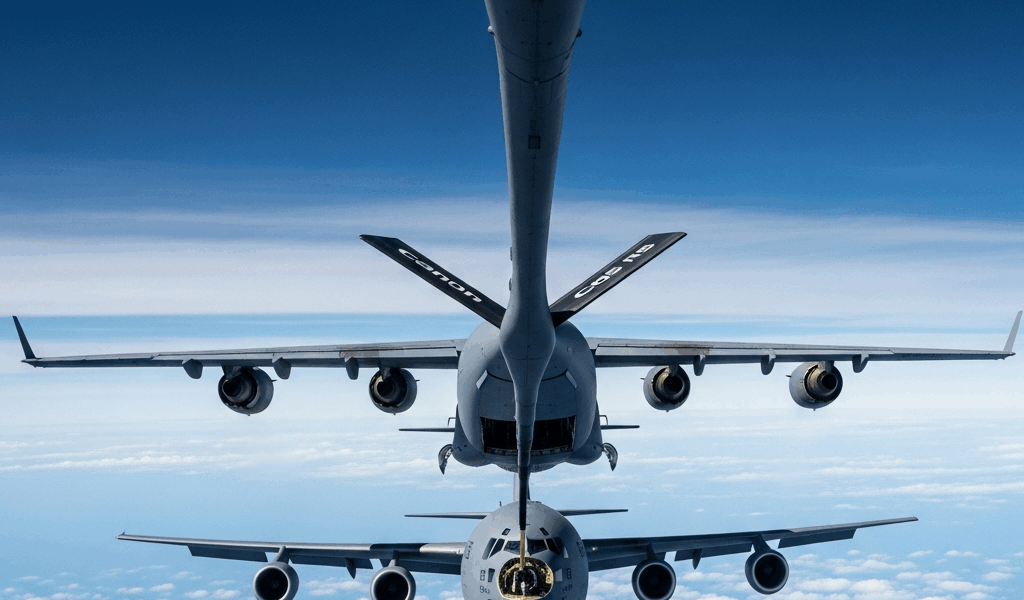
Why Aerial Refueling Is a Core C-17 Mission Requirement
Aerial refueling for C-17 pilots has gotten complicated with all the misconceptions flying around. People assume it’s a niche skill — a cherry on top of an already demanding qualification. It isn’t. It’s the whole cake.
Here’s the math, plain and simple. Unrefueled, a C-17 hauls 170,000 pounds of cargo roughly 2,400 nautical miles. Add two or three aerial refueling contacts and that number climbs past 4,500 nautical miles. That gap — those 2,100 extra miles — is the difference between parking at an intermediate staging area and actually delivering to a forward base in the Middle East or Eastern Europe. Without refueling, you’re a regional truck. With it, you’re genuinely global.
Most C-17 operations pair with either a KC-135 Stratotanker or a KC-10 Extender. The KC-135 is the workhorse — older, more numerous, smaller boom diameter. The KC-10 hits heavier, carrying more fuel with a larger boom, though you’ll see fewer of them rotating through. The KC-46 Pegasus started entering service more recently, bringing slightly different boom geometry that crews had to absorb fast. New procedures, new muscle memory, same unforgiving sky.
The qualification isn’t optional — not even a little. It’s written directly into the baseline requirements every C-17 pilot must meet. No aerial refueling credential in your logbook? Your aircraft isn’t considered fully mission-capable. Full stop.
That’s what makes this skill endearing to us transport pilots. It’s not glamorous. Nobody’s making movies about boom geometry. But it’s what separates a capable airlifter from a truly strategic one. So, without further ado, let’s dive in.
Ground Training and Simulator Requirements Before First Flight
Probably should have opened with this section, honestly. Before any pilot gets within 50 feet of a tanker in actual air, they spend serious time in a fluorescent-lit room with PowerPoint slides and a very patient instructor.
Ground school covers boom geometry, fuel transfer management, pressure limitations, and boom operator signal interpretation. You learn that the C-17’s receptacle sits on the upper fuselage, forward of the wings — a detail that sounds trivial until you’re trying to visualize your exact position relative to a moving boom at 20,000 feet with wake turbulence pushing your nose around.
Then come the boldface procedures. These are memory items — no checklist, no looking anything up. Loss of pressurization during contact. Inadvertent boom disconnect. Emergency breakaway sequence. You drill these until the words come out automatic, like reciting your own phone number. Honestly, the boldface deck was harder than I expected the first time through. The procedures aren’t built around intuition. They’re built around worst-case scenarios that never unfold the same way twice.
After academics comes simulator time. Full-motion C-17 training devices — typically at a dedicated training squadron — replicate the visual picture reasonably well. Tanker ahead, boom extended, contact position established. The sim models throttle response, pitch sensitivity, roll behavior, even a rough version of wake turbulence. It gets you 70% of the way there.
The other 30% the sim simply can’t deliver. There’s no physical sensation of flying 50 feet off another aircraft’s tail. The visual cues are flat. You can’t feel the subtle wing-rock that disturbed air produces in the real world. Most pilots describe their first live aerial refueling contact as visually more compressed and dynamically more sensitive than anything the simulator suggested. Don’t make my mistake of thinking the sim fully prepares you. It doesn’t.
Most squadrons push pilots through four to six simulator sorties before approving live contact work. Each session builds on the last — approach procedures first, then establishing position, maintaining contact, then practicing breakaway execution.
Flying the Contact Position — What Makes the C-17 Unique
As someone who has flown the contact position in actual operational conditions, I learned everything there is to know about how the C-17’s size works against you in ways no preflight briefing fully captures. Today, I will share it all with you.
Stabilized behind a tanker at 20,000 feet, a C-17 pilot confronts handling characteristics that simply don’t carry over from lighter airlifters or tactical transports. The aircraft is 170 feet long with a 169-foot wingspan. When you’re sitting 50 feet behind the boom, looking up at it through the cockpit glass, that size becomes a liability. You don’t have the tight visual reference points a fighter pilot relies on. Pitch changes feel delayed — you’re managing control inputs across a longer moment arm than most transport pilots have trained on.
But what is the contact position? In essence, it’s a defined box in three-dimensional space: 25 to 50 feet behind the boom tip, centered laterally, receptacle aligned to accept contact. But it’s much more than that. It’s a constantly moving target you’re chasing through invisible air currents while coordinating with two other crew members and a boom operator on a separate aircraft.
Throttle management is the first skill separating competent pilots from confident ones. At contact altitude — typically 16,000 to 24,000 feet depending on tanker type and weather — a 200-RPM power adjustment can move the C-17 ten feet forward or backward. You’re making micro-corrections constantly. New pilots make them too large. Every one of them.
The boom operator talks you in using a standard call rhythm. “C-17, move up 10 feet… left 5… stable.” You’re processing three-dimensional positioning instructions while flying the aircraft, monitoring your instruments, and coordinating simultaneously with a co-pilot and flight engineer. The flight engineer — sitting between the two pilots — monitors fuel transfer, system pressures, and boom position in real time. “2,000 pounds transferred… 4,000… contact stable.” That information runs through your head continuously while you’re flying. Miss a callout and you might not catch a fuel imbalance until it becomes an actual problem.
Wake turbulence from the tanker creates invisible disturbances that push wings down or lift the nose unpredictably. The KC-10, being heavier and traveling at similar airspeeds, generates noticeable turbulence. The C-17, large but relatively light for its dimensions, gets tossed more than a smaller receiver would. You’re correcting for forces you cannot see.
Crew coordination becomes automatic through repetition — and only through repetition. The co-pilot cross-checks heading, altitude, and power setting. The engineer manages fuel. You fly. Silence means the system is working. The moment someone sounds uncertain — hesitation in a callout, a missed update — the whole rhythm fractures.
Common Errors New C-17 Pilots Make During Aerial Refueling
I’m apparently an overcontroller by default, and deliberate restraint works for me while chasing inputs never does. Most new C-17 AR pilots share this problem, even if they won’t admit it during debrief.
Chasing is the most common mistake. You’re 40 feet back. The boom operator calls “move forward 5 feet.” You push forward on the controls. But the boom is moving, the tanker drifted slightly, and your input takes 2 seconds to produce visible results — by which point you’re 15 feet closer than intended. Now you’re overcorrecting backward. The oscillation starts small and compounds until you’re hunting position constantly, burning extra fuel, and frustrating the boom operator who’s watching this from 50 feet away.
Small inputs. Patience. Trust the aircraft to respond. This takes actual flights to internalize — the sim doesn’t teach it properly.
Rudder overuse is another classic. New pilots feel yaw, reflexively step on the rudder pedal, overcorrect, and suddenly they’re fishtailing laterally while the boom operator announces, “Stop — you’re oscillating.” The C-17’s directional stability is strong. Its rudder is powerful at altitude. A small yaw does not require a rudder input the size of what you’d use on a fighter.
Fuel balance management catches people off guard because nothing about it is intuitive. As fuel transfers from the tanker, weight distribution shifts across the airframe. The engineer adjusts fuel pumps and crossfeed valves to keep everything balanced. If the pilot and engineer haven’t coordinated properly before boom contact, or if setup procedures got skipped, you can end up fighting trim changes mid-transfer — which breaks position stability and compounds every other error you’re already managing.
Communication breakdowns are rarer but more serious when they happen. Pilot says “ready for contact,” engineer misses the callout, boom connects, fuel flows, and nobody’s actively monitoring system pressures. That’s the scenario that turns a routine refueling into an incident report. Rare — but not rare enough to ignore.
Breakaway Procedures and What Happens When Things Go Wrong
Frustrated by ambiguity around breakaway execution, experienced C-17 instructors developed a simple internal rule using nothing more than repetition and discipline: when breakaway is called, you move immediately — using wings level, nose down, slight throttle reduction as a single automatic sequence.
This new habit took off several years later and eventually evolved into the standardized breakaway muscle memory C-17 crews know and drill today.
Breakaway is called by either the boom operator or the pilot. Standard scenario: boom operator announces “breakaway,” pilot acknowledges and executes. Roll wings level. Pitch nose down. Throttle back slightly. Establish separation. This needs to happen in seconds — not after a thoughtful pause, not after confirming with the engineer. Seconds.
Emergency disconnect is rarer. A boom releases inadvertently during a pressure spike, a structural anomaly, or a sudden control input that overloads the boom structure at contact. When it happens, the C-17 pilot feels almost nothing. The engineer catches the pressure drop first, announces the disconnection, and the pilot executes immediate breakaway. Fuel may still be venting from the receptacle — which is exactly why you’re climbing away from the tanker quickly and descending afterward to allow remaining fuel to drain naturally. While you won’t need to memorize every possible failure mode, you will need a handful of immediate-action responses drilled cold, without reference to any checklist.
Most sorties debrief in a structured, honest format. What went well? Where were you out of position? Did the engineer catch a drift before you did? Did communication hold its rhythm? Good squadrons use these debriefs without softening the feedback. That feedback loop — specific, uncomfortable, immediate — is what moves a pilot from barely acceptable to genuinely competent.
First, you should expect four to six live sorties before position holding stops feeling like active concentration — at least if you want to reach true automaticity rather than just minimum qualification standards. The boom operator stops correcting constantly. You’re flying the position instead of chasing it. That transition is when you actually know you’ve arrived.
True mastery takes longer. Holding position through moderate turbulence, transferring maximum fuel load, coordinating with a tanker crew you’ve never worked with before — these scenarios separate experienced AR pilots from the ones meeting minimums and nothing more. But the baseline competency? Most C-17 pilots reach it within the first month of qualification sorties. The ceiling above that baseline is where the real work begins.

Subscribe for Updates
Get the latest c-17 pilot updates delivered to your inbox.
We respect your privacy. Unsubscribe anytime.