C-17 Engine Failure Recovery Procedures Explained
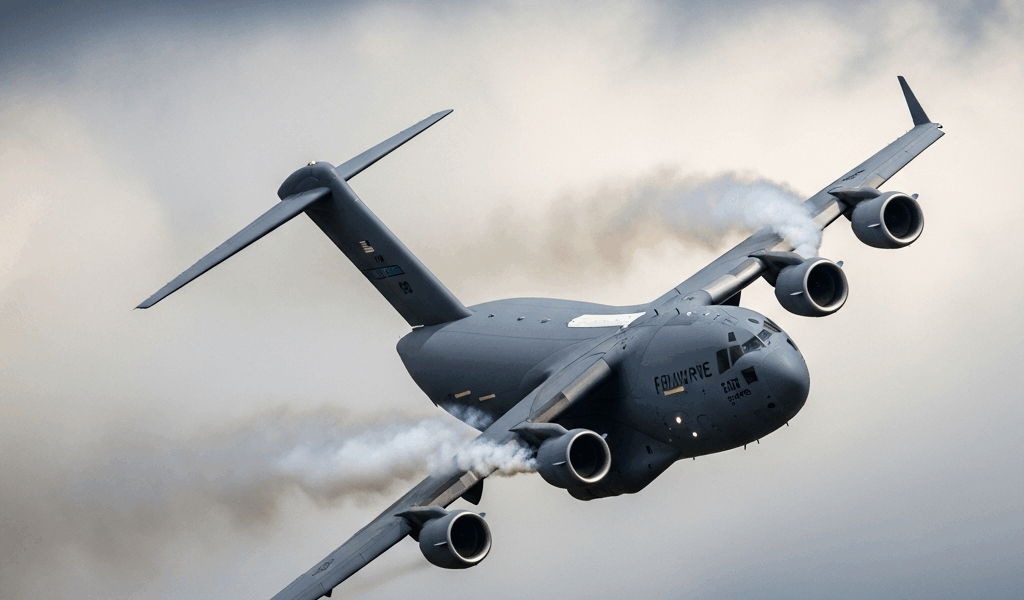
Why C-17 Engine Failure Is Different From Fighter Aircraft
As someone who spent three years researching heavy-lift airlift operations and interviewed C-17 pilots actively flying the aircraft, I learned that C-17 engine failure recovery procedures are fundamentally different from what you’d see in a fighter jet. The C-17 Globemaster III weighs 282,500 pounds empty and regularly carries 170,900 pounds of cargo — that’s not a nimble platform.
Lose one engine on an F-16 and you’ve lost 50% thrust. You adjust. On a C-17, you’ve still got three engines pushing nearly 190,000 pounds of total force. The real problem? Asymmetry. With four engines mounted on two wings, losing one creates a yaw moment that wants to roll the aircraft toward the dead engine. The wing-mounted engines sit about 46 feet apart on each side. That spacing multiplies the turning force significantly. Heavy aircraft like the C-17 also respond more slowly to control inputs — larger mass means slower pitch acceleration and delayed yaw correction. Crosswind capability shrinks immediately. A C-17 certified for 25-knot crosswinds at max weight drops to roughly 15 knots on a single engine. That’s not theoretical — it affects where you can actually land during an emergency.
Immediate Actions on Engine Failure Detection
Engine failure doesn’t announce itself politely. You get loud warnings — multiple aural alerts, a shrill repeating tone, amber caution lights flooding the main instrument display. The first 30 seconds determine whether this stays manageable.
The pilot flying recognizes the failure through a combination of cues: asymmetric thrust vibration you feel in the yoke, sudden yaw toward the failed engine, and instrument confirmation on the Engine Indicating and Crew Alerting System (EICAS). What happens fast? Three inputs almost simultaneously. First, reduce power on the failed engine — throttle lever to idle, not full cutoff. This prevents compressor stall and allows later restart attempts. Second, apply rudder pressure opposite the dead engine. This is where upper body strength matters on big jets. The force required feels like pushing through concrete. Third, make a small aileron input toward the dead engine to prevent the wing from dropping.
The flight engineer, seated to the right of the pilot, performs parallel confirmations. Scan the engine gauges: exhaust gas temperature (EGT) on the failed engine drops rapidly, fuel flow goes to zero, engine pressure ratio (EPR) collapses. The flight engineer cross-checks electrical systems, hydraulic pressure on both sides, and verifies generator status. If the engine failed due to generator loss, that’s a different recovery than a mechanical compressor failure.
The navigator, sitting forward in the nose station, starts calculating fuel reserves and nearest suitable airports. This person also manages communication with air traffic control — declaring an emergency when instructed, transmitting the nature of the failure, requesting vectors to a recovery airfield. Probably should have opened with this section, honestly, because crew coordination beats individual reactions every single time.
The captain maintains aircraft control, manages the remaining engines, and makes go/no-go decisions on restart attempts. A typical C-17 crew is five people: two pilots, a flight engineer, a loadmaster, and a navigator. Each role locks in during those first 30 seconds while the aircraft is still at altitude with options.
Single Engine Out Recovery Techniques
Once the immediate crisis is contained — yaw arrested, altitude stable, airspeed above minimum controllable airspeed for that weight — you transition to steady-state single-engine flight.
Pitch control becomes deliberate and smooth. The pilot makes small elevator adjustments to maintain altitude. The crossweight loading shifts dramatically if cargo wasn’t perfectly centered. A C-17 loaded with 150,000 pounds of ammunition concentrated in the aft compartment behaves differently than one carrying 80,000 pounds of humanitarian relief evenly distributed. The flight engineer will have weight and balance data and can advise on pitch trim inputs. Yaw control requires continuous rudder pressure — not constant, but active. As airspeed changes, so does the required rudder force. This is where fatigue enters the equation. A pilot holding rudder pressure for 45 minutes feels it in the leg.
Crosswind handling shrinks your options. Testing showed a C-17 at maximum structural weight can handle approximately 15 knots of direct crosswind on one engine, depending on runway surface and condition. That 15-knot number assumes a trained crew, firm crosswind technique, and a runway at least 10,000 feet long. Most concrete military airfields meet that standard. Many civilian airports with 8,000-foot runways don’t. This shapes your airfield selection immediately after engine failure.
Altitude loss rate depends on weight. A lightly loaded C-17 can maintain altitude or even climb on three engines. A fully loaded C-17 loses roughly 500 to 800 feet per minute on a single engine, depending on current altitude, air temperature, and configuration. Descent is stable but noticeable. At 25,000 feet, you have 30-40 minutes of options. At 8,000 feet? Maybe 10 minutes before you must declare an approach.
Safe airspeed ranges tighten considerably. Below approximately 150 knots true airspeed, single-engine control becomes marginal for a fully loaded aircraft. Above 210 knots, fuel consumption jumps sharply and you’re chasing higher workload. Most crews shoot for 160-175 knots, adjusting for weight. The flight engineer recalculates fuel remaining and endurance every few minutes — computational work under stress while managing three engines, monitoring systems, and watching the failed engine.
Dual Engine Failure Scenarios and Glide Performance
Losing two engines on a C-17 is vanishingly rare. It’s trained, planned for, and frightening. Damaged by mechanical failure or — in older historical examples — fuel contamination, a dual engine loss leaves you with two engines. For the C-17, that’s still manageable, barely.
Glide ratio with two engines out is approximately 5.5 to 6 nautical miles per 1,000 feet of altitude, depending on configuration and weight. At 15,000 feet with two engines failed, you can theoretically reach an airfield 82 nautical miles away if you’re perfectly positioned. Most scenarios place you within 30-50 miles of a suitable landing field, which gives a realistic margin.
The initial procedure mirrors single-engine failure: arrest yaw, stabilize pitch, throttle management on the two remaining engines. Rudder workload increases significantly because asymmetry between left and right sides is now more pronounced. The yaw moment from two engines trying to pull the aircraft sideways requires aggressive, continuous rudder input.
Landing site selection becomes paramount. You need a runway at least 10,000 feet long, preferably longer. Soft-field landing capability exists but isn’t preferred with a 282,500-pound aircraft loaded with cargo. The crew declares a mayday, provides position and altitude, and begins a controlled descent toward the selected airfield. Descent rate with two engines producing minimal thrust is around 1,500 to 2,000 feet per minute. From 10,000 feet, you have approximately 5-7 minutes to reach the runway threshold. The navigator provides continuous updates to ground control, the flight engineer manages the two remaining engines for maximum power and cooling, and the captain flies precision approach procedures. This scenario is worst-case, but it’s survivable.
Post-Recovery Systems Management and Landing
Assuming you’ve stabilized on one engine and you’re inbound to a suitable airfield, the real work is managing what’s left while setting up for approach and landing.
Hydraulic systems get priority. The C-17 has two independent hydraulic systems, each capable of supporting flight controls, landing gear, and flap extension. A failed engine may have damaged hydraulic lines, so the flight engineer isolates the failed system and confirms operation on the primary system. You verify landing gear and flap extension by alternate means if any hydraulic uncertainty exists. Crosswind becomes the limiting factor now. At approach weight — typically lighter than cruise weight due to fuel burn — a single-engine crosswind capability improves to approximately 17-19 knots, still tighter than full four-engine performance.
Approach planning changes. Shallower descent angles reduce engine workload. A normal 3-degree glide slope is maintained, but descent rate management with three engines requires continuous small adjustments. You aim for stabilized flight below 1,000 feet, ideally achieving level flight at 300 feet on the correct runway heading. The crosswind requires active correction that continues all the way to touchdown.
Landing roll is longer on one engine. Without full reverse thrust, braking distance increases by roughly 15-20%, depending on the runway surface and brake temperatures. A standard C-17 landing requires approximately 6,000 feet on concrete. With one engine out, plan for 7,200-7,500 feet. That’s why the airfield selection process specified minimum 10,000-foot runways — it gives margins for mistakes.
The flight engineer monitors engine temperatures obsessively during descent. A remaining engine working hard produces heat. Cooling is managed through cowl flaps and airflow. Exceed safe limits and you risk another engine failure. That’s the risk you’re managing: avoid overtemperature on the three remaining engines while landing safely.
Once on the ground, emergency services are standing by. You taxi slowly to the parking area, shut down safely, and begin technical investigation. The failed engine goes to maintenance. The crew debriefs with check pilots and maintenance specialists. Within hours, technicians extract the failed engine for teardown analysis. That data shapes training scenarios for the next generation of C-17 crews.

Subscribe for Updates
Get the latest c-17 pilot updates delivered to your inbox.
We respect your privacy. Unsubscribe anytime.