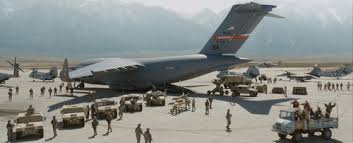
C-17 Airdrop Operations
Airdrop operations represent the ultimate expression of the C-17’s tactical capabilities. When ground forces need supplies but no runway exists, when casualties require extraction from contested territory, or when heavy equipment must arrive without warning, the C-17 delivers from the sky. From precision container drops to heavy platform extraction of armored vehicles, the Globemaster III’s airdrop systems are the most advanced in military aviation.
Types of Airdrop Operations
The C-17 can execute multiple types of airdrop missions, each designed for specific operational requirements:
Container Delivery System (CDS)
CDS bundles are standardized containers weighing up to 2,200 pounds each. The C-17 can deliver up to 40 CDS bundles in a single pass, resupplying an entire forward operating base in minutes. These bundles typically carry:
- Ammunition and weapons
- Food and water (Class I supplies)
- Medical supplies
- Fuel in flexible containers
- General equipment and repair parts
Heavy Equipment/Platform Drops
The C-17 can airdrop loads weighing up to 60,000 pounds on extraction platforms. This capability allows delivery of:
- Humvees and tactical vehicles
- Artillery pieces
- Engineering equipment
- Armored vehicles
- Communication systems
Personnel Airdrop
The C-17 can drop 102 paratroopers through side doors or the ramp. Personnel airdrop is used for:
- Airborne assaults seizing objectives
- Special operations insertions
- Humanitarian response teams
- Pathfinder teams preparing drop zones
High-Altitude Low-Opening (HALO) and High-Altitude High-Opening (HAHO)
Special operations personnel use the C-17 as a platform for HALO and HAHO insertions at altitudes up to 25,000 feet, enabling covert delivery deep into hostile territory.
The Computed Air Release Point (CARP)
Precision airdrop requires calculating exactly where to release the load so it lands on target. The Computed Air Release Point accounts for:
- Aircraft altitude and airspeed: Higher altitude means longer drift time
- Winds aloft: Measured from the surface to release altitude
- Parachute characteristics: Descent rate and forward drive of different canopy types
- Load weight: Heavier loads fall faster with less wind drift
- Ballistic dispersion: Expected scatter pattern of multiple containers
The C-17’s flight management computer calculates the CARP automatically, displaying release cues on the HUD. Pilots see a countdown timer, release point symbology, and “hack” cue indicating when to signal the loadmasters.
Joint Precision Airdrop System (JPADS)
The most significant advancement in airdrop technology is JPADS—GPS-guided parachute systems that steer loads to precise impact points. The C-17 can deliver JPADS loads that:
- Navigate autonomously to the drop zone after release
- Achieve accuracy within 150 meters from high altitude
- Allow release from outside threat range (up to 25,000 feet AGL)
- Operate in weather that would preclude visual drops
JPADS has revolutionized resupply in Afghanistan and other theaters where ground convoys face IED and ambush threats. Supplies that once required dangerous road movements now arrive directly from the sky.
Low-Cost Low-Altitude (LCLA) Airdrop
Not every airdrop requires expensive parachute systems. LCLA bundles use simplified rigging dropped from 300-500 feet. The bundles are designed to survive ground impact using:
- Honeycomb energy absorbers
- Padded containers
- Small deceleration parachutes
LCLA is faster to rig, cheaper to execute, and effective for delivering supplies that can withstand rough handling.
The Loadmaster’s Critical Role
While pilots fly the aircraft to the release point, loadmasters execute the actual airdrop. Their responsibilities include:
- Load preparation: Rigging loads with proper parachutes and release systems
- Pre-drop checks: Verifying restraint systems are properly configured
- Ramp and door operation: Opening the aircraft for drop and managing pressurization
- Drop execution: Releasing loads on pilot command or automatic system signals
- Post-drop verification: Confirming all loads exited and the aircraft is clean
Loadmasters receive extensive training in airdrop procedures, including the physics of parachute systems and troubleshooting malfunctions.
Drop Zone Control
Ground personnel at the drop zone play essential roles:
- Pathfinders: Special operations-qualified soldiers who establish and mark drop zones
- Drop Zone Safety Officers: Ensure the zone is clear of hazards and personnel
- Combat Controllers: Air Force ground specialists providing terminal attack control
- Recovery teams: Personnel who collect and distribute dropped supplies
Communication between the aircraft and ground team is essential—changes in wind, threats, or drop zone status must be passed quickly to the crew.
Night Airdrop Operations
Many airdrop missions occur at night to reduce vulnerability to ground threats. Night drops require:
- NVG proficiency: Crews must be qualified for night vision operations
- Infrared marking: Drop zones marked with IR lights visible through goggles
- Automated systems: Greater reliance on computed release points versus visual references
- Enhanced crew coordination: Reduced visual cues require tighter communication
Combat Airdrop Procedures
In hostile environments, airdrop profiles minimize exposure to threats:
- High-altitude release: JPADS drops from above enemy air defense range
- Pop-up profiles: Staying low until the last moment, then climbing rapidly to release altitude
- Multiple aircraft: Formation drops that overwhelm enemy targeting
- Defensive systems: Countermeasures ready for ground-launched missiles
Training and Qualification
Airdrop qualification requires specialized training beyond basic C-17 qualification:
- Formal training: Dedicated airdrop course at Little Rock AFB
- Mission qualification: Supervised missions before independent operations
- Currency requirements: Regular airdrop practice to maintain proficiency
- Annual evaluations: Checkride scenarios testing all airdrop procedures
Historical Context
The C-17 has executed countless combat airdrops since entering service:
- Operation Enduring Freedom: First combat airdrop in Afghanistan, 2001
- Operation Iraqi Freedom: Mass personnel drops during the 2003 invasion
- Operation Inherent Resolve: Resupply drops to besieged populations in Syria and Iraq
- Humanitarian missions: Emergency drops during disaster response worldwide
Conclusion
Airdrop operations showcase the C-17’s versatility and the skill of its crews. From precision JPADS deliveries at 25,000 feet to low-altitude personnel drops on contested drop zones, these missions deliver what ground forces need when no other method will work. The combination of advanced technology, rigorous training, and combat experience makes C-17 airdrop one of military aviation’s most demanding and rewarding missions.
Subscribe for Updates
Get the latest articles delivered to your inbox.
We respect your privacy. Unsubscribe anytime.