C-17 Crosswind Landings: Limits, Context and Training
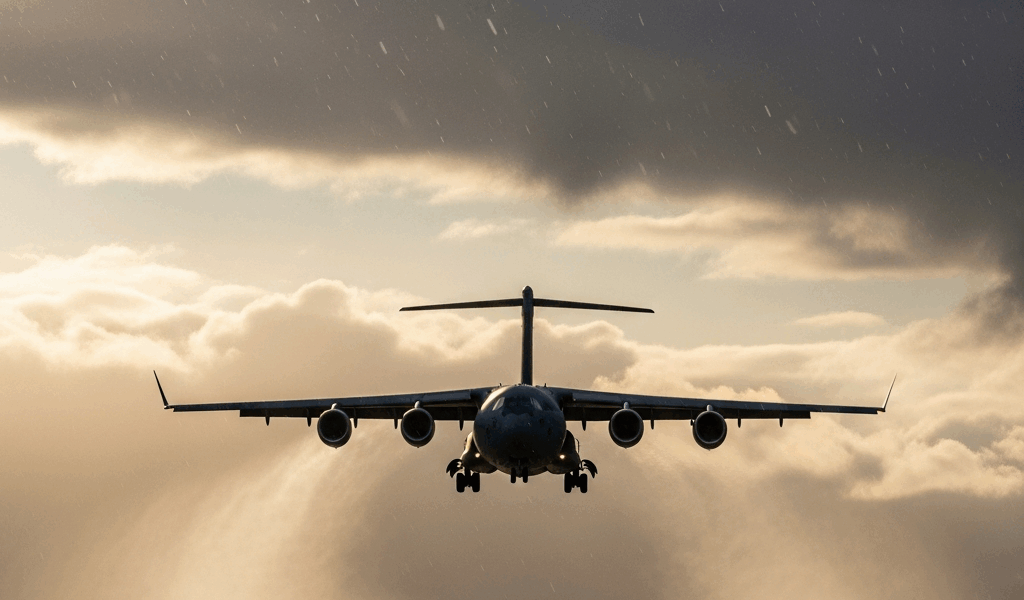
There is no responsible single public “C-17 crosswind limit” that applies to every takeoff, landing, runway and mission. Applicable limits and planning thresholds depend on the current aircraft guidance, runway type and width, mission profile, training event, aircraft condition and other factors.
This page explains why public numbers differ and how C-17 crews train for crosswinds. It does not replace the flight manual, performance data, weather evaluation, unit guidance or crew judgment.
Why different C-17 crosswind numbers appear online
Search results often present one number without its context. Public Air Force documents show why that is misleading:
- a weather-planning threshold is not necessarily the aircraft’s demonstrated limit;
- a touch-and-go training restriction may differ from a full-stop landing criterion;
- night-vision, assault-zone or narrow-runway operations can have additional restrictions;
- runway condition and braking action affect the decision;
- gusts and wind shear are not captured by a steady crosswind component alone.
For example, a public Wright-Patterson weather instruction lists separate crosswind sensitivities for general C-17 operations/training, touch-and-go landings and night-vision events. Those values serve that document’s delay, alternate and training-planning purposes. They should not be extracted and advertised as one worldwide aircraft limit.
The C-17’s published runway capability
The Air Force fact sheet says the C-17 can take off and land on runways as short as 3,500 feet and 90 feet wide under the conditions behind those published figures. It credits the aircraft’s high-lift wing, slats, externally blown flaps and thrust reversers for short-field and austere-airfield capability.
That statement does not mean every 3,500-by-90-foot runway is suitable in every wind, weight, temperature or surface condition. Qualified planners and crews must evaluate the actual airfield and mission.
Crosswind component is only part of the wind picture
Reported wind has direction, speed and sometimes gust information. Its crosswind component depends on the angle between the wind and runway. A similar crosswind component can present differently when accompanied by:
- large or rapidly changing gusts;
- wind shear;
- a wet, contaminated or unpaved surface;
- reduced visibility;
- a narrow or short landing zone;
- terrain or obstacles affecting airflow.
That is why a single calculator result cannot decide whether a C-17 landing is appropriate.
Crab and sideslip are concepts, not a public checklist
All fixed-wing pilots learn ways to manage drift and align an aircraft with a runway in crosswind conditions. Large-aircraft technique depends on aircraft guidance, flight-control characteristics, runway conditions and the specific phase of the landing.
A public article should not prescribe control inputs, touchdown attitudes or rollout corrections for a military transport. C-17 pilots learn and demonstrate the approved techniques through formal academics, simulation, instruction and evaluated flying.
Why the rollout matters
Crosswind risk does not end at touchdown. Directional control, braking effectiveness, runway width, surface condition and gusts remain relevant as the aircraft decelerates. The C-17’s size and narrow-runway capability make accurate centerline control important, but the response belongs in current approved guidance rather than a blog procedure.
Crosswind training
Air Force reporting describes C-17 training as a progression from technical instruction to simulators and aircraft events. Simulation lets instructors expose pilots to demanding weather and abnormal situations in a controlled environment before or alongside flying training.
Altus Air Force Base also uses external observation and landing-zone cameras during assault-landing training to give students objective feedback on touchdown position. That illustrates the emphasis on measured performance and instructor evaluation rather than self-taught internet technique.
When a crew does not continue a landing
A crew considers current weather, aircraft status, runway suitability, approach stability, applicable limits and available alternatives. If the approach or conditions do not meet the governing criteria, the crew uses the approved response and reassesses the plan.
This page intentionally does not publish a go-around decision tree or numeric triggers. Those belong in current Air Force and unit guidance.
How to interpret a claimed C-17 crosswind limit
- Identify the source and publication date.
- Check whether it applies to full-stop, touch-and-go, assault, narrow-runway or NVG operations.
- Determine whether it is a planning sensitivity, training restriction or aircraft limitation.
- Check runway condition and any additional restrictions.
- Do not use an unsourced number for operational planning.
For the broader training structure, see C-17 pilot training at Altus. For the aircraft’s landing-gear design, see the C-17 landing-gear overview.
C-17 crosswind FAQ
What is the maximum C-17 crosswind?
Public documents contain different numbers for different operations and planning contexts. There is no responsible universal figure to quote without the current governing source and mission context.
Can a C-17 land on a 90-foot-wide runway?
The Air Force publishes a capability to operate on runways 90 feet wide under the applicable conditions. Actual suitability depends on the airfield, aircraft, weather and mission.
Do C-17 pilots practice crosswind landings in simulators?
Yes. C-17 training uses simulators to apply technical knowledge and practice demanding scenarios in a controlled environment.
Does one base’s weather table apply everywhere?
No. A local weather instruction can include planning thresholds and training sensitivities for that organization. It should not be relabeled as the universal aircraft limit.
Official sources
- U.S. Air Force: C-17 runway and aircraft capabilities
- Wright-Patterson AFB: weather sensitivities illustrating operation-specific criteria
- Altus AFB: C-17 technical, simulator and aircraft training
- U.S. Air Force: C-17 landing-zone training feedback

Subscribe for Updates
Get the latest c-17 pilot updates delivered to your inbox.
We respect your privacy. Unsubscribe anytime.