C-17 Loadmaster Career — Training, Pay, and What the Job Is Actually Like
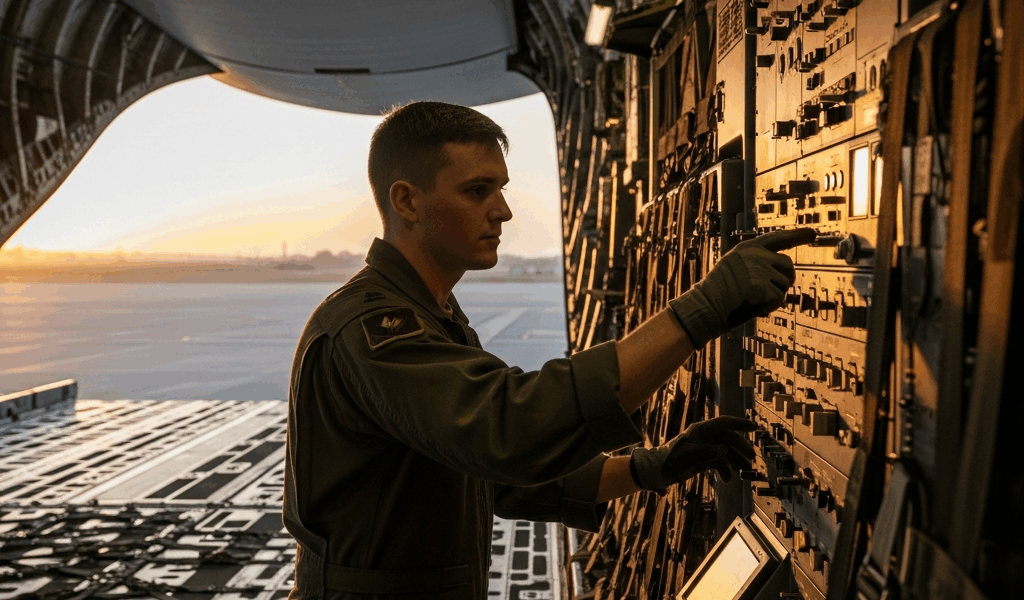
C-17 Loadmaster Career — Training, Pay, and What the Job Is Actually Like
The C-17 loadmaster career path has gotten complicated with all the noise flying around — Air Force recruiting pages that read like travel brochures, job boards posting salaries with zero context, and Reddit threads that contradict each other every third comment. None of that tells you what a 0300 pushback on a Bagram flightline actually feels like. Or what it takes to run weight and balance calculations on a 585,000-pound aircraft while the crew is already strapped in and waiting. As someone who spent years around C-17 aircrew, I learned everything there is to know about what this job demands day to day — the training pipeline, the pay broken down by grade, and the parts the official materials quietly skip over.
What a C-17 Loadmaster Actually Does
But what is a C-17 loadmaster? In essence, it’s AFSC 1A2X1 — officially responsible for calculating, loading, and securing cargo and passengers. But it’s much more than that. Saying a loadmaster “handles cargo” is like saying a surgeon “handles patients.” Technically accurate. Practically useless as a description.
Here’s what the job looks like from the flightline. On a humanitarian mission, a loadmaster might supervise 65 tons of cargo loaded in 45 minutes, run fuel burn and center-of-gravity calculations for a 10-hour flight, then oversee an airdrop of palletized relief supplies on the back end. All of that happens under time pressure — often in darkness, sometimes in weather that’s actively working against you. The cargo isn’t abstract, either. We’re talking Humvees, MRAPs, CH-47 helicopters, 463L pallets loaded right to the edge of allowable floor loading limits.
At max gross weight of 585,000 pounds, weight and balance isn’t a formality. A center-of-gravity outside limits at rotation isn’t a recoverable situation — that’s a crash. Loadmasters own that math entirely. Before departure, during flight as fuel burns off, and again if anything shifts in the cargo compartment. The pilots fly the aircraft. The loadmaster manages the physics of everything inside it. That’s a real distinction, not a morale poster.
Deployments run 14 to 90 days and are genuinely global. C-17 loadmasters have supported missions on every continent — including Antarctica. Operation Deep Freeze has been running for decades, and the C-17 is now the primary strategic airlifter keeping McMurdo Station supplied. That’s the upside. The honest downside: short-notice deployments are common, and crew rest requirements mean your days off won’t always line up with what your family’s calendar expects. More on that later.
C-17 Loadmaster Training Pipeline — From Accession to Mission Ready
Probably should have opened with this section, honestly, because mapping out the training pipeline is what most people are actually trying to do before they commit to anything. So — three phases. Here’s how they break down.
Phase 1 — Basic Military Training
Eight and a half weeks at Lackland AFB in San Antonio. Standard enlisted accession — nothing aviation-specific yet. The purpose is what it’s always been: baseline fitness, military customs and courtesies, and the administrative processing that officially gets you into the Air Force system. You won’t touch an aircraft here. Don’t expect to.
Phase 2 — Technical Training at Altus AFB
This is where the actual job starts. Technical training at Altus AFB, Oklahoma runs approximately 15 to 20 weeks — covering aircraft systems familiarization on the C-17, weight and balance calculation methods, hazardous cargo handling under IATA and DOD standards, airdrop procedures, and passenger configuration layouts. Altus is also an active C-17 flying unit, which matters. You’re learning on the actual aircraft, not some generic simulator platform cobbled together for a classroom.
The weight and balance coursework deserves its own mention because it catches a lot of trainees off guard. This isn’t arithmetic on a worksheet. It’s iterative load planning — cargo density, floor loading limits, tie-down patterns, fuel burn sequencing across multiple tanks, all running simultaneously. Students who struggle here usually struggle with translating the math to real time pressure on a real ramp. Learnable skill. Takes repetition. Don’t make my mistake of underestimating it going in.
Phase 3 — Initial Qualification Training at the Unit
After tech school, new loadmasters report to their assigned C-17 unit for Initial Qualification Training — IQT. This phase qualifies them in the mission sets specific to that unit. Airdrop profiles, aeromedical evacuation configurations, special operations support procedures if the unit carries that mission. IQT is where technical training gets applied to real operational taskings, with experienced aircrew watching over your shoulder until you’ve proven you can own it independently.
Total time from enlistment contract to mission-qualified loadmaster: roughly 12 to 18 months. That’s a competitive timeline. For comparison, a C-17 pilot starting from officer accession needs closer to four or five years before their first operational C-17 flight.
One path worth flagging: prior-service loadmasters with C-130 or C-5 backgrounds who lateral transfer to the C-17 community complete an abbreviated qualification course. The foundational skills carry over — the retraining focus is aircraft-specific systems and procedures. Faster pipeline, same end state.
C-17 Loadmaster Pay — What Airmen Actually Earn
Military pay discussions usually go one of two ways — oversimplified (“you don’t get paid much”) or buried in total compensation math that doesn’t reflect what actually hits your bank account. Here’s the realistic breakdown at relevant career points.
Loadmaster pay is standard military base pay by grade and years of service. Aviation crew members also collect Aviation Career Incentive Pay — ACIP — which for E-4 through E-9 enlisted aircrew runs $150 to $240 per month depending on years of aviation service. Not life-changing money, but it’s consistent and shows up every month without conditions.
At E-4 with four years of service — a typical grade for a newly mission-qualified loadmaster — base pay runs approximately $2,600 per month. Stack BAH on top of that (Basic Allowance for Housing, non-taxable, figure $1,200 to $1,800 for a mid-tier duty station like Altus or McChord), add BAS at $452.56 per month for enlisted members as of 2024, plus ACIP — total monthly compensation lands somewhere between $4,400 and $5,200 before taxes. The non-taxable portion of that matters more than people initially realize.
At E-7 with 12 years of service — a senior loadmaster, possibly an instructor — base pay is approximately $4,300 per month. With BAH for a dependent at a higher-cost station like Joint Base Lewis-McChord, total monthly compensation runs $6,000 to $7,500. That’s before Tricare healthcare coverage, commissary access, or the defined-benefit retirement system that kicks in at 20 years.
Civilian comparison, for context: regional cargo handlers earn $25,000 to $45,000 annually. Experienced contract loadmasters — people who held this job in uniform and are now doing a version of it for a defense contractor or civilian cargo operator — typically earn $60,000 to $90,000 per year, sometimes more on overseas contract positions. Military compensation is competitive when benefits are included, and the 20-year retirement math is genuinely difficult to replicate outside a union pension.
Loadmaster vs. C-17 Pilot — Career Comparison
This is the most common question I see from people early in the decision process. It deserves a direct answer — not a recruiting pitch for either path.
The pilot path requires a four-year degree before officer accession is even on the table. From degree to OTS or ROTC commission, through Specialized Undergraduate Pilot Training — roughly two years — through the C-17 formal training unit, you’re looking at four to five years from the degree to your first operational C-17 flight. SUPT is a competitive washout environment. OTS selection is competitive. The path is real, but the attrition points are real too.
The loadmaster path requires a high school diploma. Technical training starts within months of enlisting. A mission-qualified loadmaster is flying operational missions inside 18 months of their enlistment date.
Same aircraft — but an O-3 pilot at four years of service earns more in base pay than an E-4 loadmaster. That’s a real difference. The investment to reach O-3 — four years of college, competitive selection — is also a real cost the comparison usually skips. Neither path is objectively better. They’re different commitments with different timelines and different post-military options.
Career stability: both AFSCs are actively retained. Pilot requirements fluctuate with force structure and procurement cycles; loadmaster requirements track more closely with the C-17 fleet size, which has been stable. Post-military transition: pilots have the well-documented airline career path. Experienced loadmasters move into civilian contract positions, safety officer roles, and cargo operations management — less visible from the outside, but consistently employed. That’s what makes this field endearing to us career researchers — the civilian pipeline is real, just quieter about it.
What Loadmasters Say About the Job — The Real Version
Frustrated by vague recruiting descriptions early in my research, I started tracking what working C-17 aircrew actually said about the job over time — not in year one when everything is still shiny, but at the 8- and 12-year marks when people have enough context to be honest. A few consistent themes came up.
The physical reality is undersold. Loading and securing heavy equipment on an active airfield — in January at Ramstein, or at 0200 at an austere strip with no ground support equipment and no shelter — is manual labor at a high level of proficiency. Tie-down chains for a single MRAP add up to over 1,000 pounds of equipment on the floor. Cold weather makes it harder. It is not a desk job and it never becomes one, regardless of rank or time in service.
[X] might be the best option for mission-critical cargo security, as this job requires a particular kind of physical and mental resilience working in tandem. That is because the environment strips away every comfortable variable — lighting, temperature, time — and the math still has to be right. Loadmasters who thrive here aren’t just technically sharp. They’re physically durable and mentally steady under operational pressure simultaneously.
The irregular schedule affects families more than it affects the individual airman — apparently this surprises people, but it shouldn’t. Crew rest requirements are federally mandated and non-negotiable, which is correct from a safety standpoint. It also means days off don’t follow a Monday-Friday pattern, and TDY assignments interrupt planned leave without much warning. Families who go in expecting a conventional schedule get blindsided. Families who understood the operational tempo from the start tend to adapt. That distinction is not small.
The mission scope, though — genuinely significant. Operation Deep Freeze in Antarctica. Humanitarian airlifts into regions with no functional ground infrastructure. Aeromedical missions moving critically wounded service members from forward locations. This new commitment to global strategic airlift took off several years after the C-17 entered service and eventually evolved into the operational breadth loadmasters know and depend on today. The combination of technical depth, geographic variety, and mission relevance is what keeps retention rates higher than many other enlisted career fields. That’s consistent feedback across years of conversations — not recruiting material.
First, you should go in with a realistic picture of the schedule — at least if you have family or relationships that depend on predictability. While you won’t need to be a mathematician or a professional athlete, you will need a handful of real qualities: physical durability, comfort with iterative math under time pressure, and the ability to function at 0300 on an airfield in bad weather without your performance degrading. The honest caveat, repeated here because it matters: this job involves sustained time away from home. Not occasional travel. Sustained absence, sometimes on short notice. If that’s workable for your situation, the career offers technical depth, global experience, and post-military employment value that’s hard to match. If it’s not workable, knowing that upfront saves everyone a lot of time.

Subscribe for Updates
Get the latest c-17 pilot updates delivered to your inbox.
We respect your privacy. Unsubscribe anytime.