Flying the C-17 at Night — NVG Ops Explained
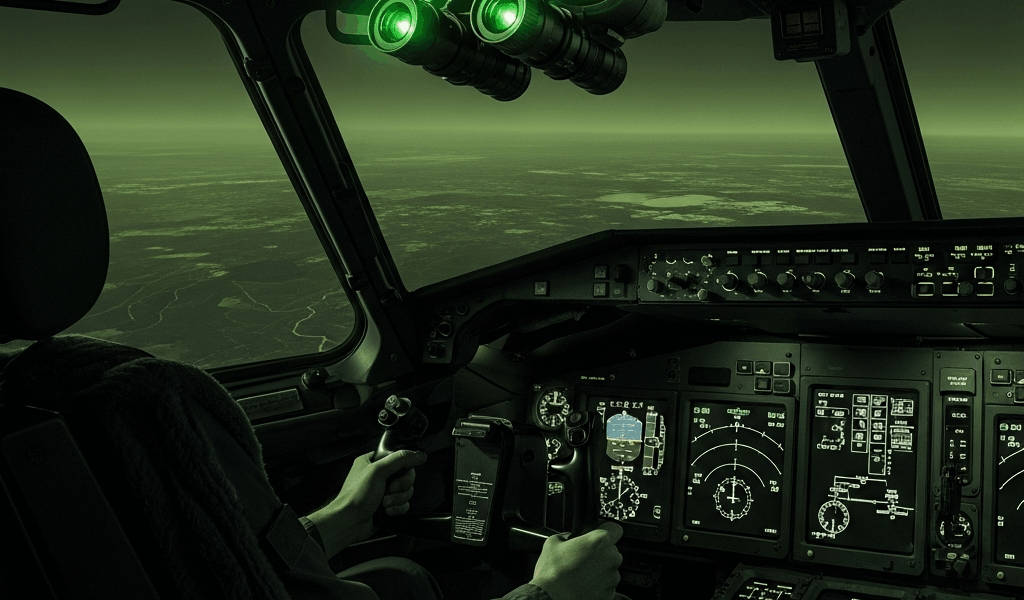
Why NVG Flying in the C-17 Is Its Own Skill Set
NVG ops in the C-17 have gotten complicated with all the Hollywood mythology flying around. Black Hawk Down makes it look visceral and fast. Fighter pilot footage makes it look precise and clean. Neither of those things prepared me for my first NVG approach into a desert strip in 2015 — when every instinct I’d built over hundreds of daylight hours started working directly against me.
The Globemaster is enormous. 580,000 pounds empty. That’s not a number you feel in your bones until you’re trying to correct a drift at night and the aircraft just… keeps going. Tactical jets respond instantly. Helicopters respond instantly. The C-17 does not. You input a correction and wait two, maybe three seconds while the aircraft finishes doing whatever it was already doing. In daylight, that delay is manageable. After dark with compressed depth perception, that delay becomes the thing most likely to kill you.
Night vision goggles shrink your world down to roughly 40 degrees — that’s the ANVIS-9 field of view, the system military crews train on. You’re not scanning terrain and sky the way your naked eye does. You’re looking through a tube. Power lines that are 200 feet out can register as 500 feet away, or 50. Your brain knows the math of your altitude. Your eyes are lying to your brain. That conflict is the whole problem.
Building a completely different mental model isn’t optional. It’s foundational. Crews that carry daylight technique into NVG operations are the ones who end up in accident reports. That’s not an opinion — it’s a recurring pattern in mishap investigations going back decades.
What Crews Are Actually Wearing and Seeing
The ANVIS-9 weighs about 1.3 pounds. Doesn’t sound like much until it’s been strapped to your helmet for 90 minutes. Both single-tube and dual-tube configurations exist in the fleet, though dual-tube is the modern standard for C-17 crews. When you’re sitting in the cockpit wearing them, every instrument panel you look at glows green — cockpit lighting gets filtered specifically to green wavelengths so the goggles can amplify it without blooming out into a useless wash of brightness.
But what is bloom-out, exactly? In essence, it’s what happens when a light source overwhelms the image intensifier tube and wipes out the surrounding detail. But it’s much more than that — it’s a persistent problem that shapes every cockpit lighting decision on an NVG mission, from the brightness of the altimeter backlight to whether someone opens a door to the cargo compartment mid-flight.
Your airspeed indicator, altimeter, heading indicator — they’re all still there. Same panels, same layout. Under goggles, though, the contrast degrades. Numbers get fuzzier. Crews end up relying more on mechanically-lit analog gauges than the glass cockpit displays, which is counterintuitive given how much money went into those displays. LED screens and night vision technology genuinely don’t play well together. Nobody puts that in the marketing videos.
How much you see outside depends almost entirely on moon angle and cloud cover. Heavy overcast, no moon — you’re distinguishing black from slightly-less-black. That’s it. Bright moon over sand or snow and suddenly the image is almost too sharp, too bright. You dial back the gain on the goggles, which means trading away detail you actually want. The usable “just right” window is narrow. Most nights fall outside it in one direction or the other.
Cockpit lighting management becomes its own discipline — honestly, it deserves its own training block. Every light source in the forward section has to be NVG-compatible. One wrong-wavelength indicator light degrades the whole image. I’ve watched crews spend 20 minutes before takeoff just walking through switches, verifying backlit displays, checking indicator brightness levels. Twenty minutes. On a light check. That’s how unforgiving the system is.
The loadmaster’s station runs dark during NVG ops. Very dark. The cargo compartment doesn’t get filtered lighting, which means anyone back there conducting airdrop operations or setting up for an assault landing is working with a separate monocular NVG device — AN/PVS-14 variants are common — or essentially working blind. Communication between the flight deck and cargo compartment gets harder exactly when it needs to get easier.
Crew Coordination When Visibility Goes to Zero
Probably should have opened with this section, honestly. This is where NVG ops separate the crews that are ready from the ones who are just current on paper.
Pilot flying is heads-up, eyes on terrain, working whatever visual cues the goggles are giving. Pilot monitoring is heads-down, reading instruments, calling altitude, descent rate, distance to the next fix. Those roles don’t swap halfway through the approach. They’re locked in from briefing until the aircraft stops rolling. Swapping them mid-approach under NVGs has contributed to incidents. Don’t make that mistake.
Callout discipline becomes absolute. On a daytime approach a pilot can see where they are. Under goggles on a dark night, they genuinely cannot. The instrument crosscheck — altitude callouts every 100 feet through the last 300 feet of descent — stops being a procedural habit and starts being the thing physically preventing the aircraft from descending through a ridge nobody saw coming.
When you have a dedicated navigator in the crew, they become critical during low-level routing and tactical descent. They’re calling turns, calling terrain clearance, feeding data continuously. The pilot flying steers toward what the navigator describes and tries to match what the goggles show against the mental map they built during the brief. It works — when it works — because of repetition and trust built over dozens of training sorties together.
The loadmaster’s role during assault landings deserves specific attention. At a dirt strip with no lighting, the loadmaster stations at the ramp and calls obstacle clearance in real time. “Clear left. Clear right. Terrain ahead.” Under NVGs the pilots can’t reliably see what’s at ramp level. That voice on the intercom is more actionable than any instrument in those final seconds. I’m apparently more reliant on that callout than I realized until I flew a sim profile without one and nearly planted a wingtip.
The Hardest Parts Nobody Warns You About
Spatial disorientation under NVGs hits crews who have no business being disoriented. Instrument-rated, combat-experienced, hundreds of flight hours — none of that makes you immune. The compressed field of view, the absent depth cues, the lag between what your vestibular system feels and what the goggles show — on a bad night those things converge fast.
Brownout is different under NVGs than anything you experience in daylight. When rotor or prop wash kicks up dust during a landing, the goggles amplify the ambient light reflecting off that dust cloud. You go from seeing the ground to seeing a solid wall of bright green in roughly one second. The instinct is to look harder, push lower, find the surface. That instinct is exactly wrong. The correct move is climb, wings level, go around. I’ve watched experienced pilots fight that response — psychologically, climbing away from your landing zone feels like failure. It’s the opposite. It’s staying alive to try again.
Adaptation lag gets almost no coverage in training syllabi. Take off the goggles after 90 minutes of flight and your eyes need time — real time, not seconds — to rebuild dark adaptation. Step into a lit cabin briefly and you’ve restarted that clock. On a complex mission with multiple events, drop then landing then departure, you can cycle between visual states repeatedly and never feel fully calibrated to any of them. That low-grade confusion accumulates.
Fatigue compounds all of it. A two-hour NVG sortie is more cognitively demanding than a four-hour daylight flight. The scan rate, the constant crosscheck, the sustained stress of operating with degraded vision — by 90 minutes, callouts get less crisp, scan intervals stretch, decision-making slows. Training teaches you to recognize these signs in yourself. Most crews recognize them in others first. Don’t make my mistake of assuming you’re the exception.
How C-17 Pilots Build NVG Currency and Proficiency
Initial NVG qualification for C-17 crews runs somewhere around 12 to 16 training sorties. That range isn’t arbitrary — it reflects real variation in individual aptitude and training pipeline tempo. The progression starts with basic low-level navigation, builds into simulated tactical descent profiles, and ends at approaches and landings with zero external lighting at the strip.
Currency and proficiency are different things. The regulation requires one NVG approach in the last 90 days to stay current. That approach keeps your certification valid. Proficiency — the ability to execute the actual mission safely when something goes sideways — requires more. Most operational squadrons set a floor of one NVG training event per crew per month. That event might be a low-level route, an approach, a formation element, an airdrop sequence. One event. Thirty days.
A typical training sortie looks something like this: low-level navigation route at 300 feet AGL, then a tactical descent profile into a remote strip with restricted lighting, then a go-around, then a landing. Total flight time around two hours. Actual NVG events — goggles on, night vision discipline enforced — maybe 45 minutes of that. The rest is setup, transition, post-event debrief.
That’s what makes the currency-versus-proficiency gap so dangerous to squadrons that don’t take it seriously. A current crew knows the procedures. A proficient crew executes them without burning working memory, leaving cognitive bandwidth for the engine problem or the radio failure that shows up uninvited. A current crew is fully loaded just flying the approach. A proficient crew is flying the approach and thinking three steps ahead.
That gap is the whole story. Units that run consistent NVG training build crews that are genuinely ready for what night flight demands. Units that treat currency as the standard find out the difference eventually — and usually not in a simulator.

Subscribe for Updates
Get the latest c-17 pilot updates delivered to your inbox.
We respect your privacy. Unsubscribe anytime.