C-17 Low-Level Flight: Mission, Planning and Training
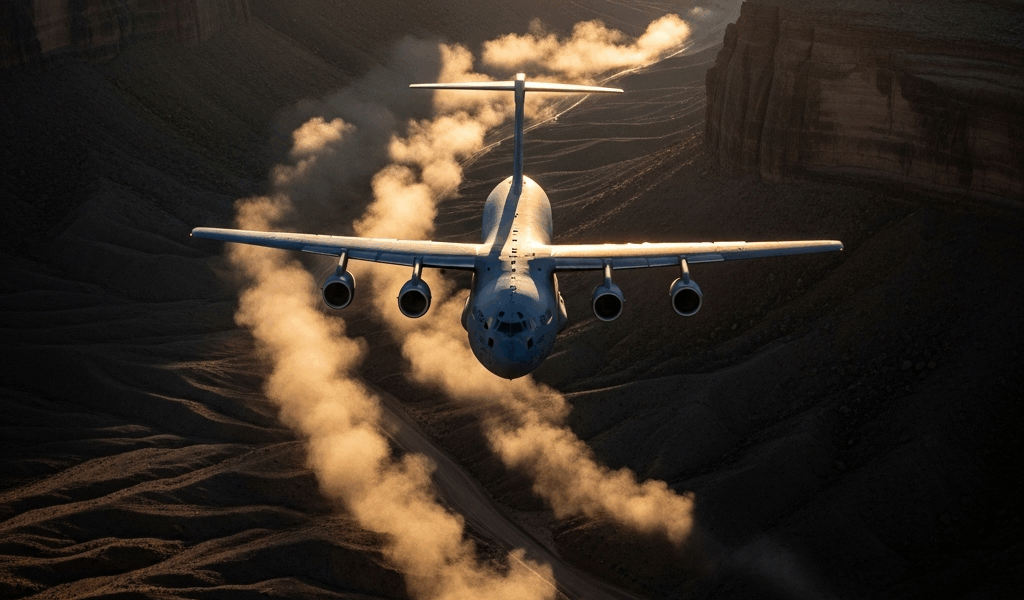
C-17 low-level flight is a trained tactical mission that lets an airlift crew approach, deliver or recover personnel and cargo in demanding environments. It requires detailed route study, aircraft-performance planning, weather evaluation, crew coordination and disciplined risk management.
This public guide explains why the mission exists and how crews train. It intentionally omits tactical altitudes, airspeeds, threat routes, obstacle-clearance calculations, callouts and defensive techniques.
What low-level flight means for a C-17
Low-level flight places the aircraft closer to terrain and obstacles than normal cruise. The purpose can include tactical ingress or egress, preparation for an airdrop or landing-zone mission, or completion of required aircrew training.
Air Force reporting confirms that C-17 crews train on formal military training routes and in complex terrain. A 2025 Travis Air Force Base training flight included low-level training tied to special-operations mission preparation.
Why would a large transport fly low?
The C-17 combines strategic range with tactical delivery. It can move a large load over long distances and then use airland or airdrop options closer to the supported force. Low-level capability supports that tactical part of the mission.
Low altitude can change how terrain and surveillance systems affect an aircraft, but it also reduces reaction time and increases exposure to obstacles, wildlife, weather and task saturation. It is not automatically safer than flying higher; it is one mission option selected and planned for a specific objective.
Who is on the crew?
The standard C-17 crew consists of two pilots and one loadmaster. The previous article incorrectly added a navigator and claimed the loadmaster watched a terrain radar. Navigation, aircraft control and mission-system duties are divided between the two pilots, while the loadmaster manages cargo-compartment and mission responsibilities within the approved crew concept.
Additional qualified crewmembers or mission personnel may be carried when required, but that does not change the standard crew listed by the Air Force.
What goes into route planning?
At a public level, planners consider:
- authorized airspace and the published route structure;
- terrain, charted obstacles and available vertical clearance;
- aircraft weight, configuration and turning performance;
- weather, visibility, turbulence and winds;
- navigation-system availability and route accuracy;
- training objectives or the supported operational requirement;
- risk controls, alternates and conditions that would stop the event.
The actual planning products, clearance rules and tactical route construction belong in current Air Force guidance and mission-planning systems—not a public blog.
Why military training routes matter
High-speed low-altitude training is conducted in limited, charted airspace designed to organize the activity and reduce conflict with other users. That structure does not remove every risk, so crews still coordinate, review notices and weather, and comply with the applicable route and air traffic rules.
Air Force reporting about a C-17 flight through the United Kingdom’s Mach Loop says months of preparation went into that training opportunity. The visible flight was the result of planning and qualification, not an improvised sightseeing pass.
How the aircraft’s size affects the mission
The C-17 has a wingspan of nearly 170 feet and a maximum gross takeoff weight of 585,000 pounds. A transport of that size has different turning, acceleration and energy characteristics from a fighter or helicopter.
Crews must plan a route the aircraft can actually fly while maintaining applicable clearance and performance margins. Internet comparisons that describe the C-17 as “threading gaps” at a fixed speed oversimplify the problem and can be misleading.
How weather changes low-level flight
At low altitude, reduced visibility, cloud, turbulence, precipitation and strong winds can quickly change workload and available margins. Terrain may obscure weather beyond the crew’s immediate view, and turbulence can make precise aircraft control more demanding.
There is no universal public ceiling or visibility number for every C-17 low-level mission. Requirements vary with the operation, airspace, route, qualification and current guidance. The fixed figures in the old article were removed.
Crew coordination at low altitude
Low-level flight requires the pilots to divide aircraft control, navigation, monitoring and communication tasks clearly. The loadmaster maintains cargo and cabin awareness and supports the mission according to approved duties.
Good crew resource management means important changes are communicated early and workload is redistributed before task saturation develops. It does not mean a public article should publish tactical callouts or assign invented duties to each position.
How C-17 pilots train for low-level missions
C-17 qualification begins with technical instruction, simulator training and aircraft events at Altus Air Force Base. Scenario-based instruction connects individual flying profiles to realistic mission objectives.
Simulators can reproduce terrain, weather, system issues and changing mission demands without exposing an aircraft to the same risk. Aircraft events then let qualified instructors evaluate the skills that must be demonstrated in the real operating environment.
Training continues after the initial course through recurring simulator and aircraft events. The exact syllabus, minimum altitude, currency and qualification rules are controlled by current Air Force publications and unit programs.
Low-level flight and airdrop
Low-level navigation may be one part of a larger tactical airlift mission, while airdrop is the actual delivery of personnel or materiel from the aircraft. They are related but distinct qualifications and planning problems.
For delivery methods and crew roles, see the C-17 airdrop operations guide.
Why the old procedural detail was removed
The earlier page presented exact altitudes, speeds, clearance margins, threat-route construction, callouts and control expectations as universal facts. It also invented crew positions and claimed personal operational experience.
Real low-level operations depend on current mission data, airspace, qualification and controlled guidance. This page provides context, not instruction for conducting a flight.
C-17 low-level flight FAQ
Do C-17 crews really train at low altitude?
Yes. Air Force sources document formal low-level training routes, simulator instruction and aircraft events.
Is there one altitude for every mission?
No. Training and operational altitudes depend on authorization, route, mission, qualification and current guidance.
Does a C-17 have a navigator?
No. The standard crew is two pilots and one loadmaster.
Can civilians practice the techniques in this article?
No. This is a public capability overview, not flight instruction. Low-level military operations require authorized airspace, qualified crews and approved guidance.
Official sources
- U.S. Air Force: C-17 Globemaster III fact sheet
- Travis Air Force Base: 2025 C-17 low-level flight training
- Air Force Reserve Command: C-17 low-level Mach Loop training
- Altus Air Force Base: scenario-based C-17 training
- Air Education and Training Command: C-17 qualification and simulator training

Subscribe for Updates
Get the latest c-17 pilot updates delivered to your inbox.
We respect your privacy. Unsubscribe anytime.