How C-17 Pilots Handle Extreme Crosswind Landings
What the C-17 Crosswind Limits Actually Allow
C-17 crosswind operations have gotten complicated with all the conflicting information flying around — especially online, where armchair aviators and actual aircrew share the same forums. As someone who has put the mains down in 23-knot crosswinds and called a go-around at 18 knots, I learned everything there is to know about where those limits actually live. Today, I will share it all with you.
So, without further ado, let’s dive in.
The aircraft is demonstrated to 25 knots of crosswind on a dry, paved runway. That number is in the flight manual. It is not a wall you hit at 25.1 knots and suddenly the airplane stops flying — it means test pilots took the aircraft to that limit under controlled conditions, documented what happened, and wrote the procedures around it. Tire speed capability, structural load limits on the gear, aerodynamic stability in a crosswind slip, rudder authority at low airspeed — all of it fed into that number.
But what is a “demonstrated limit”? In essence, it’s the boundary where controlled testing ended. But it’s much more than that. It’s the starting point for judgment, not a promise of safety up to the line.
Runway surface changes everything. A wet runway reduces tire friction and increases drift. Twenty knots of steady wind is manageable. A 15-knot wind gusting to 28 with a 10-degree variable direction component is a different animal entirely. You’re not flying a number. You’re flying the airplane’s response to conditions the forecast never fully captured.
Cargo weight matters too. A full-load C-17 near maximum gross — 840,000 pounds, though you rarely see that in practice — handles differently than a light aircraft at 580,000 pounds. The heavier jet is sluggish in pitch and roll. Slower rudder response. Longer rollout phase. That lag means more runway consumed before you have directional control back.
Wind shear near the surface is the variable nobody talks about in the manual. Ground effect compounds it. I’ve had crosswind increase by 8 knots in the last 500 feet of descent because the runway sat downwind of a ridgeline. The forecast said nothing about it.
Crab Angle vs Sideslip on a 585,000-Pound Jet
Probably should have opened with this section, honestly.
Flying a crab approach in a C-17 feels counterintuitive if you’ve spent serious time in smaller aircraft. The wingspan runs 169 feet. The engines hang on pylons extending from the wings. Sideslipping a Learjet or a Gulfstream is straightforward — cross-control, drop the bank angle into the wind, angle the fuselage toward centerline while maintaining ground track. Try that in a C-17 beyond about 8 degrees of bank and you’re managing an engine pod ground strike risk that isn’t worth the technique.
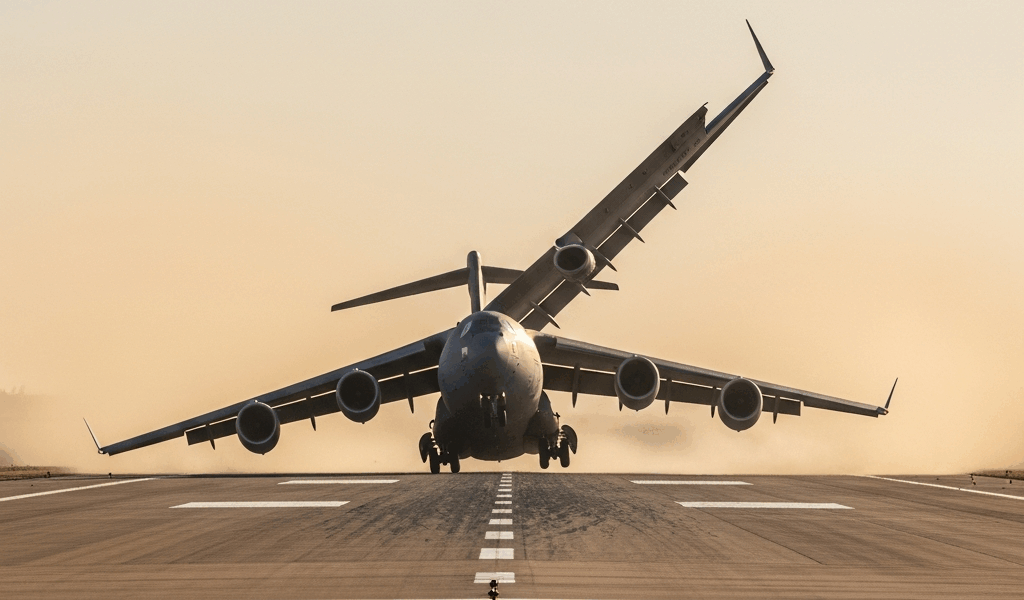
The correct technique is the crab approach. You fly the aircraft nose-into-wind to hold ground track, accepting a crab angle that can run 10 to 15 degrees in moderate crosswind — nose pointed slightly left of the runway while the aircraft tracks straight down it. The recovery begins around 200 feet.
That recovery is the real skill. You reduce crab angle progressively, apply downwind rudder to realign the fuselage with the runway. Timing has to match descent rate and ground proximity. Start too early and you’ll need a second correction. Start too late and you’re touching down sideways.
The rudder response on final approach is not what most pilots expect — and I’m apparently someone who over-corrected on the first three attempts in the actual aircraft despite solid sim performance. The C-17 has massive rudder authority, but the response at 140 knots in ground effect is sluggish compared to control column feedback. There’s a delay. You press the pedal, nothing happens immediately, you press harder, then both corrections arrive together. Don’t make my mistake.
I’m apparently wired toward reactive inputs, and the crab recovery technique works for me now while early over-correction never did. Training hammers smooth, progressive inputs. Small movements early. Anticipation rather than reaction. Captains transitioning from the C-5 — larger, slower aircraft — tend to over-correct on initial C-17 landings. Captains coming from the E-3 usually underestimate how much rudder authority the C-17 carries and get surprised by the yaw rate once it actually arrives.
Crosswind also affects pitch and roll stability on short final. Gusts from the side want to roll the upwind wing down. Your hands are moving constantly — tiny inputs on stick and rudder. Fatiguing. It demands focus that doesn’t let up until the aircraft is stopped and the reversers are stowed.
Where Crosswind Bites Hardest — The Rollout
Touched down in a 23-knot crosswind on a winter runway at an active base, and the real test started the moment the mains hit concrete. That’s where most crosswind-related accidents on large aircraft actually happen — not on final, but during rollout.
Your feet and hands are managing differential thrust reversers immediately. The C-17 has four turbofan engines. Reversers deploy and you can modulate the outboards independently. In a crosswind, the first officer is often running the throttles while the captain handles nose gear steering — both working to keep the aircraft tracking centerline as reversers deploy and the jet starts weathervaning.
Weathervaning is the natural yaw the aircraft wants to make — the vertical fin acts like a weather vane, turning the fuselage into the wind. On a 585,000-pound jet with a 65-foot tail, that’s a significant force. Nose gear steering has limited authority but you fight it through the tiller or autopilot inputs. That’s what makes the C-17’s rollout feel so alive to us who fly it — you’re not passively stopping an aircraft, you’re actively steering one that wants to go somewhere else.
Spoilers deploy asymmetrically in crosswind. The flight control computer manages roll trim automatically, but when you’re hand-flying the rollout — which happens when the autopilot disconnect gets hit or signal is lost — you’re managing all of it manually. Left wing starting to drop means right aileron input, now.
Reverse thrust deployment has to be symmetrical and progressive. You don’t slam reversers to full in a crosswind. Idle reverse first — just enough to feel the aircraft’s response — then progressive deployment to target thrust. Too much asymmetric reverse and you’re asking for a ground loop or a drift toward the edge.
The first 10 seconds after touchdown: nose gear down, reversers deploying, spoilers moving, ailerons correcting, rudder maintaining heading. Captain on the nose gear tiller and foot steering. First officer on throttles and autopilot modes. Both pilots monitoring tire temperatures, hydraulic pressures, heading. One calling out airspeeds and control responses. The other making inputs. Ten seconds. Then it settles.
Assault Strip Crosswinds — A Different Problem Entirely
Unpaved runways. Six thousand feet or shorter. Remote locations with no ILS and sometimes no reliable wind observation at all. Assault strip operations change how you evaluate crosswind risk entirely.
The surface is dirt, gravel, or PSP — pierced steel planking. Friction is lower than concrete. A 15-knot crosswind on a grass or gravel strip behaves closer to an 18-knot crosswind on pavement. The aircraft drifts more. Steering response is slower because nose gear and mains are fighting for grip on loose material.
Wind information is unreliable. You’re getting a wind check over radio from a forward air controller on the ground, or reading a hand-held anemometer if someone placed one early enough. Gusts and wind shear aren’t in that briefing. Terrain around the strip — hills, tree lines, buildings — creates acceleration and shadowing that changes by the minute.
The crosswind limit for assault operations is 15 knots on unprepared surfaces per the operational manual. That’s 10 knots lower than the paved limit, reflecting the reality of surface friction and steering response. I’ve turned down assault landings at 13 knots of reported crosswind — the wind was variable and the surface was extremely soft, roughly six inches of loose sand the nose gear would have plunged into. Reported crosswind and actual crosswind are not always the same number.
Landing on a short strip in any crosswind means you need every foot of available runway. You land as close to the touchdown zone as possible, get reversers out, get the aircraft stopped. On a 4,000-foot strip in crosswind, your envelope is tighter than anything you see on a 12,000-foot concrete runway at a major base.
How Crews Train for High Crosswind Scenarios
Crosswind training in the C-17 pipeline starts in the simulator. The CAE 7500X motion platform at Altus Air Force Base generates crosswind profiles, wind shear, and gusts. You fly approaches in simulated 20-knot, 22-knot, and 25-knot crosswinds. You fly them with gusts. You fly them at the end of a long simulated mission when fatigue is being modeled.
The aircraft commander checkride includes a max-crosswind approach and landing — standardized profile, intercept the localizer, descend on glide slope, establish crab angle for the wind, begin recovery at 200 feet, land within the touchdown zone without drifting off centerline. The evaluator grades smoothness of inputs, accuracy of crab angle, precision of touchdown. Miss the zone and you’re explaining why.
What the sim doesn’t fully teach is the feel. Real crosswind has weight and surprise to it. First time you land in 23 knots of actual wind after building all your hours in simulated conditions, the nose movement feels bigger than expected. The buffet feels more aggressive. Muscle memory from the sim transfers — but the sensory inputs are different enough that the first few real crosswind landings feel like being lied to.
Debrief after a max-crosswind event in actual conditions is where real learning happens. Captain and first officer walk through the approach on video — crab angle, descent rate, heading corrections on final, touchdown position. An instructor asks why you made certain inputs. “I saw the heading indicator drifting left, so I corrected” is a reactive answer. “I anticipated the drift based on the wind vector and corrected ahead of it” is something else. That difference — reactive versus anticipatory — is what separates a solid crosswind pilot from an exceptional one.
Crosswind operations are never routine, even at 3,000 hours in the cockpit. Every landing is a judgment call. Wind data, runway condition, aircraft weight, cargo criticality, weather forecast — all of it feeds into a go or no-go. The decision-making framework you build over years of those calls is ultimately what keeps safe operations from becoming incident reports.

Subscribe for Updates
Get the latest c-17 pilot updates delivered to your inbox.
We respect your privacy. Unsubscribe anytime.