How C-17 Pilots Navigate Degraded Visual Environments
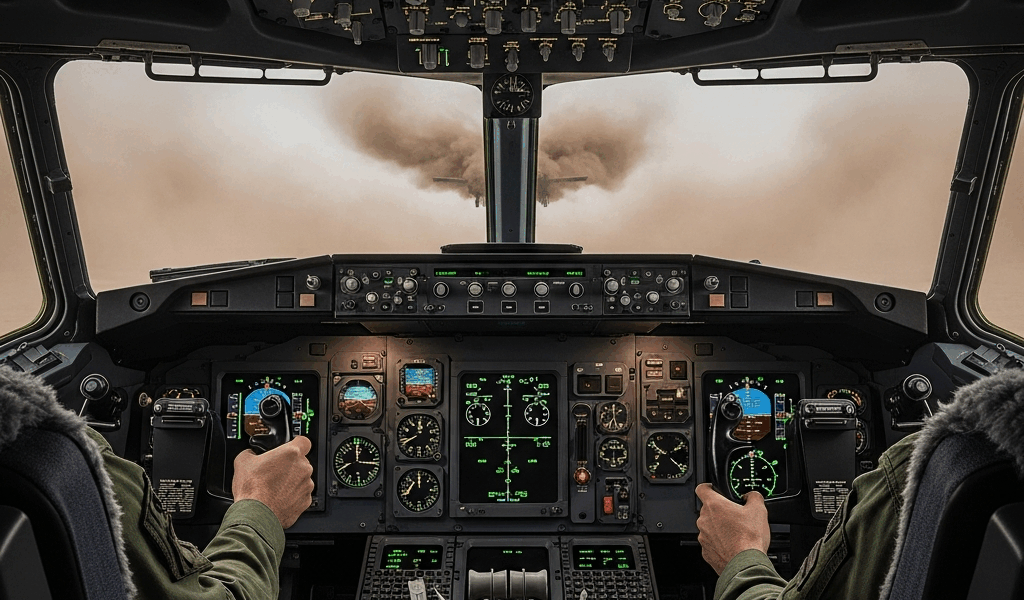
What Counts as a Degraded Visual Environment in C-17 Ops
DVE operations have gotten complicated with all the rotary-wing assumptions flying around. As someone who flew a C-17 into brownout conditions at Bagram back in 2009, I learned everything there is to know about what that environment actually does to a fixed-wing crew. Today, I will share it all with you.
But what is a degraded visual environment? In essence, it’s any condition where outside visual reference becomes unreliable or disappears entirely. But it’s much more than that. Brownout happens on unprepared landing zones — talc-fine Afghan soil lifted by rotor wash or engine exhaust — and it inverts the visual world in a specific, nasty way. Horizon visible. Ground gone. Whiteout is the arctic version: blowing snow so complete there’s no contrast, no reference, nothing distinguishable in any direction. Low-visibility IMC approaches are something else again. You’re trusting radio aids and autopilot through cloud, planning to pick up visual cues right at decision altitude. Three different problems. Three different ways they kill you if you conflate them.
The C-17 is 174 feet long. Loaded, it tips the scale at 585,000 pounds. A Blackhawk pilot can slip sideways at 50 feet and arrest the aircraft in seconds — that’s not arrogance, that’s physics working in their favor. A C-17 pilot gets no such luxury. Turn radius, descent rate, inertia — decisions made at altitude lock in fast. What feels like hovering freedom in rotary-wing work is a fixed-wing precision problem. We need actual visual reference or rock-solid instrument data. Not approximations.
Brownout on an unprepared strip in Iraq or Afghanistan is the most operationally common DVE scenario. You descend through clear air, level off around 30 feet above the surface, and the moment your mains touch down or your engines kick dust — your outside reference vanishes. Radio altimeter, ground proximity systems, and a whole lot of trained discipline. Whiteout in Alaska or Greenland is rarer but arguably more disorienting, because it creeps in gradually as you descend, stealing your horizon reference so slowly your inner ear starts lying to you. Low-vis instrument work is the most controlled of the three — you’re planning it — but failures on approach can’t be recovered by pulling power and floating down. You’re already committed.
This is a distinct skill set. Not “fly on instruments.” Crew coordination under sensory deprivation with hundreds of thousands of pounds of aluminum responding to every input you make.
How the Flight Deck Crew Divides the Scan
Probably should have opened with this section, honestly. The division of labor on the flight deck during DVE is what separates crews that make safe approaches from crews that make accident reports.
The aircraft commander owns the approach. The copilot owns the outside scan and the callouts. In standard conditions, the pilot flying cross-checks altitude, airspeed, and descent rate while trying to hold visual reference outside. In DVE, that outside world is gone — so the pilot flying locks into the instruments. Attitude indicator. Altimeter. Airspeed. The copilot, sitting right-seat with a different angle and different sight lines, is hunting for any visual cue: terrain feature, runway light, nav aid that suddenly resolves out of the murk. More importantly, the copilot is the safety net — calling altitude, descent rate, wind shear, traffic. Anything that tells the flying pilot whether this approach is stable or falling apart.
On C-17 blocks equipped with a flight engineer station — older airframes — or an Integrated Flight Management System operator seat on newer ones, that crew member manages engine parameters, fuel, and systems status. But they’re watching too. Watching descent rate. Watching whether the aircraft commander is drifting laterally. Listening to copilot callouts and confirming them. If the copilot says “200 feet” and the engineer sees something different on the engine panel, the engineer speaks up immediately. Crew resource management is not a suggestion in DVE. It’s the only thing between a safe landing and controlled flight into terrain.
The callout structure matters more than most people realize. “One thousand feet” is a callout. “Descent rate stable” is a callout. “Missed approach lights at two o’clock” is a callout. At Altus Air Force Base — where we train — instructors break crews on DVE approaches the moment communication degrades. I watched a captain and first lieutenant execute genuinely clean instrument work and still get a no-land from the check airman. The copilot hadn’t called altitude at 500 feet. The captain hadn’t asked. That one omission meant no independent verification that the descent was stabilized. Don’t make my mistake — well, their mistake. I was the one watching. It stuck with me anyway.
The flying pilot must not fixate on any single instrument. That’s the trap. Zero visibility, you lock onto the altimeter, you start chasing the needle — descent rate goes erratic, you over-correct, the aircraft oscillates. The copilot watches for exactly this and calls it out: “descent rate 800 feet per minute, smooth” or “descent rate decreasing, stabilizing.” The outside world is gone. The crew becomes the outside world. That’s not poetic — that’s literally the operational model.
Sensors and Systems the C-17 Uses to Stay Oriented
Equipped by instrumentation and years of accumulated practice, a C-17 crew can navigate environments that look completely opaque to anyone standing on the ramp below.
The Heads-Up Display — the HUD — is the primary tool in DVE. It projects altitude, airspeed, descent rate, heading, and flight path marker onto a transparent screen directly in the pilot’s line of sight. In low visibility, the HUD becomes your visual reference. The flight path marker, a green circle with a cross, shows where the nose is pointed and where the aircraft is actually tracking. Above the glide slope symbol means too high. Below it means descending too steeply. Decision altitude appears as a red line. Radio altitude reads out digitally. Some configurations overlay Terrain Awareness and Warning System data — terrain goes red or amber when you’re too close. I’m apparently someone who leans heavily on the flight path marker in degraded conditions, and that approach works for me in ways that chasing individual instruments never quite did.
Forward-Looking Infrared systems — FLIR, when installed — let you see through dust and light snow by reading heat signatures. Buildings, vehicles, terrain features all emit thermal radiation. A cleared paved runway shows a different signature than surrounding dirt. FLIR is genuinely powerful in brownout, but it requires real training and it is not a magic solution. A fully obscured runway in heavy dust still looks like terrain in thermal imagery. You need to know where the runway is supposed to be before FLIR tells you anything useful about what you’re looking at.
The radio altimeter is the single most important instrument in DVE. Full stop. It sends a pulse straight down and measures the return time — actual height above ground level, not altitude above sea level. In brownout, when the ground has disappeared visually, that readout is truth. Modern C-17 radio altitude presentations include an aural tone that increases in pitch as you descend. Another sensory input in an environment that’s trying to strip them all away. At decision altitude in a brownout, if radio altitude is passing through 200 feet and the copilot hasn’t called “runway in sight” — you briefed a go-around, and you execute it. No negotiation.
Ground proximity warning systems and TAWS are crew-alerting tools, not navigation aids. GPWS tells you if you’re descending toward terrain, too low on approach, or flying toward an obstacle. It won’t tell you where the runway is. In DVE, TAWS silence is actually meaningful — if the system is quiet and altitude is correct and descent rate is stable, things are probably okay. Probably. The moment TAWS speaks, you listen to nothing else.
The limitation nobody wants to say out loud: none of these systems sees a runway from 2,000 feet away in heavy brownout. They tell you where you are relative to known terrain and obstacles. They do not tell you whether there’s debris on the runway surface, whether the surface is solid, or whether you’re aligned with the actual landing zone versus something 100 meters to the left. That’s why we brief contingencies. That’s why we have minimums.
The Decision Point — When C-17 Crews Commit or Go Around
The decision to land or go around is made on the ground, not in the air.
Before the approach into known DVE, the crew briefs specific minimums tied to actual field conditions. Visibility, runway surface condition, crosswind limits, fuel state, go-around alternates — all of it gets planned explicitly. A realistic scenario: approaching Kandahar Airfield in summer dust. Surface visibility 400 meters, blowing dust. Runway paved, clear of obstacles. Aircraft at max structural landing weight. Fuel for two approaches plus an alternate at Kabul — roughly 60 miles northeast.
Decision altitude is briefed at 300 feet on the radio altimeter. At 300 feet, if the runway environment is not in sight and stable for landing, you go around. Not “maybe.” Not “try another 50 feet.” Around. Full power, positive rate, climb out, reassess. That’s what was briefed on the ground, and the briefing is what you fly.
Fifty percent of DVE approaches result in a go-around at some point in a pilot’s career. Some missions see multiple go-arounds before achieving a landing. That is not failure — that’s the system working exactly as designed. I’ve been waved off twice on single-runway forward operating bases and landed on the third approach after conditions improved slightly. I’ve also committed to a landing when all the data aligned, touched down safely, and later recognized that visibility was barely above minimums the whole time. The decision to commit happens when crew callouts, instrument presentations, and environmental inputs all point the same direction. The decision to go around happens when they don’t.
The trained outcome is not “land the aircraft.” The trained outcome is “make a safe decision.” That’s what the alternate airport is for. That’s what the fuel reserve is for. The crew is alive to fly another approach because those margins exist.
How Crews Train for DVE Before They Ever See It for Real
Altus Air Force Base in Oklahoma — that’s where most Air Mobility Command pilots first encounter DVE training in any structured way. The simulator there runs a dedicated brownout and whiteout profile. High-fidelity motion cues, visual distortion, the whole degraded experience — minus the consequence if you get it wrong. The simulator isn’t perfect. Nothing is. But it breaks pilots in a safe way. That was 2007 when I went through, and the fidelity has only improved since.
First DVE approaches are slow and methodical. Descend at 300 feet per minute, call out every 100 feet of altitude, rely completely on the copilot and engineer to report what’s happening outside. After four or five approaches, the environment becomes less alien. Hands stop chasing the controls. Scan settles into rhythm. By the end of the training profile — usually around 12 approaches in controlled degradation — some in brownout, some in whiteout, some with a nav aid out, some with the HUD inoperative — the technique starts feeling automatic. That’s the goal.
Formal DVE evaluations are conducted by instructor pilots who have accumulated hundreds of hours in these conditions operationally. They recognize what errors look like before the errors become catastrophic. During my aircraft commander upgrade at Ramstein Air Base in Germany, I was evaluated on a low-visibility instrument approach in actual IMC. The check airman — a lieutenant colonel with about 3,400 hours in the jet — didn’t accept “probably okay.” He wanted precise technique, timely callouts, and an immediate go-around decision the moment any go-around criteria was met. I executed a go-around on that evaluation. Intentionally — the descent was destabilizing and I knew it. He passed me. That willingness to go around is exactly what matters.
Currency in DVE is a real operational issue. A crew that hasn’t flown into DVE conditions for 90 days is rusty. Not unsafe — rusty. Coordination slows down. Callouts lose their crispness. Fixation becomes easier to fall into. The formal currency requirement is at least one approach every 90 days. Most crews in theater fly more frequently than that because the operational environment doesn’t pause. But the requirement exists for a reason. Good preparation — simulator or actual conditions — changes the outcome when you’re sitting at 200 feet above a runway you cannot see. That’s what makes DVE training endearing to us in the C-17 community. It’s the difference between a crew that survives and one that doesn’t.

Subscribe for Updates
Get the latest c-17 pilot updates delivered to your inbox.
We respect your privacy. Unsubscribe anytime.