How to Become a C-17 Loadmaster
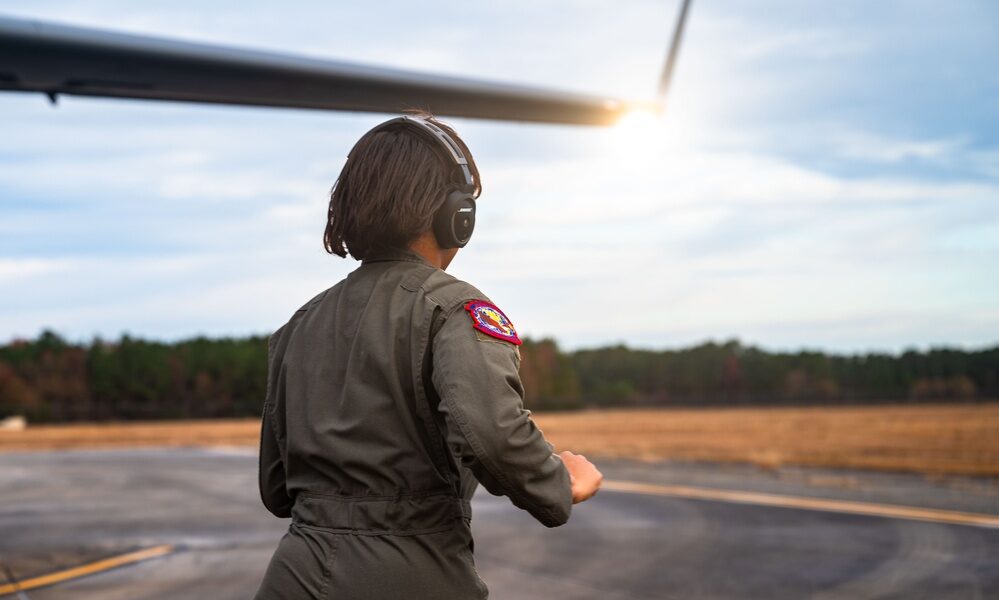
So you want to become a C-17 loadmaster? That’s awesome. Seriously, it’s one of the best jobs in the Air Force if you like combining technical expertise with hands-on mission execution.
But let’s be real—the path to those crew chief wings isn’t exactly straightforward. There’s a specific pipeline you’ll need to navigate, and it takes somewhere between 12-18 months from the day you raise your right hand to the day you’re actually flying operational missions.
Let me walk you through exactly how it works.
The Basic Requirements
First things first—can you even become a loadmaster? The Air Force has some non-negotiable requirements before they’ll even consider you for the job.
You need to be a U.S. citizen. No exceptions on this one. Aircrew positions require security clearances, and non-citizens can’t get them.
The AFSC (Air Force Specialty Code) for loadmaster is 1A2X1. You’ll need to score at least a 57 on the General (G) aptitude area of the ASVAB. That’s not particularly high—the Air Force is more interested in your ability to learn systems and think on your feet than your ability to ace standardized tests.
Here’s where it gets interesting: you also need to pass the PAST (Physical Abilities and Stamina Test). This includes a 500-meter swim, push-ups, pull-ups, sit-ups, and a timed run. The loadmaster standards aren’t as brutal as PJ or Combat Controller standards, but you can’t be a complete couch potato either.
You’ll need to meet flying class III physical standards. That means decent vision (correctable to 20/20), no major medical issues, and the ability to handle altitude changes and long missions. If you get motion sickness easily, probably should mention that to the flight doc—though many people adapt once they’re actually flying regularly.
Height and weight matter too. You need to be between 64 and 77 inches tall. The cargo compartment has tight spaces, and if you’re too tall, you’ll be constantly banging your head on everything. Too short, and you won’t be able to reach certain equipment or see over cargo loads.
Age limit is typically 39 years old, though that can vary based on prior service and other factors.
Enlisting and Job Selection
Okay, so you meet the requirements. How do you actually get the job?
If you’re enlisting straight into the Air Force, you’ll work with a recruiter who’ll help you list your job preferences. Here’s the thing though—you can’t always guarantee you’ll get loadmaster. The Air Force uses an open aptitude area system for many jobs, meaning you might book a slot in the “General” category and not find out your exact job until later.
Your best bet? Tell your recruiter you specifically want 1A2X1 and you’re willing to wait for it. Sometimes they have guaranteed contracts available. Sometimes you’ll need to wait a few months for a slot to open up. But if you’re serious about being a loadmaster, it’s worth waiting rather than taking whatever’s available and hoping to retrain later.
Some people go the Guard or Reserve route first. This can actually be easier because Guard and Reserve units often hire specifically for loadmaster positions. You interview with the unit, they decide if they want you, and boom—you’ve got a guaranteed job. The downside? You’ll probably be waiting longer to start training because Guard/Reserve training slots are more limited.
Prior service folks can also retrain into loadmaster, but you’ll need to check the retraining advisory to see if the career field is accepting cross-trainees. It opens and closes based on manning needs.
Basic Military Training (BMT)
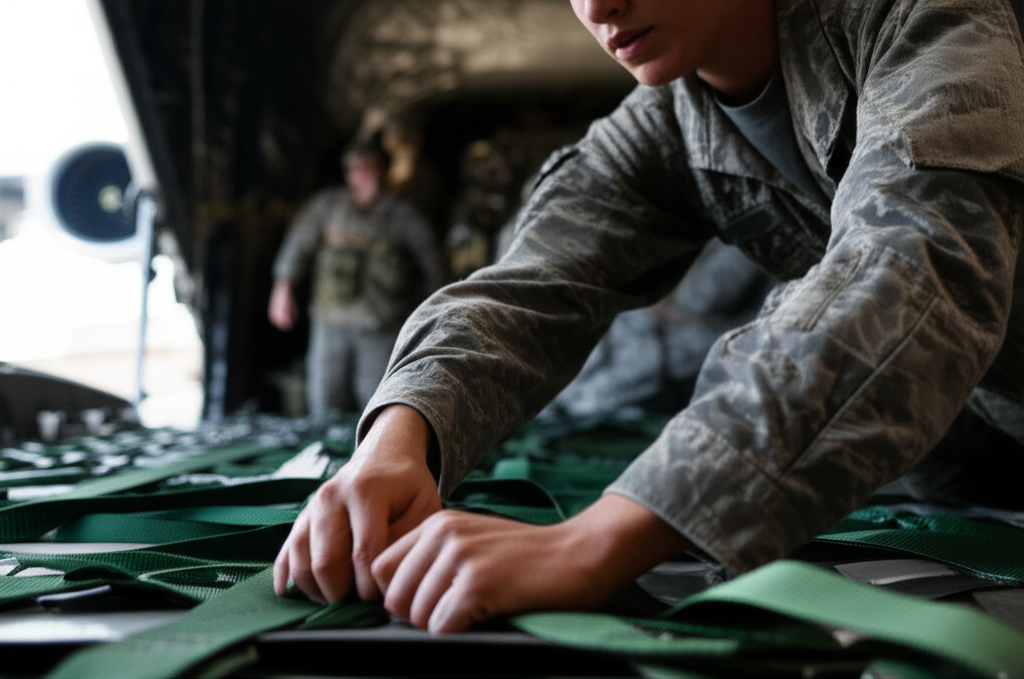
Everyone starts at Lackland Air Force Base in San Antonio, Texas for Basic Military Training. This is 7.5 weeks of learning how to be an airman before you learn how to be a loadmaster.
BMT is… well, it’s BMT. You’ll march, do PT, learn drill, get yelled at by training instructors, and learn basic military customs and courtesies. You’ll qualify on the M4 rifle, go through the gas chamber, and complete various evaluations.
For future loadmasters, BMT is honestly just a checkbox you need to complete. Nobody cares how you performed at BMT once you get to your operational squadron. Just don’t get injured, don’t get in trouble, and get through it.
The hardest part for most people? The sudden shift from civilian life to military structure. You’re going from making your own decisions to having every minute of your day controlled. But it’s temporary, and everyone gets through it.
You’ll graduate, get your orders to tech school, and probably get a couple weeks of leave before you report. Use that time wisely—it’s the last significant break you’ll have for a while.
Aircrew Fundamentals Course
After BMT, you’ll head to Lackland’s Aircrew Fundamentals Course (formerly called “Aircrew Fundamentals School” or just “Fundies”). This is where you start actually learning about being an aircrew member.
The course runs about 16 training days, and it covers all the basic stuff that applies to every Air Force aircrew member regardless of what aircraft they fly.
You’ll learn about altitude physiology—what happens to your body at high altitude, how to recognize hypoxia symptoms, and how to use supplemental oxygen systems. They’ll put you in an altitude chamber where they simulate going up to 25,000 feet or so. You’ll take your oxygen mask off and start doing simple tasks like playing patty-cake or solving math problems. Within about 30 seconds, you’ll start feeling weird—euphoria, dizziness, tingling fingers. That’s hypoxia. The instructors will tell you to put your mask back on, and within seconds you’ll feel normal again. It’s a wild experience and absolutely critical training.
You’ll learn about ejection seats (even though the C-17 doesn’t have them), ditching procedures, survival training, and combat survival evasion resistance and escape (SERE) basics. You’ll learn about crew resource management, communication procedures, and basic aircraft systems.
There’s also water survival training. You’ll get dunked in a pool while strapped into a simulated aircraft seat, practice inflating life preservers, and learn how to right an overturned life raft. If you’re not comfortable in water, this can be challenging—but the instructors are safety-focused and won’t let you drown.
The course also covers basic navigation, weather theory, and how to read aeronautical charts. You won’t be navigating the aircraft as a loadmaster, but you need to understand the basics.
Most people enjoy Aircrew Fundamentals because it’s where you start feeling like you’re training for your actual job rather than just being a generic trainee. The instructors are usually prior aircrew who have great stories and genuinely want you to succeed.
Pass rate is high if you pay attention and study. Probably should mention that failing Aircrew Fundamentals doesn’t just wash you back to try again—you could lose your aircrew slot entirely and get reclassified to a different job.
Loadmaster Technical School
Next up is the Loadmaster Apprentice Course at Joint Base San Antonio-Lackland. This is where you actually learn how to be a loadmaster, separate from any specific aircraft.
The course is roughly 6 weeks long (it changes periodically based on curriculum updates), and it’s a mix of classroom academics and hands-on training.
You’ll start with cargo loading theory. How do you calculate weight and balance? How do you determine if a specific load will fit in an aircraft? How do you secure cargo so it doesn’t shift during flight? How do you plan for center of gravity changes as fuel burns off?
There’s a lot of math involved, but it’s practical math. You’re not doing calculus—you’re calculating moments and ensuring the aircraft stays within weight and balance limits. You’ll use load planning worksheets and eventually computer programs, but you need to understand the underlying principles.
You’ll learn about different types of cargo tie-down methods. Chains, straps, nets, shoring, and how to properly use each one. You’ll learn about rolling stock (vehicles), helicopters, palletized cargo, and how to handle hazardous materials.
Airdrop theory is a big part of the curriculum. How do you rig cargo for extraction? What’s the difference between a LAPES drop and a high-altitude drop? How do you calculate the release point so the cargo actually lands where it’s supposed to?
You’ll learn about passenger handling too. Seating configurations, safety briefings, how to handle VIPs vs. regular military passengers, and what to do in emergency situations.
The course includes hands-on training with actual cargo handling equipment. You’ll spend time in training aircraft learning how to operate the winch, the K-loader interface, and how to move heavy cargo around without killing yourself or damaging the aircraft.
There’s also a significant focus on emergency procedures. What do you do if there’s a fire? What if you have rapid decompression? What if cargo breaks loose during flight? You’ll memorize procedures and practice them until they’re instinctive.
The academic load is substantial. You’ll have tests every week, and you need to maintain at least an 85% average to pass. Some people breeze through it. Others struggle and need extra instruction. The instructors are generally good about providing additional help if you’re having trouble.
Physical fitness matters here too. You’ll be moving cargo, climbing around aircraft, and generally being active. If you showed up to tech school out of shape, you’re going to have a rough time.
Most students find loadmaster tech school challenging but manageable. The people who struggle are usually the ones who don’t study or who can’t handle the hands-on practical exercises.
Probably should mention that tech school is also where you’ll start building relationships with your classmates. Some of these people will end up at your first duty station with you. Others you’ll run into throughout your career at different bases or on missions. The loadmaster community is relatively small, and you’ll keep seeing the same faces.
SERE Training
Somewhere in your training pipeline—either before or after loadmaster tech school depending on slot availability—you’ll attend Survival, Evasion, Resistance, and Escape (SERE) training.
This is the course everyone has heard horror stories about. And yeah, it’s intense, but it’s also incredibly valuable training.
The course is at Fairchild AFB in Washington and lasts about 2.5 weeks. It’s divided into distinct phases.
First, there’s academic instruction about the Code of Conduct, survival psychology, and evasion principles. This part is in a normal classroom, and while the information is serious, it’s not physically demanding.
Then you head to the field for the survival phase. You’ll practice building shelters, starting fires, finding water, and identifying edible plants. You’ll learn how to signal for rescue and how to move through terrain without being detected. You’ll also kill and eat a rabbit, which is… an experience. Some people have no problem with it. Others are vegetarians afterward.
The evasion phase involves moving through the woods trying to reach a simulated friendly position while instructors acting as enemy forces try to capture you. You’re cold, tired, and hungry. It sucks, but it’s realistic training.
If you get captured—and most people do—you enter the resistance phase. This is the part everyone worries about. You’ll be interrogated, placed in stress positions, and generally made very uncomfortable. I can’t share specific details because the course is classified, but it’s designed to give you a tiny taste of what being a prisoner of war might be like.
Here’s the thing though: the instructors are professionals. They’re not trying to break you permanently. They’re trying to teach you how to resist interrogation while complying with the Code of Conduct. The experience is valuable, and most people come out of it feeling more confident in their ability to handle adversity.
The escape phase teaches you how to get away if you ever have the opportunity, though this is a smaller portion of the overall course.
SERE is mentally and physically challenging. You’ll be cold, hungry, tired, and stressed. But thousands of aircrew members go through it every year and survive. You will too.
The washout rate is relatively low because by the time you get to SERE, the Air Force has already invested significant resources in your training. They want you to succeed. But you can fail if you quit or if you have medical issues.
After SERE, you’ll appreciate hot showers, warm beds, and food more than ever before. It’s a gut check that makes you realize you’re tougher than you thought.
C-17 Formal Training Unit (FTU)
Now we get to the aircraft-specific training. You’ll report to either Joint Base Charleston in South Carolina or Joint Base McChord-Lewis in Washington for the C-17 Formal Training Unit.
This is where you finally learn how to be a C-17 loadmaster specifically. The course is about 6-8 weeks long and combines academics, simulator training, and actual flying.
You’ll start with C-17 systems. How does the cargo floor work? How do you operate the auxiliary power unit? What are the aircraft’s weight and balance limitations? How does the cargo door mechanism work?
You’ll learn C-17-specific loading procedures. The airplane’s cargo compartment is 88 feet long, 18 feet wide, and 12.4 feet high. You need to know exactly what fits where, how to configure the seating, and how to maximize cargo capacity.
The C-17 has some unique capabilities compared to other cargo aircraft. It can do tactical airlift, airdrop, and strategic airlift missions. It can land on austere runways. It can carry outsize cargo that won’t fit in smaller aircraft. You’ll learn how to take advantage of all these capabilities.
Airdrop training is a significant portion of FTU. The C-17 can drop paratroopers, heavy equipment, and humanitarian supplies. You’ll learn how to set up for different types of drops, how to communicate with the pilots during the drop run, and how to recover the aircraft after the drop.
You’ll spend hours in the C-17 simulator practicing emergency procedures. Engine fire? You’ll run the checklist. Rapid decompression? You’ll run the checklist. Cargo fire? Checklist. The simulator can throw multiple emergencies at you simultaneously, which is both terrifying and excellent training.
Then you’ll start flying actual training missions. Your first flight is unforgettable—you’ve been training for over a year at this point, and you’re finally doing the actual job.
Training missions include cargo loading and unloading, airdrop practice, tactical arrivals and departures, and cross-country flights. You’ll fly with instructor loadmasters who will evaluate your performance and provide feedback.
You need to complete a certain number of training events and demonstrate proficiency in all required tasks. The instructors use an elimination criteria list—specific things that, if you mess them up, could fail the sortie.
Most people pass FTU without major issues, but it requires consistent effort. You’re learning a lot of information in a short time, and you’re expected to perform at a high level.
The academic tests are comprehensive. You’ll need to know procedures, limitations, emergency checklists, and aircraft specifications. You’ll have written tests, oral evaluations, and practical check rides.
By the end of FTU, you’ll feel reasonably competent. You won’t know everything—that only comes with experience—but you’ll have the foundation you need to start flying operationally.
Probably should mention that FTU is where you’ll start to understand the culture of the C-17 community. The instructors have been doing this for years, and they’ll share stories about real-world missions. You’ll learn the unofficial lessons that don’t appear in any manual but are crucial for success.
Mission Qualification Training
You’ve graduated FTU and received your orders to your first operational squadron. Congratulations! You’re almost there, but you’re not quite mission-ready yet.
Every C-17 squadron runs its own Mission Qualification Training (MQT) program to get new loadmasters ready to fly unsupervised missions. This typically takes 3-6 months depending on how frequently you fly and how quickly you progress.
MQT involves flying with experienced loadmasters on actual operational missions. Unlike FTU where everything is a training sortie, now you’re doing real missions with real cargo and real consequences.
You’ll start with basic channel missions—routine cargo runs from one base to another. These are relatively straightforward, but they let you practice the fundamentals in a low-stress environment.
As you gain experience, you’ll progress to more complex missions. Tactical missions into challenging airfields. Airdrop missions with actual paratroopers or equipment. Humanitarian missions during disaster response. Medical evacuation missions.
You’ll also complete upgrade training for special qualifications. Air refueling receiver training if your squadron does that. Night vision goggle operations. Formation flying. Each qualification involves additional training and evaluation.
Your squadron has a formal training program with specific requirements you need to complete. You’ll fill out training folders, complete task evaluations, and track your progress toward mission-ready status.
Eventually, you’ll complete your final evaluation ride with a squadron evaluator. This is a comprehensive check of all your skills. If you pass, you’re officially mission-ready and can fly as the primary loadmaster without supervision.
The timeline varies. Some people finish MQT in three months. Others take six months or longer if their squadron isn’t flying much or if they struggle with certain tasks. Don’t rush it—it’s better to take the time needed to become truly proficient.
Skill Level Upgrades
Becoming mission-ready isn’t the end of your development as a loadmaster. There’s a progression of skill levels that reflect your growing expertise.
You’ll start as a 3-level loadmaster (apprentice) when you first arrive at your squadron. After completing MQT and your CDC (Career Development Course) self-study program, you’ll upgrade to 5-level (journeyman).
The 5-level is when you’re really a fully functional loadmaster. You can fly any mission, handle any cargo, and mentor newer loadmasters.
After several years and additional experience, you can upgrade to 7-level (craftsman). This typically requires becoming an instructor or evaluator loadmaster, demonstrating expert-level knowledge, and completing additional academic requirements.
Eventually, senior loadmasters can reach 9-level (superintendent), though this is rare and usually reserved for senior NCOs in leadership positions.
Each skill level comes with increased responsibility. As a 3-level, you’re focused on learning. As a 5-level, you’re executing missions independently. As a 7-level, you’re training others and ensuring quality control.
Instructor and Evaluator Positions
Once you’ve been flying for a few years, you might have the opportunity to become an instructor loadmaster or evaluator loadmaster.
Instructors are responsible for training new loadmasters during MQT and providing continuing education for experienced crew members. You’ll fly with students, evaluate their performance, and provide feedback.
Evaluators conduct formal check rides to ensure loadmasters maintain proficiency. You’ll administer annual flight evaluations, special qualification checks, and proficiency evaluations.
Both positions require additional training and certification. You’ll attend formal instructor courses where you’ll learn teaching techniques, evaluation standards, and how to provide effective feedback.
Being an instructor or evaluator is demanding but rewarding. You’re directly responsible for maintaining standards in your squadron and ensuring new loadmasters are properly trained.
Career Development and Opportunities
The loadmaster career field offers numerous opportunities beyond just flying operational missions.
Some loadmasters become formal training unit instructors, returning to Charleston or McChord to train new loadmasters in the initial qualification course. This is highly competitive and usually requires excellent performance and instructor certification.
Others pursue special duty assignments. You could work at Air Mobility Command headquarters, become a recruiter, serve as a military training instructor at BMT, or take various staff positions.
There are also opportunities to attend professional military education. Airman Leadership School for senior airmen, the Non-Commissioned Officer Academy for staff sergeants, and the Senior NCO Academy for master sergeants. These schools develop your leadership skills and prepare you for supervisory positions.
Some loadmasters cross-train to other aircrew positions. Flight engineer positions on certain aircraft, boom operator on tankers, or even loadmaster positions on different airframes. Each requires additional training, but it adds variety to your career.
The C-17 community also offers deployment opportunities. You might deploy to support combat operations, humanitarian missions, or contingency operations worldwide. These deployments can range from a few weeks to several months.
Timeline Summary
Let’s put it all together. How long does it actually take from enlistment to flying operational missions?
Basic Military Training: 7.5 weeks
Aircrew Fundamentals: 2-3 weeks
Loadmaster Tech School: 6 weeks
SERE Training: 2.5 weeks
C-17 FTU: 6-8 weeks
Mission Qualification Training: 3-6 months
That’s a minimum of about 8 months, but realistically it’s usually 12-18 months by the time you account for holding periods between courses, leave, and the time needed to complete MQT.
Some people move through faster. Others take longer. The Air Force’s training pipeline isn’t always perfectly synchronized, so you might wait weeks or months for a training slot to become available.
What Makes a Good Loadmaster?
So what separates outstanding loadmasters from average ones?
Attention to detail is crucial. Loading calculations need to be exact. Tie-down procedures need to be followed precisely. Checklists need to be completed thoroughly. One mistake can have catastrophic consequences.
Physical fitness matters. You’ll be pushing heavy cargo, climbing around the aircraft, and working long days. Being in good shape makes the job easier and safer.
Communication skills are essential. You’re constantly coordinating with pilots, ground crews, aerial port personnel, and passengers. Clear, professional communication prevents confusion and mistakes.
Problem-solving ability is valuable. Missions rarely go exactly as planned. Equipment breaks, cargo doesn’t fit quite right, weather changes plans. Good loadmasters adapt and find solutions.
Attitude makes a huge difference. The job can be physically demanding and sometimes frustrating. Maintaining a positive, professional attitude—even when you’re exhausted at 3 AM loading cargo in the rain—separates good crew members from mediocre ones.
Willingness to learn continuously is important. The job changes, procedures update, and there’s always something new to learn. The best loadmasters remain students of their craft throughout their entire careers.
Challenges You’ll Face
Let’s be honest about the downsides, because they exist.
The hours are irregular. You’ll fly overnight missions, work weekends, and generally have a schedule that doesn’t align with normal 9-to-5 life. If you’re married or have kids, this can strain relationships.
The physical demands are real. You’ll have back problems if you’re not careful about lifting techniques. Your knees will hurt from constantly climbing on cargo. Your ears will ring after particularly loud missions.
The travel sounds glamorous until you’ve spent your 50th night in a transient lodging facility at some random base. You’ll see cool places, but you won’t always have time to enjoy them.
The stress can be significant. You’re responsible for millions of dollars of cargo, aircraft safety, and sometimes people’s lives. That responsibility weighs on you, especially early in your career.
The bureaucracy can be frustrating. There’s always additional duty assignments, mandatory training that takes time away from flying, and administrative requirements that seem pointless.
But here’s the thing—despite all these challenges, most loadmasters love their job. The negatives are real, but they’re outweighed by the positives.
Why It’s Worth It
You get to fly. Not in an airline where you’re stuck in the back while someone else does the flying, but as an actual crew member with responsibilities and a purpose.
You see the world. Yes, sometimes it’s just the airport and the hotel, but you’ll also have opportunities to explore cities on multiple continents. Where else can you get paid to visit Europe, Asia, Australia, and South America?
You’re part of something important. Whether you’re moving troops to combat zones, delivering humanitarian aid after disasters, or supporting national security operations, the work matters.
The camaraderie is special. You’ll form bonds with your crew members that last a lifetime. There’s something about spending hours in a cargo compartment together that creates genuine friendships.
The skills you develop are valuable. Load planning, logistics, problem-solving under pressure, leadership—these translate to civilian careers after the military.
The stories you’ll have are incredible. You’ll do things and see things that most people never experience. Every flight is different, and the variety keeps the job interesting.
After the Air Force
What happens when you eventually leave the Air Force? Loadmaster experience opens doors.
Many loadmasters transition to civilian aviation. Charter cargo companies, humanitarian organizations, and specialized aviation companies all hire former military loadmasters. The pay is often significantly higher than military compensation.
Airlines hire loadmasters for cargo operations or as a pathway to other positions. The logistics experience is valuable.
Supply chain and logistics companies recognize the value of loadmaster training. You understand transportation, cargo handling, and complex planning—all valuable in civilian logistics.
Federal agencies like FEMA, Customs and Border Protection, and various other organizations hire people with aircrew backgrounds.
Some loadmasters use their GI Bill benefits to complete college degrees and pursue completely different careers. The discipline and work ethic you develop as a loadmaster translate well to civilian education.
And of course, there’s the Guard and Reserve. Many active duty loadmasters transition to part-time flying, maintaining their skills while pursuing civilian careers.
Final Thoughts
Becoming a C-17 loadmaster requires commitment. The training pipeline is long, the job is demanding, and you’ll face challenges along the way.
But if you’re looking for a career that combines technical expertise, travel, purpose, and adventure, it’s hard to beat.
You won’t get rich—military pay is military pay. You won’t have predictable hours or a routine schedule. You won’t avoid all the bureaucratic frustrations that come with military service.
But you will have experiences most people only dream about. You’ll develop skills that serve you for life. You’ll be part of a professional community that takes pride in excellence. And you’ll look back on your time as a loadmaster as some of the most meaningful years of your life.
If that sounds appealing, talk to a recruiter. Tell them you want to be a C-17 loadmaster and you’re willing to wait for the slot. Start getting in shape for the PAST. Study for the ASVAB.
The path is clear. The opportunity is there. The only question is whether you’re willing to commit to the journey.
And if you are? Welcome to the loadmaster community. We’ll see you at FTU.

Subscribe for Updates
Get the latest c-17 pilot updates delivered to your inbox.
We respect your privacy. Unsubscribe anytime.