Inside the C-17 Globemaster III Interior Layout
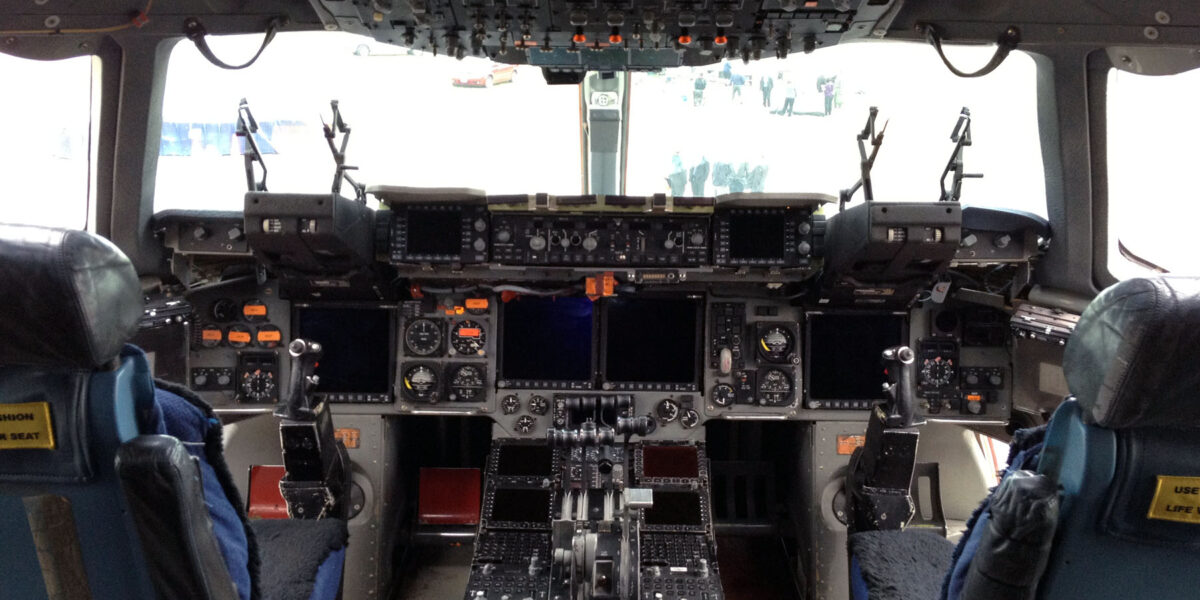
Want to know what it’s actually like inside a C-17 Globemaster III? Let me walk you through it, from the cargo hold to the cockpit, because this aircraft is a lot more complex than most people realize.
I’m not just talking about dimensions and specs here. I mean what it actually feels like to work inside this airplane, where everything is located, and how the interior is designed to accomplish the mission.
Let’s start at the back and work our way forward.
The Cargo Ramp and Door
The first thing you notice about the C-17 is the massive cargo door at the rear. Actually, it’s two parts—a ramp and a door above it—but they work together as one integrated system.
The ramp is 65 inches wide (that’s the full width of the cargo compartment minus a few inches on each side for the hydraulic mechanisms). When it’s lowered, it extends about 10 feet behind the aircraft and can support up to 36,000 pounds of rolling stock. That’s enough to drive an M1 Abrams tank onto the aircraft.
The ramp operates hydraulically and can be positioned at various angles. For loading cargo, you typically lower it all the way to the ground. For airdrop operations, you might set it to a specific angle. For in-flight operations with the ramp partially open, there are specific positions that maintain aerodynamic stability.
Above the ramp is the cargo door, which is essentially a continuation of the fuselage. When both are closed, they seal together to create the pressurized cargo compartment. When both are open, you’ve got a massive opening that allows you to load oversized cargo or conduct airdrop operations.
The door and ramp can be opened in about 30 seconds, though you usually take a bit longer to ensure everything’s operating correctly. You can open and close them on the ground or in flight (within certain speed and altitude limits).
Standing at the open ramp while the aircraft is flying is an unforgettable experience. The noise is incredible—jet engines and wind create a roar that makes communication without headsets impossible. The view is spectacular, especially during low-level tactical flying.
The Cargo Compartment
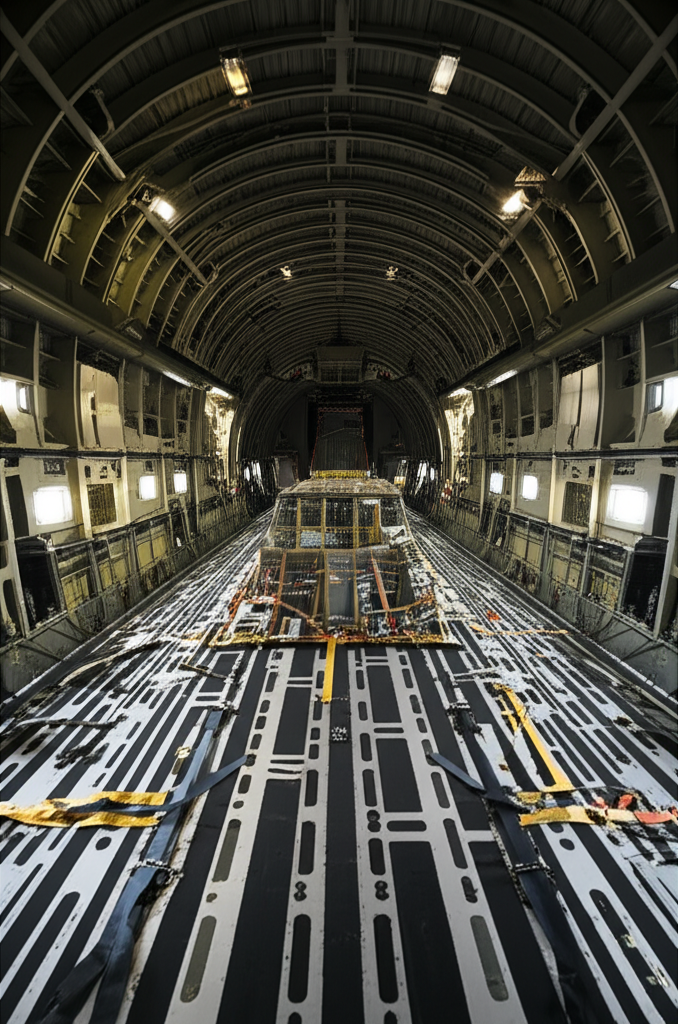
The cargo hold is where the magic happens. This is the largest section of the aircraft, and it’s designed to carry an enormous variety of cargo.
The dimensions are 88 feet long, 18 feet wide, and 12.4 feet high. That might not sound huge, but it’s deceptively spacious. You can fit three rows of standard 463L military cargo pallets (the standard 88″ x 108″ pallets used across the military logistics system). You can carry up to 18 pallets in a full load configuration.
The floor is aluminum and rated to handle extremely heavy loads. The floor has a built-in cargo handling system with rollers and locks spaced throughout. These allow you to move heavy pallets using minimal effort—you release the locks, and the pallets roll on the embedded rollers. Lock them back in place, and the cargo won’t move no matter what the aircraft does.
The tie-down rings are located throughout the floor and on the side walls. These rings can handle 25,000 pounds each, and you’ll use them constantly to secure cargo with chains, straps, and nets.
The cargo compartment isn’t climate-controlled in the traditional sense. There’s heating and ventilation, but it’s not comfortable like a passenger cabin. In flight at altitude, it’s cold—really cold. Loadmasters wear flight suits and layers because even with the heating system running, you can see your breath. On the ground in the desert, it’s hot. The temperature is dictated by whatever environment you’re operating in, plus or minus the effects of the ventilation system.
The lighting in the cargo compartment can be configured for different situations. Normal white lights for regular operations. Red lights for night operations to preserve night vision. Blackout mode for tactical situations where you don’t want any light visible from outside the aircraft.
The walls aren’t smooth—they’re covered with attachment points, stowage compartments, and equipment. There are fire extinguisher bottles, tie-down equipment storage, and various panels that provide access to systems and components.
Probably should mention that the noise level in the cargo compartment is substantial even with the door closed. You’re sitting between four massive jet engines, and the sound is constant. Everyone wears hearing protection, and you communicate via intercom headsets.
The Paratroop Doors
On each side of the fuselage, about two-thirds of the way back, are the paratroop doors. These are smaller doors (roughly 6 feet tall and 4 feet wide) that open outward to allow paratroopers to jump during airborne operations.
When configured for paratroop operations, you’ll install jump platforms that extend slightly outside the doors. Paratroopers line up in sticks (rows), hook their static lines to the overhead cable, and exit through these doors when the green light comes on.
The paratroop doors can also be used for personnel to enter/exit the aircraft on the ground when the main cargo door is closed. They’re equipped with built-in stairs that fold down.
During airdrop operations, the loadmaster positions themselves near these doors to monitor the paratroopers as they exit and to ensure the jump is conducted safely. It’s one of the more intense parts of the job—you’re responsible for ensuring dozens of people successfully exit a moving aircraft at 800 feet above the ground.
The Overhead Systems
Look up in the cargo compartment and you’ll see a forest of equipment and systems running the length of the ceiling.
The airdrop rails are the most prominent feature. These are heavy-duty rails that run the length of the cargo compartment, and they’re used for rigging cargo for airdrop. You attach extraction chutes or heavy equipment platforms to these rails, and when it’s time to drop, the cargo slides along the rails and out the back of the aircraft.
There’s also the static line cables for paratroopers. When jumpers hook up their static lines, they’re attaching to cables that run overhead. As they exit the aircraft, the static line pulls their parachute deployment bag open.
The oxygen system lines run overhead as well. Portable oxygen bottles can be connected to these lines to provide breathing oxygen for passengers during high-altitude flights.
Various other systems—electrical conduits, hydraulic lines, pneumatic lines—all run through the overhead area. Most of this is hidden behind panels, but you’ll see access points throughout.
The intercom boxes are mounted overhead at various positions. These allow the loadmaster to plug in their headset and communicate with the pilots and other crew members from anywhere in the cargo compartment.
The Crew Entry Door and Galley
Forward of the cargo compartment on the left side is the crew entry door. This is the normal entry point for the crew when the cargo door is closed.
Built-in stairs extend from the door, making entry and exit easy. This door can be opened and closed quickly, and it’s used constantly during ground operations.
Just inside the crew door is the galley area. “Galley” is a generous term—it’s basically a small compartment with a microwave, a coffee maker, and some storage for crew meals and supplies. On long missions, this area sees a lot of use. There’s nothing quite like microwaved airline-style meals at 35,000 feet, but it beats being hungry.
There’s also a lavatory nearby. It’s small (aircraft lavatories always are), but it’s functional and necessary on missions that can last 15-20 hours.
This forward area also has some bunk spaces for crew rest on ultra-long missions. The bunks are basic—essentially padded shelves with curtains for privacy—but they allow crew members to sleep in shifts during extended missions. You won’t get quality sleep on a crew bunk with jet noise and turbulence, but you can get enough rest to remain functional.
Passenger Seating
The C-17 can be configured to carry passengers in addition to or instead of cargo. The seating system uses deployable seats that fold down from the side walls.
The seats are rear-facing (this is safer in the event of a crash or hard landing). They’re not comfortable by airline standards—they’re basic web seats with minimal padding. But they work, and you can seat over 100 passengers in a full configuration.
For mixed cargo and passenger loads, you configure part of the cargo compartment for pallets and part for passengers. This flexibility is one of the C-17’s greatest strengths.
Passengers don’t get the same pressurization comfort as the crew. The cargo compartment is pressurized, but not to the same degree as the cockpit. You’ll feel altitude changes more noticeably, and your ears will pop more frequently.
The Cockpit
Let’s move forward to where the pilots work. The C-17 cockpit is modern, spacious, and packed with technology.
The layout is a standard side-by-side configuration. The pilot sits in the left seat, the copilot in the right seat. Unlike the C-5, which requires flight engineers, the C-17 is a two-pilot aircraft. Automation and integrated systems eliminate the need for a flight engineer.
The instrument panels are dominated by multi-function displays. The C-17 uses a glass cockpit with digital screens rather than analog gauges. You’ve got primary flight displays showing attitude, altitude, airspeed, and navigation information. Multi-function displays can show engine parameters, systems status, tactical information, maps, or whatever the pilots need to see.
The heads-up display (HUD) is mounted in front of each pilot. This projects flight information onto a transparent screen, allowing pilots to see critical data while looking forward out the window. For tactical approaches, night operations, or low-level flying, the HUD is invaluable.
The throttles are located on the center console between the pilots. Each of the four engines has its own throttle lever, though they’re typically operated together. The throttles have various detents and features that make precise power control possible.
The yoke (control wheel) is traditional—pull back to pitch up, push forward to pitch down, turn left or right to bank. The C-17 has fly-by-wire controls, meaning there’s no direct mechanical linkage between the yoke and the control surfaces. Computers interpret the pilot’s inputs and move the flight controls electronically. This allows for features like automatic stall protection and envelope protection.
The autopilot system is sophisticated. It can handle everything from basic altitude and heading hold to fully automated approaches and landings. The autothrottle can maintain specific airspeeds or power settings.
Overhead, there’s a panel with circuit breakers, light controls, and various system switches. This is where you’ll find controls for the anti-ice systems, fuel management, hydraulics, and other critical systems.
The center console has the radio controls, navigation controls, and other communication systems. Modern avionics mean you’re managing multiple radios, data links, and communication systems simultaneously.
Visibility from the cockpit is excellent. Large windows provide good forward and side visibility. For landing on tactical runways or narrow strips, this visibility is crucial.
There’s also a jump seat behind the pilots for observers, instructors, or the loadmaster when they need to coordinate with the flight deck.
The Loadmaster Station
The loadmaster has a dedicated crew station in the cargo compartment, typically located on the left side about midway back.
The loadmaster panel is where you control many of the cargo compartment functions. You can operate the cargo door and ramp from here. You can control the lighting in the cargo compartment. You can monitor the intercom and communicate with the pilots and ground crew.
There’s also a computer terminal at the loadmaster station. This is used for load planning calculations, accessing technical orders, and managing cargo documentation. The computer can calculate weight and balance, determine center of gravity, and ensure the aircraft stays within limits.
During airdrop operations, the loadmaster has controls for the airdrop systems. You can arm and release cargo extraction systems, control the timing of drops, and monitor the status of the airdrop equipment.
The loadmaster station has a seat, though you won’t spend much time sitting during actual cargo operations. Most of the job involves moving around the cargo compartment, checking tie-downs, supervising loading, and preparing cargo for airdrop.
There’s also emergency equipment nearby—additional fire extinguishers, emergency oxygen, and safety equipment specific to the loadmaster’s responsibilities.
The Avionics Bay
Below the cockpit floor is the avionics bay. This isn’t normally accessible in flight, but it’s an important part of the aircraft.
This compartment houses most of the aircraft’s electronic systems—navigation computers, communication radios, radar systems, and the various computers that make the C-17 function. It’s temperature-controlled because electronics generate heat and are sensitive to temperature extremes.
Maintenance technicians access this area on the ground for troubleshooting and repairs. As a crew member, you typically don’t go down there unless something’s wrong and maintenance needs help diagnosing an issue in flight.
External Access Points
The aircraft has numerous external access panels for maintenance. The engines have cowlings that open to allow access to internal components. The landing gear bays have doors that open for inspection and servicing.
There’s also the refueling receptacle on the top of the fuselage, just behind the cockpit. The C-17 can receive fuel from KC-135, KC-10, or KC-46 tankers during flight. The boom receptacle is operated by the copilot, who uses controls in the cockpit to open and close it.
Wing and Engine Layout
While technically external, the wing and engine configuration affects the interior experience.
The C-17 has four engines mounted on pylons beneath the wings. This configuration keeps the engines away from the fuselage, which reduces noise and vibration inside the cargo compartment (though it’s still loud—just not as loud as it could be).
The high-wing configuration means the cargo floor is relatively low to the ground. This makes loading and unloading easier—you can back vehicles up the ramp without extreme angles, and forklifts can drive on and off with minimal difficulty.
The wings also house the fuel tanks. Total fuel capacity is approximately 180,000 pounds, stored in multiple tanks throughout the wing structure. Fuel management is handled automatically by the aircraft’s systems, though pilots can manually control fuel transfer if needed.
Living in the Space
So what’s it actually like to work inside a C-17 for hours at a time?
The noise is the first thing that strikes people. Even with the best hearing protection, you feel the engines as much as hear them. The constant roar becomes background noise eventually, but it’s always there.
The vibration is constant but not excessive. You feel every power change, every turn, every bit of turbulence. After a while, you learn to interpret the vibrations—you can tell when the pilots are making power changes or when the aircraft is banking just by the feel.
Temperature management is an ongoing challenge. At altitude, it’s cold. The heating system helps, but you’re still going to want layers. On the ground in hot climates, it’s sweltering until you get airborne. You learn to dress in layers and adjust constantly.
The cargo compartment is functional, not comfortable. Everything is metal, aluminum, or heavy-duty fabric. There’s no sound insulation beyond what’s structurally necessary. Comfort wasn’t a design priority—functionality was.
Long missions become a test of endurance. Your back hurts from the basic seating. Your ears ring despite hearing protection. You’re tired from the constant noise and vibration. But you adapt, and experienced loadmasters can sleep on the cargo floor during cruise portions of missions.
The sense of space is interesting. The cargo compartment feels enormous when it’s empty. But load it full of pallets, and suddenly it feels cramped. Navigation through a fully loaded cargo compartment means squeezing between pallets and ducking under tie-down straps.
Safety Features
The interior is designed with safety in mind throughout.
Fire detection and suppression systems are installed in the cargo compartment, cockpit, engines, and avionics bay. Fire extinguisher bottles are strategically placed, and the crew is extensively trained in fire-fighting procedures.
Emergency oxygen systems provide breathing oxygen if cabin pressurization is lost. Walk-around oxygen bottles are located throughout the cargo compartment, allowing crew members to move around while breathing supplemental oxygen.
Emergency exits include the main cargo door, the crew entry door, the paratroop doors, and emergency hatches in the cockpit. In an emergency, there are multiple ways to exit the aircraft quickly.
The cargo restraint system is designed to handle extreme forces. Even in the event of hard landings or severe turbulence, properly secured cargo should remain in place. The tie-down rings and floor locks are engineered with massive safety factors.
Lighting is designed with redundancy. If the main electrical system fails, emergency lighting automatically activates to allow crew members to see well enough to conduct emergency procedures and evacuate if necessary.
Combat Modifications
C-17s can be equipped with additional defensive systems for operations in threat environments.
Chaff and flare dispensers can be installed to defend against missile threats. These systems eject countermeasures that confuse heat-seeking or radar-guided missiles.
The aircraft can be equipped with missile warning systems that detect incoming threats and provide alerts to the crew.
Additional armor protection can be installed in certain areas to protect crew members and critical systems from ground fire.
These modifications aren’t installed on all aircraft all the time—they’re added as mission requirements dictate. A C-17 flying routine cargo missions between secure bases won’t have these systems, but one supporting combat operations in contested airspace will.
Unique Features
A few things make the C-17 interior distinctive compared to other cargo aircraft.
The ability to carry such diverse cargo types is notable. Palletized cargo, rolling stock, helicopters, troops, medical patients, humanitarian supplies—the C-17 handles all of it. The interior can be reconfigured relatively quickly to support different mission types.
The tactical capability combined with strategic capacity is unusual. Most cargo aircraft are either tactical (like the C-130) or strategic (like the C-5). The C-17 genuinely does both, and the interior design supports this flexibility.
The crew-friendly aspects are better than older aircraft. The cockpit ergonomics, the crew rest facilities, the galley—these weren’t priorities in earlier cargo aircraft designs. The C-17 was designed with the recognition that crew comfort and capability are linked.
The integration of modern technology throughout is evident. Digital displays, advanced avionics, automated systems—the C-17 feels contemporary in a way that older cargo aircraft don’t.
Maintenance Accessibility
The interior is designed to be maintained. Access panels are located throughout, allowing technicians to reach components without extensive disassembly.
The modular design of many systems means components can be swapped out relatively quickly. A failed display unit? Remove a few screws, disconnect the cables, install a new unit. This reduces downtime and keeps the aircraft mission-capable.
Diagnostic systems are integrated throughout. When something fails, the aircraft’s computers often can identify the problem and guide maintenance personnel to the specific failed component.
This maintainability was a design goal from the beginning. Previous cargo aircraft were notorious for requiring extensive maintenance downtime. The C-17 was engineered to spend more time flying and less time broken.
The Experience
Walking through a C-17 from the cargo ramp to the cockpit, you get a sense of how every inch is purposeful. Nothing is wasted. Every system, every control, every feature exists to support the mission.
It’s not glamorous. The interior is industrial, functional, and built for durability rather than aesthetics. But there’s a beauty in that functionality. Every rivet, every panel, every component is there for a reason.
For the crews who work in this aircraft, the interior becomes familiar to the point of being invisible. You stop noticing the noise, the vibration, the Spartan accommodations. You focus on the mission—loading cargo, planning drops, coordinating with ground crews, ensuring safe operations.
But every so often, usually when you’re standing at the open ramp watching the sunset from 25,000 feet or when you’re landing on a dirt strip in some remote location, you remember that you’re working inside a pretty incredible machine.
The C-17 interior isn’t comfortable, quiet, or luxurious. But it’s capable, versatile, and designed to accomplish missions that few other aircraft can handle. And that’s exactly what it needs to be.

Subscribe for Updates
Get the latest c-17 pilot updates delivered to your inbox.
We respect your privacy. Unsubscribe anytime.