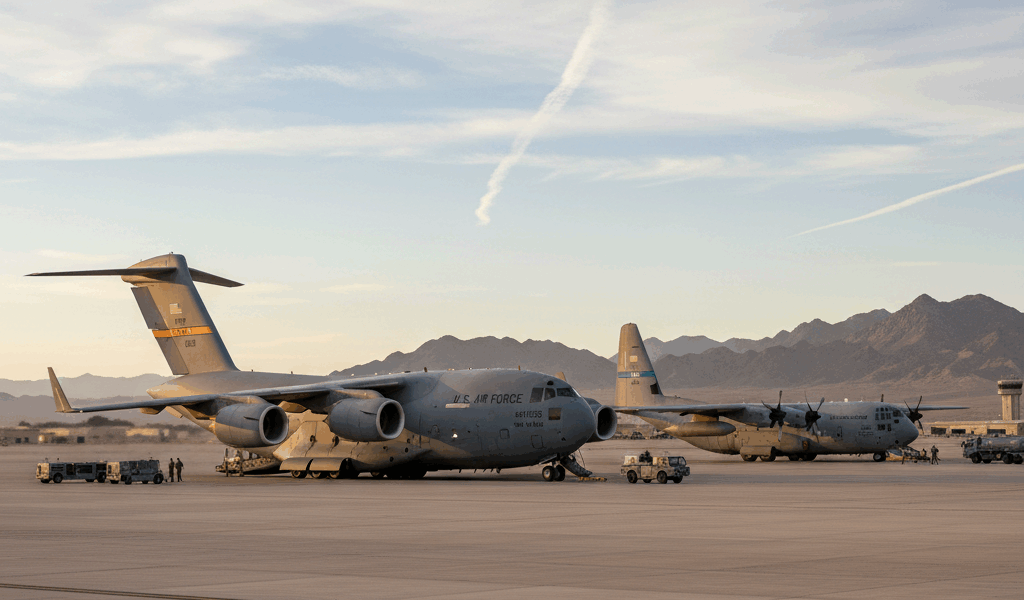
Why C-130 Pilots Make Great C-17 Pilots (And Vice Versa)
In Air Mobility Command, two aircraft dominate the tactical airlift conversation: the C-130 Hercules and the C-17 Globemaster III. Pilots often transition between them—sometimes voluntarily, sometimes based on assignment needs. But what does that transition actually involve? And why do C-130 pilots often excel in the C-17 (and vice versa)?
This deep-dive explores the transition process, the skills that transfer, and the adjustments pilots must make when switching between these iconic aircraft.
The Aircraft: A Brief Comparison
| Characteristic | C-130 Hercules | C-17 Globemaster III |
|---|---|---|
| Crew Size | 5-6 (2 pilots, navigator, flight engineer, 2 loadmasters) | 3 (2 pilots, 1 loadmaster) |
| Max Payload | ~45,000 lbs | ~170,000 lbs |
| Flight Controls | Hydraulic-boosted, mechanical reversion | Fly-by-wire |
| Cruise Speed | ~290 knots | ~450 knots |
| Range (max payload) | ~2,000 nm | ~2,400 nm |
| Engines | 4 turboprops | 4 turbofans |
Why Pilots Transition
Pilots move between aircraft for various reasons:
- Career progression: Different aircraft offer different opportunities for advancement
- Assignment availability: You go where the Air Force needs you
- Personal preference: Some pilots want the tactical focus of the C-130, others want the global reach of the C-17
- Base location: C-130s and C-17s are stationed at different locations
- Mission variety: Seeking new challenges and experiences
What Transfers Between Aircraft
The good news: much of what makes a good C-130 pilot also makes a good C-17 pilot.
Skills That Transfer Directly
Tactical mindset: C-130 pilots are trained to think tactically—assault landings, austere airfields, contested environments. This mindset is essential in the C-17, which despite its size, is designed for similar missions.
Crew resource management: Both aircraft demand effective crew coordination. C-130 pilots are accustomed to working with multiple crew members; C-17 pilots work with a smaller crew but similar principles apply.
Airdrop operations: The fundamentals of personnel and cargo airdrop are consistent between aircraft. Timing, altitude, and coordination skills transfer well.
Formation flying: Both aircraft conduct formation operations. Basic formation skills learned in one apply to the other.
Adverse weather operations: Neither aircraft sits on the ground waiting for perfect weather. The judgment required to operate in challenging conditions transfers directly.
Skills That Require Adjustment
Speed and energy management: The C-17 cruises 160 knots faster than the C-130. Approaches happen faster. Energy management requires recalibration.
Automation management: The C-17’s glass cockpit and fly-by-wire system are generations ahead of most C-130 variants. New pilots must learn to manage, not fight, the automation.
Physical feel: C-130 pilots develop an intimate feel for the aircraft through mechanical controls. The C-17’s fly-by-wire provides less tactile feedback, requiring pilots to rely more on instruments.
Workload distribution: Without a navigator and flight engineer, C-17 pilots handle more responsibilities. Former C-130 pilots must adjust to a leaner crew.
The Transition Training Program
C-130 to C-17 Transition
For experienced C-130 pilots transitioning to the C-17, training typically includes:
- Ground school: 3-4 weeks covering C-17 systems, procedures, and limitations
- Simulator training: 50-60 hours learning the aircraft and its automation
- Aircraft flights: 10-15 flights demonstrating proficiency
- Mission qualification: Additional training for specific mission sets
Total time: approximately 4-5 months
Experienced mobility pilots typically progress faster than ab initio students because they understand airlift operations. The challenge is unlearning C-130-specific habits and adapting to a larger, faster, more automated aircraft.
C-17 to C-130 Transition
Moving from C-17 to C-130 presents different challenges:
- Ground school: 4-5 weeks on C-130 systems (more complex in some ways due to older technology)
- Simulator training: 40-50 hours (C-130 sims vary by variant)
- Aircraft flights: 15-20 flights
- Mission qualification: Varies by unit and mission
C-17 pilots moving to the C-130 must learn to fly without the automation safety net. The workload feels higher because it is—tasks the C-17 handles automatically require manual attention in the C-130.
Common Transition Challenges
For C-130 Pilots Moving to C-17
Over-controlling: The C-17’s fly-by-wire is more responsive than the C-130’s cable-and-hydraulic system. Former C-130 pilots often make larger inputs than necessary.
Solution: Relax. The C-17 requires light, gentle inputs. Let the aircraft do the work.
Trusting the automation: C-130 pilots are hands-on by nature. The C-17’s autopilot and autothrottle can feel like giving up control.
Solution: Learn when automation helps and when to fly manually. Both have their place.
Speed management: Everything happens faster. The visual picture changes more rapidly. Decisions can’t wait as long.
Solution: Think ahead. Brief approaches earlier. Plan for the pace.
For C-17 Pilots Moving to C-130
Increased workload: Tasks the C-17 handles automatically require manual attention. Fuel management, navigation, and systems monitoring demand more direct oversight.
Solution: Develop new habit patterns. Chair fly procedures until they’re automatic.
Slower everything: Cruise speed, climb rate, mission tempo—everything takes longer. This can be frustrating initially.
Solution: Embrace the C-130’s deliberate pace. It offers opportunities for precision that the C-17’s speed sometimes prohibits.
Propeller management: The C-130’s turboprops require understanding of prop RPM, condition levers, and techniques foreign to pure jet pilots.
Solution: Study the propulsion system thoroughly. It’s different, not harder.
Why Each Aircraft’s Pilots Make Good Transitions
Why C-130 Pilots Excel in the C-17
Tactical foundation: C-130 pilots understand dirt strips, assault zones, and the mindset required for austere operations. They don’t see the C-17’s size as a limitation.
Workload management: Having operated with larger crews, former C-130 pilots appreciate the C-17’s streamlined operations while understanding what systems require attention.
Mission focus: C-130 pilots are mission-oriented. They want to get the cargo where it needs to go, conditions be damned. This attitude serves them well in the C-17.
Why C-17 Pilots Excel in the C-130
Systems understanding: C-17 training emphasizes deep systems knowledge. This foundation helps when learning the C-130’s different but equally complex systems.
Precision flying: The C-17’s fly-by-wire teaches precise control. This precision translates to smooth, controlled C-130 flying.
Global perspective: C-17 pilots are accustomed to worldwide operations—different regulations, varied environments, complex airspace. This experience benefits C-130 operations anywhere.
Career Considerations
Both aircraft offer excellent career paths, but they’re different:
C-130 career path:
- More tactical, expeditionary focus
- More variants and mission specializations
- Smaller units often mean faster leadership opportunities
- Special operations variants offer unique career options
C-17 career path:
- Strategic and tactical airlift missions
- Larger units with more structure
- Global reach missions are standard
- Aeromedical, airdrop, and air refueling missions
Neither path is “better”—they’re different tools for different missions.
The Pilot Perspective
We asked pilots who’ve flown both aircraft to share their thoughts:
“Flying the C-130 made me a better pilot. Flying the C-17 made me a better officer. The C-130 forces hands-on proficiency. The C-17’s complexity develops decision-making skills.” — Lieutenant Colonel with 2,000+ hours in each aircraft
“I missed the C-130’s direct connection to the aircraft when I moved to the C-17. But I don’t miss cruise speeds of 250 knots on a 12-hour mission.” — Major, former C-130 pilot
“The C-130 taught me to fly. The C-17 taught me to think. Both are essential for the complete mobility pilot.” — Captain, currently flying C-17s
The Bottom Line
Whether you’re a C-130 pilot looking at the C-17, or a C-17 pilot curious about the Hercules, the transition is absolutely achievable. The skills you’ve developed in one aircraft provide a solid foundation for the other.
The mobility community values pilots who understand multiple platforms. Each aircraft teaches something different, and pilots who’ve flown both bring broader perspectives to every mission.
Great pilots can fly anything. The transition between the C-130 and C-17 proves that airlift fundamentals transcend specific airframes.
Subscribe for Updates
Get the latest articles delivered to your inbox.
We respect your privacy. Unsubscribe anytime.